Monday, May 3, 2010

Three Days Left Before the British Elections

Summary: A recap of the UK campaign and predictions for the new Parliament.

What a wild ride the British election has been.


Before the year began, it was widely expected that the Conservative Party would win the elections, making their leader - David Cameron - the next Prime Minister.

By March, however, the Conservative victory was considerably less certain. It seemed entirely possible that the Labour Party - the current governing party - could retain power or cling on to enough seats for a hung Parliament.

Then Prime Minister Gordon Brown - the leader of the Labour Party - asked the Queen to dissolve Parliament and hold a general election on May 6 (the usual way elections work there). That gave the parties and politicians about a month to campaign.

Nobody could have predicted what happened next.

The ultimate game changer came the night of the first ever leaders debate between Cameron, Brown, and Nick Clegg, the leader of the Liberal Democrats (a sort of moderate libertarian party).


According to polls released the next day, Clegg won the debate - in fact, he dominated compared to the leaders of what he called “the old parties” - and support for the Lib Dems actually surpassed support for Labour for the first time since the inception of the third party.


So for the past few weeks, the consensus prediction has been a hung Parliament.

Before I go any further, let me explain a few terms in British politics.

• Government = majority party (the leader becomes Prime Minister and forms a cabinet which controls the administrative business of the country)

• Opposition = minority parties

• Hung Parliament = no clear majority, either the party with a plurality forms a minority government or two parties can form a coalition (last hung Parliament was in 1974, the last coalition government - I believe - was about 150 years ago).

• Tories = nickname for the Conservatives

• Marginal constituencies = swing districts (for example, a “Labour marginal” refers to a swing seat currently held by the Labour Party).

• Colors = Labour is red, Conservative is blue, Lib Dem is yellow

There have since been two more debates, and not a whole lot has changed. Brown has still struggled to connect with voters, Clegg has continually pushed the “old parties” line, and Cameron has failed to inspire his base, instead opting to appear like a reasonable choice to undecided voters.

To Brown’s credit, he did better in the debates than people give him credit for. He stuck to the talking points, sounded authoritative, and won on the one-liners (which is huge in debates).

To Cameron’s credit, the Tories are doing better in the polls today than they were two weeks ago, and people are finally beginning to think there could be a Conservative government again.

Finally, to Clegg’s credit, he’s doing everything right. He’s even convincing Labour supporters in some Tory marginals to choose the Lib Dems because they’re more likely to win there.

So what will the results of Thursday’s election be?

Because the make-up of Parliament is decided with single-member districts and first-past-the-post elections, the Liberal Democrats won’t actually do as well as the polls suggest. Simply put, the marginals aren’t there for them.

They will, however, increase the number of seats they hold by quite a bit. Currently they hold 62 seats. That could almost double.

The Tories, meanwhile, are expected to pick up about 90 to 110 seats, bringing their total to something between 295 and 320. Labour will probably lose quite a few, possibly more than 130 seats.

First, Ladbrokes has a very cool interactive map with rolling predictions. They’re currently predicting a hung Parliament, with the Tories short of a majority by 10 to 15 seats.
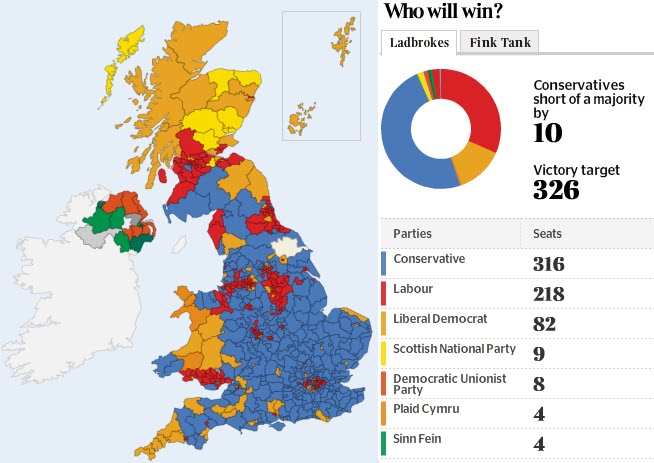

If I was a betting man, however, I’d rely more on the predictions made by FiveThirtyEight.com. They’ve been following the race more closely than I have (and probably closer than most Brits have) and they’ve developed a prediction model that finds the Tories could be short of a majority by more than 25 seats. They also find that Labour will be worse off than Ladbrokes does, and believe the Lib Dems will pick up 58 seats, rather than 20.

While these are by no means conservative estimates for the Conservatives (pun intended) FiveThirtyEight has an amazing track record when predicting election outcomes.

So what happens next?

I see two possible outcomes of this election. They both involve a hung Parliament.

1) The Conservative Party forms a minority Government. This is the view many in the UK are taking at the moment. If this happens, then Cameron will be on very shaky ground as Prime Minister. He will have a tougher time with Parliament, his own party, and the British people than President Obama is having with all the American equivalents.

2) The Labour Party forms a coalition government with the Liberal Democrats. Frankly, while these two parties don’t get along, they’re far more ideologically similar than either is with the Tories. Power sharing won’t be easy, but they may find it necessary. They may also want to court the Scottish Nationalist Party and Plaid Cymru (Welsh nationalists) for the coalition.

Either way, it’s been a fun and exciting election to observe, and I can’t wait for Thursday. Next week we’ll recap what happened and discuss what we’ll likely see in the coming weeks.

In the meantime, you might be wondering what party you’d support if you were British. The Daily Telegraph has a good online quiz to help you figure that out. Take a look!

Wednesday, April 28, 2010

Achieving Marriage Equality, One Campaign at a Time

Summary: A New York State Senate race characterizes the national debate over gay marriage.

For years now, the debate over gay marriage has been a defining issue of the modern civil rights push. For years liberals and moderates pushed back against a GOP agenda that sought to ban the unorthodox arrangement in the U.S. Constitution, as well as in several state constitutions.

Today, liberals are fighting back, and over 40% of Americans believe in total marriage equality. A majority of Americans now believe that, at the very least, gays and lesbians should have the right to form a civil union.

Yet to date, only one referendum banning gay marriage has failed to pass. It happened in Arizona in 2006, where a similar ballot measure was passed in 2008.

After seeing what happened in these states - though especially California and Maine - in recent years, gay rights activists have realized the importance of political campaigns.

Yet referendum campaigns should not be the only area of focus. Recently, full marriage equality was achieved in Vermont and New Hampshire when their State Legislatures passed bills allowing gay marriages.

In New York, however, the dream fell short.

Although the New York State Assembly passed two gay marriage bills with bipartisan approval, the legislation fell 7 votes short in the State Senate. Democrats controlled the chamber, but many of them voted with the anti-marriage Republicans in the upper house.

Now some of those Democrats are feeling the heat.

From the New York Times:

“…gay rights groups, which have become major financial players in state politics, wanted to know which senators they should back in the future and which ones to target for defeat.

Alan Van Capelle, executive director of the Empire State Pride Agenda, New York’s largest gay rights group, hinted that senators who voted against the bill on Wednesday could face repercussions. And Christine C. Quinn, the New York City Council Speaker echoed that sentiment, saying, ‘Anybody who thinks that by casting a no vote they’re putting this issue to bed, they’re making a massive miscalculation.’”

Enter State Senate District 10, a sprawling district in south Queens. Here the residents of the Jamaica, Springfield Gardens, and Brookville neighborhoods are represented by State Senator Shirley Huntley - one of the eight Democrats who opposed the marriage equality bill.

To be sure, Queens is not the place a politician should oppose gay marriage. The borough elected two openly gay City Council members last year and it’s a hot bed of gay rights advocacy in New York. Needless to say, gay rights activists are calling for Huntley’s defeat.

And she may have a formidable opponent. Lynn Nunes, a local politician, has been exploring a challenge to Huntley following her vote on gay marriage. Although he is not gay himself, Nunes is a strong supporter of marriage equality.

Additionally, Nunes is a strong candidate. Last year he was just barely edged out of a City Council race - by literally 4 votes - against a popular two-term incumbent. The race gave him the opportunity to build political contacts and a base of support for future campaigns - such as State Senate.

What Nunes needs now is support from the gay rights community.

The late U.S. House Speaker Tip O’Neil will be remembered for many things, but for campaign people like us he will be remembered most for some of the most important words in our profession…

“All politics is local.”

In order to achieve marriage equality across America, pro-marriage advocates need to build momentum on a state-by-state basis. In New York, gay marriage is only a few votes shy of reality in the State Senate. Gay rights activists need to focus on the handful of State Senate races that will change the state’s laws.

What better place to start the march towards full equality than on the streets of south Queens?

Monday, April 19, 2010

Midterm Money: What the Fundraising Figures Are Telling Us

Summary: Mixed results for Democrats and Republicans should make for an interesting year.

Two weeks ago we noted how the campaign finance reports for the first quarter of 2010 would be something to watch when thinking about how this year’s midterm elections will shape up.

Well, the numbers are coming in. What do they tell us?

Democrats Are Falling Behind

Republican challengers in ten of the most competitive Democratic seats have outraised the incumbents. A few of them weren’t just edged out by the GOP candidates, they were crushed.

From Politico:

Democratic Reps. Mary Jo Kilroy of Ohio, Frank Kratovil of Maryland, Gabrielle Giffords of Arizona, Ron Klein of Florida, Carol Shea-Porter of New Hampshire, Harry Teague of New Mexico, Jerry McNerney of California, Larry Kissell of North Carolina and John Hall and Michael Arcuri of New York were all outraised by GOP candidates running against them.

For some of the incumbents, the financial disparity was stark. Arcuri raised just $208,000 in the first three months of the year – about $150,000 less than challenger Richard Hanna brought in over the same period. Teague, who has the capacity to put some personal resources into the race, brought in $134,000 to former GOP Rep. Steve Pearce's $278,000.

Still, others were only edged out, and for the most part the Democratic incumbents still retain the advantage in cash-on-hand. Besides, I personally have worked on campaigns in which an incumbent lost the first quarter fundraising contest and still won in November.

Democrats Are Ahead of the Game

Despite the dire forecast for Democrats made by Politico, other targeted Democrats did particularly well last quarter. Reps. Tom Perriello (D-VA), Betsy Markey (D-CO), and Alan Grayson (D-FL) all raised over $500,000 from early January to late March, bringing each of the war chests to over a million dollars.

Sen. Harry Reid (D-NV) raised nearly $2 million, bringing his cash-on-hand to an incredible $9.4 million - something unheard of in a state with such a small population.

Raising money is always easier for incumbents - it’s one of the so called “powers of incumbency.” And it’s a lot easier when the President of the United States is on your side.

From the Los Angeles Times:

With midterm elections looming, President Obama is raising campaign money at a ferocious pace, tapping into an energized corps of Democratic donors.

Obama trailed his predecessor, George W. Bush, in the amount of money raised 13 months into their tenures ($32 million to $53 million), but had more than twice the number of fundraising appearances (33 to 13) compared with Bush…

… Polls show Obama enjoys less popular support than he had when he took office 15 months ago. Yet his fundraising prowess shows that he remains a powerful political force who can stockpile chits from grateful Democratic candidates eager for his help.

Meanwhile, Democratic challengers have outraised at-risk GOP Representatives Joseph Cao (R-LA) and Dan Lungren (R-CA).

However, it’s important to remember that despite the good news, it’s still going to be a tough year for Democrats.

According to Reuters:

The Center for Responsive Politics, a nonpartisan watchdog group that tracks money in politics, says Democrats received about 57 percent of all campaign donations in the current election cycle as of December 31. By contrast, Republicans claimed about 62 percent of campaign donations just before they lost control of Congress in 2006.

Questions That Need Answers

In our last post on fundraising, we also posed three questions to keep in mind when reviewing the campaign finance figures.

Who is winning and losing on health care reform? Will the RNC’s woes be another Republican’s gain? And how will the Citizens United case play a role?

First, it would appear Democrats are winning on health care reform. Even if it hurts some particular Democratic campaigns, the DNC saw a huge spike in fundraising once the overhaul passed - and that money can filter down to the at-risk incumbents.

Second, it is not yet obvious that the RNC’s frequent PR problems have shifted money to individual Republican campaigns, although the RNC did fall behind yet again in fundraising.

Third, the impact of the Citizens United decision has not yet been seen at all. However, it is likely that we’ll see more on that front in the coming months.

Monday, April 12, 2010

A Bad Week for Democrats

When healthcare reform passed, Democrats were convinced their troubles were over. No more worrying about the midterms - Republicans won’t be able to win on a message of repeal. No more worrying about a disaffected base - we’ve accomplished something that generations of politicians have strived to accomplish.

Except you wouldn’t know it last week.

New Gallup polls find the image of the Democratic Party at a record low, the GOP tying on the generic ballot, and President Obama’s approval rating was down considerably.

The outlook for incumbents is especially bad right now. Only 49% of Americans said they believe their member of Congress deserves to be re-elected - that’s lower than when the question was asked in both 1994 and 2006.

Then there are the retirements. Rep. Bart Stupak (D-MI) announced he would be stepping down, leaving his conservative northern Michigan seat open in a Republican year.

Then Supreme Court Justice John Paul Stevens announced his intention to retire, leaving the President with the task of choosing a replacement - a task that will no doubt give Republicans a great political opportunity to characterize Democrats as “judicial activists” trampling on the Constitution.

Overall, things look about as bad as they can look for Democrats in the House. The new 2010 model by political scientist Alan Abramowitz projects a 37-seat swing for the GOP.


On the Senate side, things don’t look much better . CQ Politics is predicting eight seats will be toss-ups this year - four of which are Democratic - most of which with polling that suggests GOP take-overs. Arkansas - currently represented by Democrat Blanche Lincoln - is now in the “leaning Republican” column, while North Dakota - currently represented by Democrat Byron Dorgan - is considered a “solid” Republican seat now.

Even in Wisconsin - considered a “solid” Democratic seat - incumbent Democrat Russ Feingold is facing a competitive challenge by Real Estate developer Terrance Wall, with former (and popular) Governor Tommy Thompson and former Wisconsin Secretary of Commerce (and well-known beer family heirloom) Dick Leinenkugel considering their own bids.

Despite all of these setbacks, it’s important to remember that one week is only one week.

There is still another 204 days until Election Day this year, and a lot can change over these next several months.

The economy hasn’t been great, but it’s getting better. Hopefully economic confidence is back to pre-2008 levels by Labor Day.

Many of the good things in the recent healthcare overhaul won’t actually be noticed by consumers for at least another two months. Hopefully support for this legislation increases when Americans can actually start to reap the benefits of it.

The average onlooker would say Democrats are in for a bloodbath this year. It certainly won’t be an easy year for us, but remember that politics is a difficult spectator sport, and it’s still to early to say anything for sure.

Monday, April 5, 2010

Show Me the Money: First Glimpse into the Midterms

Summary: With the first quarter over, campaigns prepare for a competitive year.

A lot of people have enjoyed speculating the outcomes of this year’s midterm elections. I’ve done it. You’ve probably done it. We’ve all done it.

This morning I read an interesting post by a liberal blogger who claimed we’re in a “new progressive era” in which Republicans simply won’t win this November. He claims Democrats are in good position with the base now that the healthcare bill is law and we don’t really need to worry anymore.

On the other hand, a new Gallup poll finds that 37% (a significant number) of independents views the Tea Party movement favorably. Meanwhile, Friday’s jobs report found that unemployment is still hovering around 10%.

So how can we know we’re speculating the right way? We can’t, of course.

But there is one important, relevant, and tangible way to get a glimpse into this year’s midterm elections: campaign finance figures.

At this point, we still don’t know exactly how it’s going for everybody - the filing isn’t due until later next week. Until then we’ll just be getting periodic and voluntary fundraising updates from individual campaigns. For now, here are three interesting things to watch for when looking at fundraising headlines…


1) Who is Winning and Losing on Healthcare?

After the healthcare bill passed, CQ Politics reported that it led to a big influx in contributions to candidates of almost all stripes. The exception was moderate Democrats, especially the ones who switched their votes one way or another. Both GOP and primary challengers saw big gains in their war chests as a result.


2) Will the RNC’s Woes Be Another Republican’s Gain?

We all know the RNC has had money problems lately. A lot of donors are now discontinuing their relationship with the organization. The question is whether or not this loss will be offset by more money going to individual campaigns.


3) How Will Citizens United play a role?

A big concern about campaign finance this year has been surrounding the Citizens United v. FEC case from last year, as well as a lesser known case the RNC took to the Supreme Court over soft money contributions. Can Democrats use it to raise more money? Will Republicans bring in less because resources will shift to corporate IEs? We’ll have to see.

Do YOU have any good tips, suggestions, or questions for watching the first quarter fundraising results? Let us know!

Monday, March 29, 2010

Republicans: The Next Underrepresented Americans?

Summary: Anti-government conservatives have been slow to return their census forms.

According to an article in the Houston Chronicle today, politically conservative Texas has been behind in completing the 2010 Census so far.

From the article:

Texas is counting on the 2010 Census to deliver four new congressional districts, four new Electoral College votes in presidential elections, and millions of dollars in additional federal aid. But, as some elected officials are starting to worry, Uncle Sam can't deliver anything to the rapidly growing Sun Belt state unless Texas residents deliver their forms back to the government.

As of Friday afternoon, only 27 percent of Texas households had filled in and returned their census forms — well below the national average of 34 percent — according to computer data from the U.S. Census Bureau.

And there is reason to suggest politics is behind this trend.

Polling by the Pew Research Center finds Democrats are more likely than other Americans to view the census as “very important” to the country. Seventy-six percent of Democrats call this year's count very important, compared with 61 percent of Republicans and independents.

In Texas, some of the counties with the lowest census return rates are among the state's most Republican, including Briscoe County in the Panhandle, 8 percent; King County, near Lubbock, 5 percent; Culberson County, near El Paso, 11 percent; and Newton County, in deep East Texas, 18 percent…

…There is a reason for the enthusiasm gap on the census: A number of prominent conservative and libertarian Republicans have been blasting the census for months…

…Earlier this month, Texas Rep. Ron Paul voted against a congressional resolution asking Americans to participate in the census.

“The invasive nature of the current census raises serious questions about how and why government will use the collected information,” the Lake Jackson Republican recently said. “It also demonstrates how the federal bureaucracy consistently encourages citizens to think of themselves in terms of groups, rather than as individual Americans.”

Houston-area GOP lawmakers say anti-census feelings run deep among their constituents.

“People are concerned about the apparent intrusive nature of the census,” said Rep. Ted Poe, R-Humble. “People are very concerned that the government is going too far.”

Of course, it is considerably more expensive for the government when you don’t return your census form. Because the Census is required in the Constitution, the Census Bureau has to hire interviewers to go to your home if you fail to send it in the mail.

But because the Census is apparently “intrusive” conservatives seem to be willing to add a bit more to the national debt. Plus they seem to be less interested in the fact that they would lose representation in Congress.

Not that those Democrats would mind the latter prospect.

Friday, March 26, 2010

Begging for a Reasonable Republican Party

Summary: Paul Krugman articulates what every liberal is currently feeling about the GOP.

I was hoping to bring you the final results of the Iraqi election today, but it appears that they haven’t quite finished counting the ballots on time.

So instead, I thought you would like to read Paul Krugman’s latest editorial for the New York Times. Simply put, it puts what every liberal is feeling into words.

From his piece:

I admit it: I had fun watching right-wingers go wild as health reform finally became law. But a few days later, it doesn’t seem quite as entertaining — and not just because of the wave of vandalism and threats aimed at Democratic lawmakers. For if you care about America’s future, you can’t be happy as extremists take full control of one of our two great political parties.

To be sure, it was enjoyable watching Representative Devin Nunes, a Republican of California, warn that by passing health reform, Democrats “will finally lay the cornerstone of their socialist utopia on the backs of the American people.”

Gosh, that sounds uncomfortable.

And it’s been a hoot watching Mitt Romney squirm as he tries to distance himself from a plan that, as he knows full well, is nearly identical to the reform he himself pushed through as governor of Massachusetts. His best shot was declaring that enacting reform was an “unconscionable abuse of power,” a “historic usurpation of the legislative process” — presumably because the legislative process isn’t supposed to include things like “votes” in which the majority prevails.

A side observation: one Republican talking point has been that Democrats had no right to pass a bill facing overwhelming public disapproval. As it happens, the Constitution says nothing about opinion polls trumping the right and duty of elected officials to make decisions based on what they perceive as the merits.

But in any case, the message from the polls is much more ambiguous than opponents of reform claim: While many Americans disapprove of Obamacare, a significant number do so because they feel that it doesn’t go far enough. And a Gallup poll taken after health reform’s enactment showed the public, by a modest but significant margin, seeming pleased that it passed.

But back to the main theme. What has been really striking has been the eliminationist rhetoric of the G.O.P., coming not from some radical fringe but from the party’s leaders. John Boehner, the House minority leader, declared that the passage of health reform was “Armageddon.” The Republican National Committee put out a fund-raising appeal that included a picture of Nancy Pelosi, the speaker of the House, surrounded by flames, while the committee’s chairman declared that it was time to put Ms. Pelosi on “the firing line.” And Sarah Palin put out a map literally putting Democratic lawmakers in the cross hairs of a rifle sight.

All of this goes far beyond politics as usual. Democrats had a lot of harsh things to say about former President George W. Bush — but you’ll search in vain for anything comparably menacing, anything that even hinted at an appeal to violence, from members of Congress, let alone senior party officials.

No, to find anything like what we’re seeing now you have to go back to the last time a Democrat was president.

Like President Obama, Bill Clinton faced a G.O.P. that denied his legitimacy — Dick Armey, the second-ranking House Republican (and now a Tea Party leader) referred to him as “your president.” Threats were common: President Clinton, declared Senator Jesse Helms of North Carolina, “better watch out if he comes down here. He’d better have a bodyguard.” (Helms later expressed regrets over the remark — but only after a media firestorm.)

And once they controlled Congress, Republicans tried to govern as if they held the White House, too, eventually shutting down the federal government in an attempt to bully Mr. Clinton into submission.

Mr. Obama seems to have sincerely believed that he would face a different reception. And he made a real try at bipartisanship, nearly losing his chance at health reform by frittering away months in a vain attempt to get a few Republicans on board. At this point, however, it’s clear that any Democratic president will face total opposition from a Republican Party that is completely dominated by right-wing extremists.

For today’s G.O.P. is, fully and finally, the party of Ronald Reagan — not Reagan the pragmatic politician, who could and did strike deals with Democrats, but Reagan the antigovernment fanatic, who warned that Medicare would destroy American freedom. It’s a party that sees modest efforts to improve Americans’ economic and health security not merely as unwise, but as monstrous. It’s a party in which paranoid fantasies about the other side — Obama is a socialist, Democrats have totalitarian ambitions — are mainstream. And, as a result, it’s a party that fundamentally doesn’t accept anyone else’s right to govern.

In the short run, Republican extremism may be good for Democrats, to the extent that it prompts a voter backlash. But in the long run, it’s a very bad thing for America. We need to have two reasonable, rational parties in this country. And right now we don’t.

Another good piece on this subject, by journalist Beth Arnold, is currently on the Huffington Post.

Thursday, March 25, 2010

How Healthcare Reform Can Still Hurt Senate Democrats

Summary: Democrats in the upper chamber will have to defend some indefensible votes this November.

As you may have heard by now, the healthcare reconciliation bill will have to go back to the House of Representatives. The fear among proponents of the bill was that Senate Republicans would offer amendments that Democrats could not pass up, which would automatically mean it would need to go back to the House for approval.

What actually happened: the Republicans won on a point of order at 3:00 AM this morning using a parliamentary rule that by necessity changes the bill in question. Democrats have thus far been resilient to resist tempting amendments.

This means that little in the bill changes, it will likely be passed about an hour from now, and be approved by the House later tonight. President Obama will then likely sign this last piece of healthcare legislation in to law by next week.

And as we mentioned Monday, healthcare reform success should help Democrats in the midterm elections this November.

At least in the House - the Senate may be a different story.

So far the Senate GOP has introduced no less than 146 amendments to the reconciliation bill that Democrats have had to vote against to guarantee swift passage. They’ve been steadfast, but it comes at a price.

Among some of the amendments:

• S.AMDT.3556 - Senator Tom Coburn (R-OK) introduced an amendment “prohibiting coverage of Viagra for child molesters and rapists” under the government’s health insurance exchange.

• S.AMDT.3639 - Senator John Thune (R-SD) introduced an amendment to “ensure that no State experiences a net job loss as a result of” healthcare reform.

• S.AMDT.3564 - Senator Chuck Grassley (R-IA) introduced an amendment that guarantees “the President, Cabinet Members, all White House Senior staff and Congressional Committee and Leadership Staff are purchasing health insurance through the health insurance exchanges” established in the overhaul.

Now who would disagree with these measures?

Most people wouldn’t. And that’s exactly the point. Republicans are making sure that Democrats have to choose between a rock and a hard place.

The rock: the healthcare bill faces a tougher time getting passed.

The hard place: Democratic Senators at risk in 2010 have to face attack ads that say “Senator So-and-So voted to give rapists Viagra at the taxpayer’s expense.”

The hard place is a lot more important.

According to Nate Silver’s most recent Senate Forecast, there’s more than a 50% chance that the Democrats will lose at least 5 Senate seats this year. There’s even some chance - albeit, a small one - that they could lose the majority.


Protecting our at-risk incumbents would be a lot easier if they didn’t have to make some of these votes.

Wednesday, March 24, 2010

Another Fake Census to Watch Out For

Summary: A conservative interest group sends out a fake census for political purposes.

Back in January, the Republican National Committee raised criticisms for sending out a fundraising mailer labeled as an official “census document.”

WAYLA has recently uncovered a similar fundraising mailer from the Secure America Alliance, a project of the conservative (or even nationalist) U.S. Public Policy Council. Other projects include American Boarder Control and American Energy Independence.

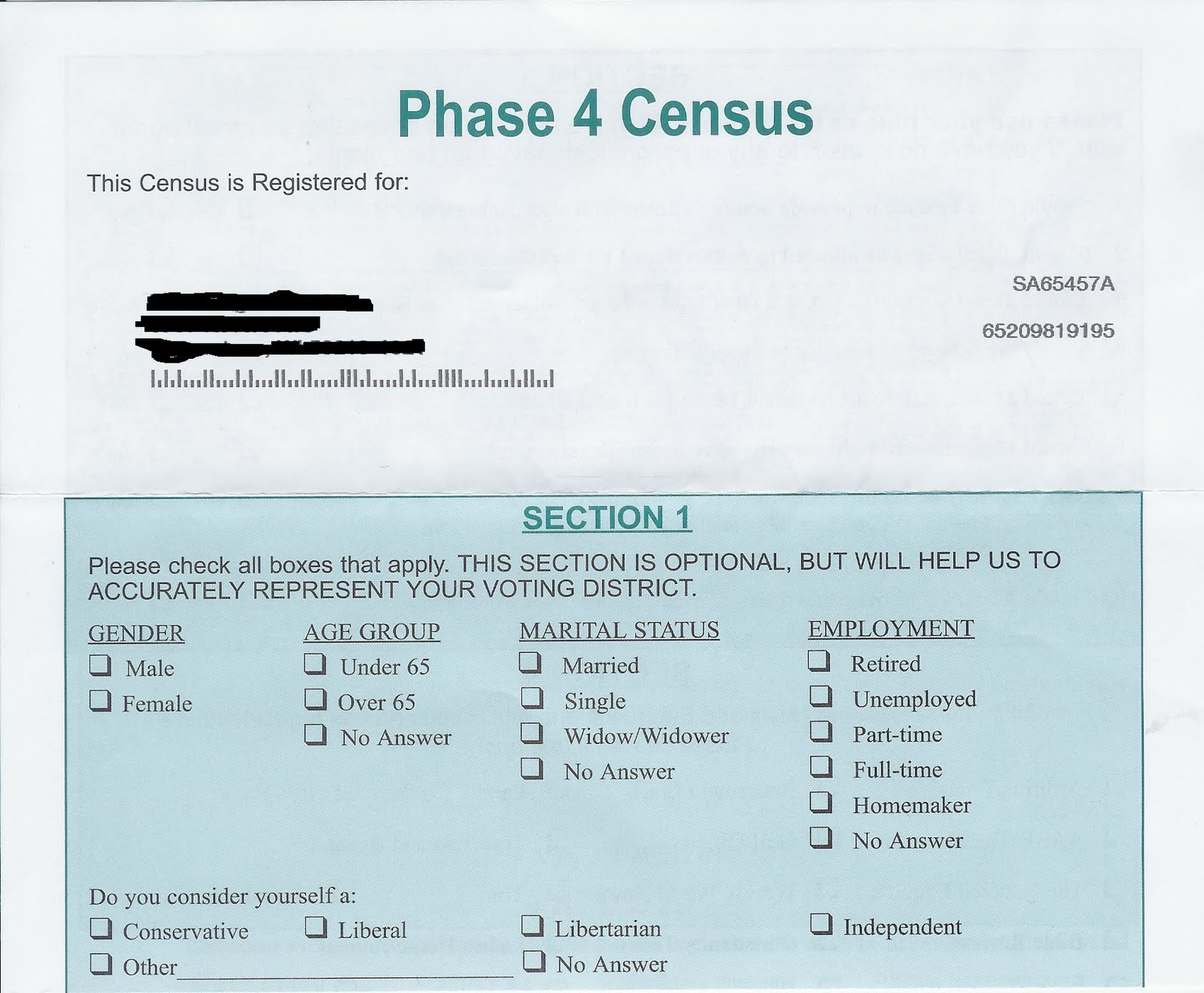
The envelope it was sent in is marked “Phase 4 Census” and mentions the Secure America Alliance. However, it does not explicitly say anywhere on the envelope or in the enclosed documents that it is not an official 2010 Census form.

The following images are of the “census” document enclosed:


By the time you see Section 2 it should be obvious that this is not an official census form - the official census will not ask you if you support the sitting president’s agenda. Nor will the census ask you for money, like it does in Section 5.

Okay, so the mailer is specifically meant to raise awareness about a pending Totalization agreement with Mexico and to raise money for this obscure political organization.

According to an attached letter:

“This Census is built around one of the most important issues facing Social Security today: Totalization.

Totalization is the scheme that will give Social Security checks to illegal aliens…

…You have been carefully chosen to participate in this Census. And this Phase 4 Census has been officially registered with your name and a special identification number…”

That sounds a little suspicious, doesn’t it? What else does it say?

“…A lot of Americans don’t even know about this disastrous plan to give Social Security Checks to illegal aliens…

Most Americans don’t know just how dangerous the Social Security crisis is…”

I’ll say. A Google News search of “Totalization” doesn’t find anything regarding a U.S.-Mexico treaty.

A broader search, however, does find a 2004 news release from the Social Security Administration:

“[A Totalization] agreement with Mexico would save U.S. workers and their employers about $140 million in Mexican social security and health insurance taxes over the first 5 years of the agreement.

An agreement would also fill the gaps in benefit protection for U.S. workers who have worked in both countries, but not long enough in one or both countries to qualify for benefits.

Mexico is the second largest trading partner with the U.S. Agreements are already in effect with Canada, the largest trading partner with the U.S., and 19 other countries.

With Mexico, the U.S. now has signed agreements with eight of its top ten trading partners. Many of these agreements have been in effect for nearly two decades. The two exceptions are China and Taiwan. By law, the U.S. could not enter into agreements with these two countries because they do not have generally applicable social security systems that pay periodic benefits or the actuarial equivalent.”

Well, just in case that sounds reasonable, Ronald Wilcox (the Executive Director of the Secure America Alliance) signs his letter and adds “P.S. Social Security is for Americans. It’s not for freeloading illegal aliens who are looking for a handout.”

In a lot of ways, it all sounds too crazy to be taken seriously. Plus, the organization’s website doesn’t inspire confidence that this was conducted by a D.C. professional.

Yet the substance of the letter does include some classic indicators of astroturfing. Namely, it’s regarding an issue that absolutely no one has ever heard of. Additionally, a 2007 document connects this group to Stuart Grey, a conservative direct mail and fundraising consultant in Washington D.C.

Here are some other interesting notes about the “Census” they sent:

• In Section 1 they ask about gender, age, marital status, and employment. Then in Section 4 they ask about magazines the respondent reads. These questions will yield results that will be strikingly similar to the kinds of demographical and consumer-based data that the two main parties use in their voter files.

• The timeline they give (“within the next three days”) to submit the “Census” is awfully short.

• There is a TON of fine print under Section 5.

• The envelope clearly mentions “Registered for use by the addressee listed below…Tampering with mail is a Federal Crime.”

So a lot of things about this mailer should raise a few eyebrows. Either way, it is not a real Census document, and I would advise anyone receiving it to immediately throw it out.

Tuesday, March 23, 2010

How the New Healthcare Law Changes the Dynamics of 2010

Summary: the Democrats’ legislative success means an electoral challenge for Republicans.

President Obama finally signed healthcare reform into law this morning. Soon, millions of uninsured Americans will have access to healthcare, sick Americans will be at lesser risk of losing coverage, and insurance prices will stop skyrocketing.


Over the past year, the healthcare debate has changed the political landscape entirely. It has led to the growth of the Tea Party movement, made members of Congress like Bart Stupak and Joe Wilson household names, and seriously depleted Obama’s approval ratings.

By the end of 2009, we warned that a failure to pass healthcare would mean more trouble than security for the Democratic caucuses in Congress.

Now that it’s passed, the tables have turned. Republicans warn that a “yes” vote on healthcare will mean trouble for Democrats come November, but it is the GOP that needs to start worrying.

They’ve been pursuing a strategy of “no” for the past year. Even now, they’re only suggestion is to repeal the law.

Except most of the legislation is quite popular. Measures that most voters would generally approve will be in place before July, including the end of pre-existing conditions. Young Americans could stay on their parents’ plans until they’re 26, and insurance companies would be unable to drop someone from coverage when they get sick.

One of the demographics most afraid of the overhaul - the elderly - will see huge benefits very soon, such as free preventive care and the closing of the Medicare Part D donut hole.

Republicans won’t actually want to repeal all that, will they?

Democrats, meanwhile, saved themselves a lot of trouble by proving to their base they could accomplish something. Things were looking pretty dismal here and there throughout the debate, and Democrats around the country were becoming less and less confident in Congressional leaders.

They won’t be feeling quite so disaffected come November, knowing that near-universal healthcare was achieved as promised.

Watch the President's remarks here:


Visit msnbc.com for breaking news, world news, and news about the economy

Tuesday, March 9, 2010

Can Labour Still Hold on to Parliament?

Summary: A new poll predicts a slimmer swing to the Tories in Britain than previously expected.

I know we blogged about foreign elections yesterday, but the news from the United Kingdom this morning is worth mentioning. Back in January we noted how many in Britain had come to accept a Conservative Party victory in this year’s elections for Parliament. Now it’s more difficult to say what will happen.

It was recently revealed that a key Tory lord who will be bankrolling the party’s campaign operations has maintained a “non-dom” tax status (which allows him to forego taxes on international earnings) despite pledging to end it a decade ago. That’s creating problems for his party’s leader, David Cameron.

A new poll of the marginal constituencies (or “swing districts” as they would be called here) finds the Conservatives might be underperforming if they want to form the next government (or “majority” as we would say).


From the London Times:

The poll shows that the switch of voters from Labour to the Tories is about 1.5 to 2 points higher in the battleground seats than nationally. That might be worth an extra 20 MPs to the Conservatives, smaller than many in the party would hope after the big spending on these targets. It might be enough only to take the Tories to the threshold of the 326 seats they need for a bare overall majority in the Commons.

Now, the poll excluded the Tories’ top 50 targeted seats - surveying the next 100 - as well as the seats they’re targeting that are currently held by Liberal Democrats. That might make a difference, but either way it’s all beginning to look a lot closer than expected.

From another Times article:

If the swing implied by the poll occurred uniformly across the 100 seats, the Tories would gain 47, on the top of the first 50, to give them 97 Labour-held seats. Taking account of changed constituency boundaries, this would mean 307 Conservative MPs, up from a notional 210 at the last election (after adjusting for boundary changes). This would put them nearly 60 ahead of Labour.

While this poll is just in Tory/Labour marginals, the Tories would expect to gain a number of additional seats from the Lib Dems and other parties. They would need to gain at least an additional 15 to 20 seats for an overall majority of one in the new House of Commons.


In fact, an increasing number of Brits appear to be expecting a hung Parliament after the elections.


Basically, a hung Parliament is when no single party controls a majority of seats in the House of Commons. In these circumstances, two or more parties have to form a coalition government.

If the Conservatives fall short of a majority, they won’t necessarily be in too bad of shape. They’ll still be close to a majority, and could easily join with minor center-right parties such as the Democratic Unionists and Ulster Unionists from Northern Ireland. That would put them over the 326-seat threshold.

Labour, on the other hand, would be further behind. It would take more than the Scottish and Welsh national parties to help them form a coalition - they would need to consolidate with the Lib Dems in order to keep sitting on the government benches. Whether that would be possible or not is hard to say.

No matter what parties make up the government, it will be with a slim number of seats. It could certainly make for an interesting few years.

While the exact date of the elections is still unknown - the Labour government has still not called for them yet - they have to happen soon in order to stay within the constitutional rule of every-five-years. Most Brits are now guessing they will take place on May 6th.

Also, for a bit of fun, be sure to check out Sky News’s poll tracker. It can generate levels of support for each of the main three British parties as far back as 1983.

Monday, March 8, 2010

Happy Election Day 2010…in Iraq!

Summary: Iraqis went to the polls today in what is sure to have been a close election.

Turnout in Iraq’s elections today were down a bit from 2005 - in which about 76% of the country cast ballots - but estimates show that about 55% - 60% still came to vote.

So who was running and who will win?

Well, for starters, the dynamic has changed up quite a bit since the last national elections. The number of seats in Parliament is increasing from 275 seats to 325 seats, accounting for an increase in the general population (as their constitution requires).

The parties have changed around a bit as well. There are dozens of parties - as well as several independent candidates - which form into coalitions. The main three for 2010 are the State of Law Coalition (headed by PM Nouri al-Maliki), the National Iraqi Alliance, and the Iraqi National Movement (headed by former PM Iyad Allawi).

Now, al-Maliki’s Islamic Da’awa Party used to be part of the National Iraqi Alliance, until they split around 2008, and now run on separate tickets. As a result, the bloc of parties that will control of Parliament is not as certain as it was in 2005.


In fact, a poll last month by Iraq’s National Media Center of 5,000 voters seemed to confirm the uncertainty looking forward.


So it appears unlikely that there will be a clear cut winner after the ballots are counted. It is more likely that negotiations between the parties will go on for some time while they jockey for position while combining (or even splitting) party coalitions and forming a government.

This is unfortunate because it could lead to a lot of tension among Iraqis, especially during a period in which there is no government to act. Some would say it was this period following the 2005 elections which sent the country into two of the bloodiest years of the Iraq War.

Luckily, this year’s coalitions have so far formed less around sectarian similarities and more around political ones. It is possible that this will be easier on the country as the political battles won’t be over ancient religious rifts.

We’ll have to see.

In the meantime, if you’d like to read-up on the campaigns, take time to read this interesting analysis by the Carnegie Endowment for International Peace.

Friday, March 5, 2010

Will a Controversial RNC Presentation Bring Down Michael Steele?

Summary: An internal RNC document - mocking donors and encouraging politics of fear - finds its way on to the internet and embarrases party leaders.

On Wednesday, Politico broke one of the most interesting stories about the RNC of the entire 2010 election cycle. An internal document - a PowerPoint presentation by the RNC finance staff - mocked their donors and explained how to play to their shortcomings for fundraising purposes.

There were some other interesting things in the presentation. For example, it mentions how the RNC plans to fight the FEC over soft money, refers to a fundraiser with the firm formerly known as Blackwater, and complains about all the “regulations” the RNC must abide by - even listing the Defense Department, the Patent Office, and Postal Service of regulating them.

The USPS regulations they refer to probably have to do with the “census” fundraising mailers they’ve been doing.

But the most shocking things were how they characterized the Democrats and their own contributors.

The presentation lists two kinds of contributors: the “reactionary” small donors and “ego-driven” large donors.


The small donors, according to the slideshow, do “visceral giving” based on “fear” and “extreme negative feelings” about the Obama Administration. The large donors do “calculated giving” based on “peer-to-peer pressure”, “networking opportunities” and “access [to politicians].”

Of course, large donors are becoming skeptical of the RNC and the committee’s fundraisers have begun to rely more on small donors. Thus, the document says “What can you sell when you do not have the White House, the House or the Senate…? Save the Country from trending toward socialism!”

Finally, one slide includes images of how RNC fundraisers should depict Democrats.


RNC Chairman Michael Steele, and his press staff, have been distancing him from the presentation. Steele even went on Fox News recently to defend himself and his party.


To say a few words in defense of the RNC finance staff, none of what they’re saying is technically untrue. These are well-grounded ways - on both sides of the spectrum - of effectively raising money. Furthermore, the parts of the presentation that have been getting so much attention are a relatively small part of the presentation.

Most of the presentation is pretty boring, and is of little interest to the common person (although it’s loaded with strategic details such as fundraising goals that will be quite useful for the DNC to know).

But this much is true: the RNC finance staff must have been pretty stupid to put such a cynical slant on the game in a document that could be found and posted online, especially one that admits that they’re willing to drive a radical anti-Obama message for the sake of raising money.

This is not the first time we’ve mentioned that the RNC is having problems - including fundraising difficulties - during the 2010 cycle. In fact, despite all the predicted success for the GOP this year, these internal issues are weighing down on their optimism.

I would go a step further than simply acknowledging some problems in the RNC. I would say that the committee has been completely falling apart lately. Furthermore, it all seems to have started when Michael Steele took over as chairman.

This latest scandal is just one more disaster on top of an already dismal position for the Republican National Committee. Steele has not been popular with committee members for some time now, and - depending on their internal rules, which I’ll admit I am unfamiliar with - they may impeach him or at least demand a resignation in due time.

I now have to imagine that he won’t complete his term at the RNC. So here’s the question: just how much longer can Steele last?

Thursday, March 4, 2010

Who Are the Millennials? (Part 3)

Summary: Wrapping up our short series on America’s youngest generation.

We hope you’ve enjoyed - and learned from - our posts this week regarding the Millennial Generation.

To wrap up this mini-series, we thought you’d be interested in seeing this PBS report on the Pew study we looked at.


And you can find out just how Millennial you are by taking this short quiz!

Wednesday, March 3, 2010

Who Are the Millennials? (Part 2)

Summary: The youngest generation of Americans is the most technologically savvy. Knowing how they communicate and obtain information is paramount to engaging them politically.

Yesterday we examined a new Pew Research Center study on the Millennial Generation to find out how they were different from older generation in terms of politics and values. While we found that there were some striking differences, they pale in comparison to the differences in terms of technology use.

From the study:

Technological change and generational change often go hand in hand. That’s certainly the story of the Millennials and their embrace of all things digital. The internet and mobile phones have been broadly adopted in America in the past 15 years, and Millennials have been leading technology enthusiasts. For them, these innovations provide more than a bottomless source of information and entertainment, and more than a new ecosystem for their social lives. They also are a badge of generational identity. Many Millennials say their use of modern technology is what distinguishes them from other generations.

WAYLA often examines trends in New Media and their impact on the political scene. But what’s interesting is that the older generations - who are more likely to vote - are typically not the most likely to use these media.

Millennials dominate in terms New Media and cell phone technology. Three out of every four Millennials use online social networking, compared with just half of Gen Xers, and less than a third of Baby Boomers.


Almost nine out of ten Millennials use their phones to text, and do so about 20 times per day. 83% of them sleep next to their cell phones, compared to 68% of Gen Xers and 50% of Baby Boomers.

They also appreciate technological advancements and innovation more than the average American. While almost a third of Baby Boomers believe these new technologies have made life more complicated, a staggering 74% of Millennials say they’ve made life easier.

One reason Millennials like these new technologies, no doubt, is because they’ve made it easier and more affordable to follow the news - especially the selective news they are interested in. They’re considerably less likely than their parents or grandparents to get news from television or newspapers, and more likely to find it on the internet.

In fact, “kids these days” are considerably less likely to watch television in general than any other age group.


None of these trends are necessarily surprising though, so why do we bring them up?

Knowing your audience is always important. Thus communicating via social networking services and texting will require different messages than traditional media.

Now, one of the most important rules in politics is maintaining a consistent message. But what areas of the message you focus on will differ depending on what media you use.

Understanding that Millennials - who have different perspectives and values than older generations - are more likely to use these new media sources means that tailoring your message over these media should reflect more on their concerns.

For example, Republicans should steer clear of stressing so-called “traditional family values” on Twitter and Facebook. Democrats should feel more free to promote issues in terms of equality and less compelled to defend the role of government in the economy. And while it would never hurt to do so, neither Republicans nor Democrats really need to hype veterans’ issues.

Tomorrow we’ll visit the topic of the Millennials one last time to wrap-up some key thoughts on the generational shift we’re seeing and its impact on politics.

Tuesday, March 2, 2010

Who Are The Millennials? (Part 1)

Summary: How to understand the youngest generation of Americans, and engage them politically.

Last year we pointed out the magnitude Americans under 30 had on public opinion. Not only were they strikingly supportive of Barack Obama in the 2008 presidential election, but also of gay marriage, legalizing marijuana, curbing climate change, and amnesty for illegal immigrants.

A new Pew Report finds that the Millennials are still heavily Democratic, though their identification with the party has slipped about 8%.

Still, as any good political consultant understands, politics is about more than just “politics” - it is about the values that the voting public holds.


So what kind of values does this demographic hold?

First of all, their priorities compare with those of their parents, although not entirely. Whether the discrepancies are simply due to youth or if there's an actual shift is uncertain, but either way it’s something to take seriously when trying to communicate with them.

From the report summary:


In weighing their own life priorities, Millennials (like older adults) place parenthood and marriage far above career and financial success. But they aren't rushing to the altar. Just one-in-five Millennials (21%) are married now, half the share of their parents' generation at the same stage of life. About a third (34%) are parents, according to the Pew Research survey. We estimate that, in 2006, more than a third of 18 to 29 year old women who gave birth were unmarried. This is a far higher share than was the case in earlier generations.

But their shifting priorities and values aren’t meant to be part of a counter-culture. Unlike the Woodstock Generation of the Baby-Boomer years, they respect their parents - and their parents’ values - tremendously.

Looking back at their teenage years, Millennials report having had fewer spats with mom or dad than older adults say they had with their own parents when they were growing up. And now, hard times have kept a significant share of adult Millennials and their parents under the same roof. About one-in-eight older Millennials (ages 22 and older) say they've "boomeranged" back to a parent's home because of the recession.

They respect their elders. A majority say that the older generation is superior to the younger generation when it comes to moral values and work ethic. Also, more than six-in-ten say that families have a responsibility to have an elderly parent come live with them if that parent wants to. By contrast, fewer than four-in-ten adults ages 60 and older agree that this is a family responsibility.

They also bring different perspectives to the arena than older generations did.

Despite coming of age at a time when the United States has been waging two wars, relatively few Millennials -- just 2% of males -- are military veterans. At a comparable stage of their life cycle, 6% of Gen Xer men, 13% of Baby Boomer men and 24% of Silent men were veterans.

This is in part - no doubt - because of the intensity of their educational background. A record 39.6% of 18-22 year olds were enrolled in college in 2008. But just because they aren’t serving their country on the battlefield doesn’t mean they’re unwilling to serve in general. Quite the opposite, in fact.

Volunteering for an organization or helping others without being paid is one way many Americans are involved in their communities. Nearly six-in-ten (57%) Millennials say that they had volunteered in the past 12 months, which is no higher than the proportion of Gen Xers (54%) who said they had done this. About half of Baby Boomers (52%) and just 39% of those in the Silent generation say they volunteered in the past year.

Millennials also tend to be more ethnically diverse, less religious, and have higher confidence in the efficacy of government.

And then of course there are all the ways they are more technologically advanced, which is where we’ll pick up tomorrow.

Monday, March 1, 2010

Prediction Correct: Canada Got Home-Country Boost

Summary: Canada’s Olympic performance verifies that the host country does indeed win more medals than they would without home-field advantage.


Around the time the 2010 Winter Olympics began, we did an analysis which found that in eight of the past nine Olympics, the home-country did better than they do on average in terms of both overall medals and gold medals.

Now that the games are over, we decided to review our predictions.

We said that Canada - the host nation - would win 6 or 7 more medals than would otherwise be expected, including one or two additional gold medals.

This was based off the average medal increase that host countries saw over the past nine Olympics. Keep in mind there is a lot of variation on how much better the host country does. In theory, Canada should have brought in 2.57% additional available medals than they do on average during the Winter Games, including 2.1% additional golds.

We weren’t too far off.

With 26 medals overall - 14 of which were gold - Canada secured 1.68% more medals than they have on average. In a really surprising feat, they secured 9.91% more golds than on average.

In other words, Canada earned four or five more medals than they would have had the Olympics been outside their country, and a whopping eight or nine additional golds.

Meanwhile, the United States beat Canada (and the rest of the world) in the overall count (with 37 total medals), but lost in terms of gold medals (with only 9).

We really didn’t do too bad. We actually picked up about 4% more medals overall than on average for Winter games (though we did drop 0.14% in terms of golds). Perhaps our generally sound performance was due (at least in part) to Vancouver’s close proximity to the U.S. Our fans had a relatively short trip to make to support our athletes.

Either way, these findings further solidify our argument that Americans should always support their cities for hosting the games, regardless of politics.

Friday, February 26, 2010

The Aftermath of the Healthcare Summit

Summary: What the summit means for a healthcare reform bill and the 2010 midterm elections.

As promised yesterday, we need to give our wrap-up opinions on yesterday’s healthcare summit in Washington, DC.


First of all, the media have not been impressed by what was accomplished yesterday. I’m not quite sure what they were expecting, but evidently they seemed to assume that the bill would have been ready to go after the summit.

In fact, the new deadline for passing a bill is before Easter. That gives Congress over a month to continue hashing out the details - and even that’s under the unlikely scenario that they’ll meet the deadline - before there’s a final vote.

In part, it’s because the GOP still seems unwilling to cooperate.

From Politico:

Heading into the summit, Democrats were preparing to start the steps to get the bill through the Senate with reconciliation — needing only 51 votes to pass a bill — as early as next week. They didn’t expect Republican cooperation Thursday and they didn’t get any. Republicans walked out of the session saying the same thing they said going in — unless you start over, we can’t get on board.

Yet watching the summit, they seemed to be a lot more engaged in reaching a pragmatic compromise than usual. With the exception of John Boehner - who gave a speech loaded with conservative rhetoric about killing the bill - most Republicans (even the super-conservative Sen. Tom Coburn) appeared more focused on working with Democrats than we’ve seen so far.

This is in no small part thanks to President Obama, who took a very serious tone yesterday about bipartisan efforts, which I feel encouraged some Republicans to drop the talking points - especially because the one who did were called out on it.

So we come to two questions. 1) Will this lead to a bill being passed? 2) What implications will it have for the 2010 elections?

It seems to me like a bill was going to be passed regardless of the summit, but I feel that this helped the GOP get over their minority-complex. The attention President Obama showed them (and has been showing them) contrasts - in their minds - with the way the Democratic Congressional leadership has treated them.

And some bridges were built yesterday. Senators Kent Conrad (D-ND) and Tom Coburn (R-OK) made some progress together regarding prescription drug coordination, while Democrats and Republicans in general came to some broad agreements regarding the healthcare-deficit connection.

Of course, there will be plenty of time for Tea Party special interest groups to disrupt this progress, but I feel that the summit probably did help bringing Republicans to the table, making it a little less likely that the inevitable filibuster efforts will succeed.

But in order for a bill to pass by Easter, it is entirely clear that President Obama and the Democratic leadership will have to continue to engage Republicans.

In the 2010 midterms, Democrats will be between a rock and a hard place, but there is a growing agreement among pundits that passing a bill will be more beneficial to them than failing on a key issue they were elected to address. This is something we’ve been saying for months.

Yet if a bill doesn’t pass, pointing to the summit will be a good way for Democrats to defend themselves. “Hey, we had a summit,” they can say, “the Republicans still refused to work with us. They care more about these elections than about the American families who are struggling with healthcare costs.” It’s not a great defense, but it helps solidify the idea that the GOP is nothing more than a “Party of No” these days.

Anyone who watched the summit - there weren’t many who did, albeit, though web traffic for it tripled that of the State of the Union Address - could see how Democrats were more willing to work with Republicans on the bill than vice versa.

Yet even a lot of Republicans were less aggressive than normal yesterday.

Ultimately, a lot of people may be disappointed with the outcomes of the healthcare summit. I, for one, think it could prove to be rather successful.

Thursday, February 25, 2010

Healthcare Summit and Getting the Job Done

Sorry this post is so late, as it’s been tough to avert my eyes from the healthcare summit going on today.

Watching it reminded me yet again why President Obama was such a wise choice in 2008. Throughout the day he’s been doing such a great job trying to put politics aside and hash out policy.

Perhaps nowhere was it more obvious then during an exchange that’s making headlines right now with his former rival, Sen. John McCain (R-AZ):


Watch CBS News Videos Online

Indeed, he seems to be taking this summit much more seriously than a lot of the attendees. This demeanor reminds me a lot about what Eric and I said yesterday about getting the job done.

Anyway, be sure to come back tomorrow as we give our wrap-up on the healthcare summit, and what it means for 2010.

In the meantime, you can watch the healthcare summit at www.WhiteHouse.gov.

We’ll also start live tweeting the summit at @HSGWAYLABlog.

Wednesday, February 24, 2010

Editorial: Can’t We Just Get the Job Done?

Summary: Eric and Dave explain their frustrations with the politics of pessimism.

It’s not difficult to be pessimistic about the outlook of the world sometimes. In recent years, it hasn’t been difficult to be pessimistic about the future of the United States.

For liberals, many of us made the claim that we would move to Canada following the re-election of George W. Bush. In our knee-jerk reaction to the unconscionable decision of the American public, we were certain America was on its downfall. But when we had the chance to think clearly, we remembered it was our country, and we needed to fight for it.

Two years later, we started to win this fight by taking back both chambers of Congress for the Democrats.

Have we reached some sort of Utopia? Of course not. We never will.

Some liberals are now feeling that pessimism in the midst of the healthcare debate. We’re not getting the perfect bill we were hoping for. And some are afraid that if we pass an even mildly-controversial bill, seats will be lost in November.

But as Mark Sump from Activate reminded us on Monday, sometimes we just need to get the job done.

From his blog post:

My son is 16, six foot four and plays varsity basketball at his high school. I attend all of his games. A couple weeks ago his team was playing one of the top teams in the conference. It was close. The other team stole the ball, drove the floor and went in for the lay up. There was one player between him and the basket. They both went up. Our player was trying not to foul, but there was no chance he wouldn’t. He tried to block the ball, but it was out of reach. The ball went in and the foul was called. I thought to myself, if you’re going to foul…foul. Don’t let the shot go in.

Sixteen years ago we tried to pass health care reform. We failed. That year the Republicans took the House. First time in decades. They patted themselves on the back and told the country it was because they succeeded in pushing back against change, against finally bringing true reform to our health care system.

In 1992, Bill Clinton won an electoral landslide. The campaign was built on hope and change. The cornerstone issue was health care reform. He had a mandate. He really did. Then he ran into a Democratic Congress who played not to lose. The more change that was proposed, the dimmer the outlook was for Democrats in Congress. They hesitated. They blinked. They were afraid to lose. Guess what? They lost anyway…

… So, here we are sixteen years later. We’re playing defense. The Republicans are going up for the dunk. Democrats have a decision to make. Do we stop them from scoring and take the penalty, or do we try not to foul.

We can learn from the past. We can know that sixteen years ago as many people were discouraged by our lack of ability to bring real change as were afraid of what that change might bring. Democrats can stand up today, knowing they will lose in November but knowing they did the right thing. Sixteen years ago we blinked and we know the results. History shows we’re going to lose seats in Congress if we do nothing.

So, do the right thing. Pass health care reform. Pass a public option. Pass a Medicare buy-in. Do it by any means possible. Pass a real reform by reconciliation.

If you’re going to foul…foul.

This is how it seems to be with a lot of things these days - even when we put partisan politics aside. On TV, pundits and politicians are constantly telling us that we’ll be losing out to the Chinese because of our deficits, and that it’s placing an unfair burden on the next generation.

Guess what? We are that generation! We’re the next slot of Americans who will have to clean up this mess (Eric is 32, Dave is 22). So here’s our message: either grab a mop, or get out of the way.

In the end, it doesn’t matter if you’re old or young, conservative or liberal, Republican or Democrat. Times are tough, but complaining about it isn’t going to get us anywhere. We need to reform healthcare (everybody knows it), we need to curb climate-change, and - yes - we need to reach a balanced budget sooner rather than later.

So let’s do it. Let’s grab a mop and get the job done. And let’s make sure that we force out those who are standing in the way of this job - those practicing the politics of pessimism. Barack Obama (as he’s said himself) cannot the sole maker of change - we all have to be change makers.

What makes our country great is the resilience of the American people. We were resilient enough after the 2004 elections to re-group and get the job done for the Democrats.

Now we need to be resilient in the face of great challenges and get the job done for America.