
Summary: Dave speaks to the fears that Democrats have moving forward.
Taking a look at this blog, comparing this year’s posts to last year’s posts, you can see a burgeoning trend.
Whereas last year I commented much more on Tea Parties, day-to-day embarrassments for the GOP, and Obama’s job approval ratings, I’ve now started talking more about things like the effectiveness of campaign ads and the British elections from earlier this year.
It’s because I’m finding it harder and harder to speak of good news for the Democrats going into November’s midterm elections.
It’s not difficult for Democrats to feel a bit frightened right now. Even those who (unlike me) can’t ignore the topic altogether -- those who work on Democratic congressional campaigns at the moment -- are still doing their best to practice cognitive dissidence. It’s the only way to proceed and do their jobs without falling apart emotionally.
But like all Democrats, I have to confront this fear for the moment, and speak to the reality of the political environment.
November 2, 2010, is going to be a bad day.
I’m not going to say we’ll definitely lose the House of Representatives, and I actually doubt we’ll lose control of the Senate. But I will say this much: don’t expect a terrific Congress or terrific state governments next year.
I look toward my own state, Wisconsin, as a golden example of this reasonable pessimism.
Here in the Badger State we have a governor’s race, U.S. Senate race, and two Congressional races that could easily flip their respective offices from Democratic to Republican.
We cheeseheads have proudly gone blue in the past five presidential races, two gubernatorial races, and eight U.S. Senate races. Our Congressional Delegation, State Senate, and State Assembly all have Democratic majorities.
Yet the model statesman we have always been most proud of -- Senator Russ Feingold -- is currently trailing a millionaire GOP insider named Ron Johnson by a 52%-41% margin.
The Congressional seat held by retiring Appropriations Committee Chair Dave Obey is leaning Republican. Another seat -- held by Democratic Dr. Steve Kagen -- is considered a “toss up” in the midst of a race against a Republican businessman who moved to the district (only a matter of months ago) specifically to run for Congress.
Our Governor’s mansion is also at risk of going to Tea Partying Milwaukee County Executive Scott Walker -- a man notorious for flip-flopping and lacking in anything that resembles an intellectual capacity.
Why? One simple reason: the economy is bad right now.
It doesn’t matter what party screwed the economy up, nor does the fact that the same party has no real ideas to solve the problems they complain about.
As political scientists (Niemi and Weisberg, Nadeau and Lewis-Beck, Miller and Shanks, Lodge and Steenbergen) have pointed out for decades, people blindly vote against incumbents when the economy is bad. And for the past few years now, the economy has been really, really bad.
That is the nature of the problem: voters will treat 2010 like a referendum and not as a choice between leaders and their ideas.
Democrats have tried to explain to voters how they should not treat this election as a referendum. But this argument can, in practice, only limit the inevitable damage.
When this election is over, there will certainly be things the Democrats did wrong that we can point to, trying to explain our failures (after the election, I plan on writing an extensive piece on the abysmal failure that was OFA). But most of the problem really boils down to factors that are out of our control as Democratic campaigners.
So until then, let’s do all we can ever do in these scenarios, a plan of action I have come to learn well as a political operative…
…brace for the worst and hope for the best.
Showing posts with label elections. Show all posts
Showing posts with label elections. Show all posts
Thursday, October 7, 2010


Monday, May 3, 2010
Three Days Left Before the British Elections
Summary: A recap of the UK campaign and predictions for the new Parliament.
What a wild ride the British election has been.

Before the year began, it was widely expected that the Conservative Party would win the elections, making their leader - David Cameron - the next Prime Minister.
By March, however, the Conservative victory was considerably less certain. It seemed entirely possible that the Labour Party - the current governing party - could retain power or cling on to enough seats for a hung Parliament.
Then Prime Minister Gordon Brown - the leader of the Labour Party - asked the Queen to dissolve Parliament and hold a general election on May 6 (the usual way elections work there). That gave the parties and politicians about a month to campaign.
Nobody could have predicted what happened next.
The ultimate game changer came the night of the first ever leaders debate between Cameron, Brown, and Nick Clegg, the leader of the Liberal Democrats (a sort of moderate libertarian party).

According to polls released the next day, Clegg won the debate - in fact, he dominated compared to the leaders of what he called “the old parties” - and support for the Lib Dems actually surpassed support for Labour for the first time since the inception of the third party.

So for the past few weeks, the consensus prediction has been a hung Parliament.
Before I go any further, let me explain a few terms in British politics.
• Government = majority party (the leader becomes Prime Minister and forms a cabinet which controls the administrative business of the country)
• Opposition = minority parties
• Hung Parliament = no clear majority, either the party with a plurality forms a minority government or two parties can form a coalition (last hung Parliament was in 1974, the last coalition government - I believe - was about 150 years ago).
• Tories = nickname for the Conservatives
• Marginal constituencies = swing districts (for example, a “Labour marginal” refers to a swing seat currently held by the Labour Party).
• Colors = Labour is red, Conservative is blue, Lib Dem is yellow
There have since been two more debates, and not a whole lot has changed. Brown has still struggled to connect with voters, Clegg has continually pushed the “old parties” line, and Cameron has failed to inspire his base, instead opting to appear like a reasonable choice to undecided voters.
To Brown’s credit, he did better in the debates than people give him credit for. He stuck to the talking points, sounded authoritative, and won on the one-liners (which is huge in debates).
To Cameron’s credit, the Tories are doing better in the polls today than they were two weeks ago, and people are finally beginning to think there could be a Conservative government again.
Finally, to Clegg’s credit, he’s doing everything right. He’s even convincing Labour supporters in some Tory marginals to choose the Lib Dems because they’re more likely to win there.
So what will the results of Thursday’s election be?
Because the make-up of Parliament is decided with single-member districts and first-past-the-post elections, the Liberal Democrats won’t actually do as well as the polls suggest. Simply put, the marginals aren’t there for them.
They will, however, increase the number of seats they hold by quite a bit. Currently they hold 62 seats. That could almost double.
The Tories, meanwhile, are expected to pick up about 90 to 110 seats, bringing their total to something between 295 and 320. Labour will probably lose quite a few, possibly more than 130 seats.
First, Ladbrokes has a very cool interactive map with rolling predictions. They’re currently predicting a hung Parliament, with the Tories short of a majority by 10 to 15 seats.

 If I was a betting man, however, I’d rely more on the predictions made by FiveThirtyEight.com. They’ve been following the race more closely than I have (and probably closer than most Brits have) and they’ve developed a prediction model that finds the Tories could be short of a majority by more than 25 seats. They also find that Labour will be worse off than Ladbrokes does, and believe the Lib Dems will pick up 58 seats, rather than 20.
While these are by no means conservative estimates for the Conservatives (pun intended) FiveThirtyEight has an amazing track record when predicting election outcomes.
So what happens next?
I see two possible outcomes of this election. They both involve a hung Parliament.
1) The Conservative Party forms a minority Government. This is the view many in the UK are taking at the moment. If this happens, then Cameron will be on very shaky ground as Prime Minister. He will have a tougher time with Parliament, his own party, and the British people than President Obama is having with all the American equivalents.
2) The Labour Party forms a coalition government with the Liberal Democrats. Frankly, while these two parties don’t get along, they’re far more ideologically similar than either is with the Tories. Power sharing won’t be easy, but they may find it necessary. They may also want to court the Scottish Nationalist Party and Plaid Cymru (Welsh nationalists) for the coalition.
Either way, it’s been a fun and exciting election to observe, and I can’t wait for Thursday. Next week we’ll recap what happened and discuss what we’ll likely see in the coming weeks.
In the meantime, you might be wondering what party you’d support if you were British. The Daily Telegraph has a good online quiz to help you figure that out. Take a look!
What a wild ride the British election has been.

Before the year began, it was widely expected that the Conservative Party would win the elections, making their leader - David Cameron - the next Prime Minister.
By March, however, the Conservative victory was considerably less certain. It seemed entirely possible that the Labour Party - the current governing party - could retain power or cling on to enough seats for a hung Parliament.
Then Prime Minister Gordon Brown - the leader of the Labour Party - asked the Queen to dissolve Parliament and hold a general election on May 6 (the usual way elections work there). That gave the parties and politicians about a month to campaign.
Nobody could have predicted what happened next.
The ultimate game changer came the night of the first ever leaders debate between Cameron, Brown, and Nick Clegg, the leader of the Liberal Democrats (a sort of moderate libertarian party).

According to polls released the next day, Clegg won the debate - in fact, he dominated compared to the leaders of what he called “the old parties” - and support for the Lib Dems actually surpassed support for Labour for the first time since the inception of the third party.

So for the past few weeks, the consensus prediction has been a hung Parliament.
Before I go any further, let me explain a few terms in British politics.
• Government = majority party (the leader becomes Prime Minister and forms a cabinet which controls the administrative business of the country)
• Opposition = minority parties
• Hung Parliament = no clear majority, either the party with a plurality forms a minority government or two parties can form a coalition (last hung Parliament was in 1974, the last coalition government - I believe - was about 150 years ago).
• Tories = nickname for the Conservatives
• Marginal constituencies = swing districts (for example, a “Labour marginal” refers to a swing seat currently held by the Labour Party).
• Colors = Labour is red, Conservative is blue, Lib Dem is yellow
There have since been two more debates, and not a whole lot has changed. Brown has still struggled to connect with voters, Clegg has continually pushed the “old parties” line, and Cameron has failed to inspire his base, instead opting to appear like a reasonable choice to undecided voters.
To Brown’s credit, he did better in the debates than people give him credit for. He stuck to the talking points, sounded authoritative, and won on the one-liners (which is huge in debates).
To Cameron’s credit, the Tories are doing better in the polls today than they were two weeks ago, and people are finally beginning to think there could be a Conservative government again.
Finally, to Clegg’s credit, he’s doing everything right. He’s even convincing Labour supporters in some Tory marginals to choose the Lib Dems because they’re more likely to win there.
So what will the results of Thursday’s election be?
Because the make-up of Parliament is decided with single-member districts and first-past-the-post elections, the Liberal Democrats won’t actually do as well as the polls suggest. Simply put, the marginals aren’t there for them.
They will, however, increase the number of seats they hold by quite a bit. Currently they hold 62 seats. That could almost double.
The Tories, meanwhile, are expected to pick up about 90 to 110 seats, bringing their total to something between 295 and 320. Labour will probably lose quite a few, possibly more than 130 seats.
First, Ladbrokes has a very cool interactive map with rolling predictions. They’re currently predicting a hung Parliament, with the Tories short of a majority by 10 to 15 seats.
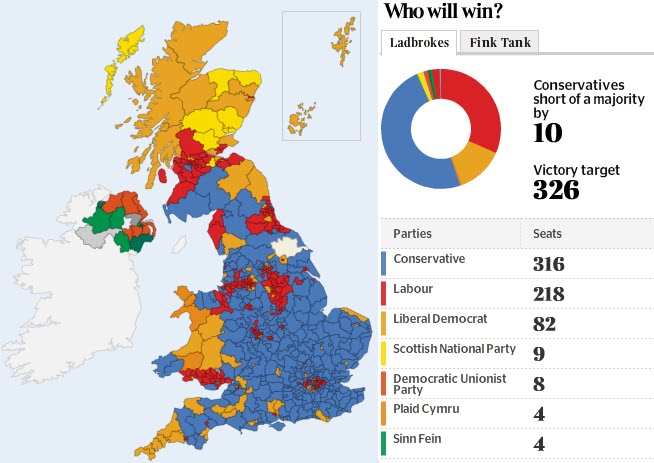
 If I was a betting man, however, I’d rely more on the predictions made by FiveThirtyEight.com. They’ve been following the race more closely than I have (and probably closer than most Brits have) and they’ve developed a prediction model that finds the Tories could be short of a majority by more than 25 seats. They also find that Labour will be worse off than Ladbrokes does, and believe the Lib Dems will pick up 58 seats, rather than 20.
While these are by no means conservative estimates for the Conservatives (pun intended) FiveThirtyEight has an amazing track record when predicting election outcomes.
So what happens next?
I see two possible outcomes of this election. They both involve a hung Parliament.
1) The Conservative Party forms a minority Government. This is the view many in the UK are taking at the moment. If this happens, then Cameron will be on very shaky ground as Prime Minister. He will have a tougher time with Parliament, his own party, and the British people than President Obama is having with all the American equivalents.
2) The Labour Party forms a coalition government with the Liberal Democrats. Frankly, while these two parties don’t get along, they’re far more ideologically similar than either is with the Tories. Power sharing won’t be easy, but they may find it necessary. They may also want to court the Scottish Nationalist Party and Plaid Cymru (Welsh nationalists) for the coalition.
Either way, it’s been a fun and exciting election to observe, and I can’t wait for Thursday. Next week we’ll recap what happened and discuss what we’ll likely see in the coming weeks.
In the meantime, you might be wondering what party you’d support if you were British. The Daily Telegraph has a good online quiz to help you figure that out. Take a look!
Monday, March 8, 2010
Happy Election Day 2010…in Iraq!
Summary: Iraqis went to the polls today in what is sure to have been a close election.
Turnout in Iraq’s elections today were down a bit from 2005 - in which about 76% of the country cast ballots - but estimates show that about 55% - 60% still came to vote.
So who was running and who will win?
Well, for starters, the dynamic has changed up quite a bit since the last national elections. The number of seats in Parliament is increasing from 275 seats to 325 seats, accounting for an increase in the general population (as their constitution requires).
The parties have changed around a bit as well. There are dozens of parties - as well as several independent candidates - which form into coalitions. The main three for 2010 are the State of Law Coalition (headed by PM Nouri al-Maliki), the National Iraqi Alliance, and the Iraqi National Movement (headed by former PM Iyad Allawi).
Now, al-Maliki’s Islamic Da’awa Party used to be part of the National Iraqi Alliance, until they split around 2008, and now run on separate tickets. As a result, the bloc of parties that will control of Parliament is not as certain as it was in 2005.

In fact, a poll last month by Iraq’s National Media Center of 5,000 voters seemed to confirm the uncertainty looking forward.

So it appears unlikely that there will be a clear cut winner after the ballots are counted. It is more likely that negotiations between the parties will go on for some time while they jockey for position while combining (or even splitting) party coalitions and forming a government.
This is unfortunate because it could lead to a lot of tension among Iraqis, especially during a period in which there is no government to act. Some would say it was this period following the 2005 elections which sent the country into two of the bloodiest years of the Iraq War.
Luckily, this year’s coalitions have so far formed less around sectarian similarities and more around political ones. It is possible that this will be easier on the country as the political battles won’t be over ancient religious rifts.
We’ll have to see.
In the meantime, if you’d like to read-up on the campaigns, take time to read this interesting analysis by the Carnegie Endowment for International Peace.
Turnout in Iraq’s elections today were down a bit from 2005 - in which about 76% of the country cast ballots - but estimates show that about 55% - 60% still came to vote.
So who was running and who will win?
Well, for starters, the dynamic has changed up quite a bit since the last national elections. The number of seats in Parliament is increasing from 275 seats to 325 seats, accounting for an increase in the general population (as their constitution requires).
The parties have changed around a bit as well. There are dozens of parties - as well as several independent candidates - which form into coalitions. The main three for 2010 are the State of Law Coalition (headed by PM Nouri al-Maliki), the National Iraqi Alliance, and the Iraqi National Movement (headed by former PM Iyad Allawi).
Now, al-Maliki’s Islamic Da’awa Party used to be part of the National Iraqi Alliance, until they split around 2008, and now run on separate tickets. As a result, the bloc of parties that will control of Parliament is not as certain as it was in 2005.

In fact, a poll last month by Iraq’s National Media Center of 5,000 voters seemed to confirm the uncertainty looking forward.

So it appears unlikely that there will be a clear cut winner after the ballots are counted. It is more likely that negotiations between the parties will go on for some time while they jockey for position while combining (or even splitting) party coalitions and forming a government.
This is unfortunate because it could lead to a lot of tension among Iraqis, especially during a period in which there is no government to act. Some would say it was this period following the 2005 elections which sent the country into two of the bloodiest years of the Iraq War.
Luckily, this year’s coalitions have so far formed less around sectarian similarities and more around political ones. It is possible that this will be easier on the country as the political battles won’t be over ancient religious rifts.
We’ll have to see.
In the meantime, if you’d like to read-up on the campaigns, take time to read this interesting analysis by the Carnegie Endowment for International Peace.
Monday, January 4, 2010
10 Things to Watch for in 2010
With 2009 over and a midterm election just 11 months away, pundits will be commenting on every imaginable issue over the year. Most of this you can probably ignore, but there are 10 things to keep your eye on in '10.
1) Jobs, Jobs, and Jobs. With only a few small dips here and there, unemployment steadily went up in 2009. The majority of Americans said at the beginning of Obama's term that they'd give him 18 months to revive the economy before blaming him for economic woes. As many predicted, that leash was a lot shorter. The stock market may be doing better, the GDP is up, and the recession is technically over - now jobs must be created. The success of the Democratic Party this year primarily hinges on this issue.
2) Who is "Nationalizing" the Midterms? Frankly, neither the Democrats nor the Republicans should want to nationalize these elections, as neither party is particularly popular at the federal level. And despite the fact that you can tweet a message across the world, all politics is still local. Republicans will want to take the route of Chris Christie and target state and local Democratic failures (particularly on state and local budget issues) rather than the President. This is not what they appear to be planning. His approval rating may be low, but many state and local Democrats are even less popular right now. Democrats should focus on themselves as individual candidates - and what they've personally done for the local community - rather than point to their larger party.
3) The Ire of the Bases. Everyone knows that the conservative base of the GOP is angry, as made evident by the outlandish Tea Party protests last year. But the liberal base of the Democratic Party is also uneasy. Just read Maureen Dowd's recent New York Times column. While nationalizing the election won't do any good reaching swing voters and changing voter preference, it could influence voter turnout. In 2010, the GOP's base is set to get active while the Democratic base might just stay home. Republicans would do themselves good to continue accelerating conservative angst with Obama and national Democrats, while Democrats would do themselves good to make a New Year's resolution to re-engage progressives against the national GOP.
4) The Incumbency Effect. It's usually beneficial to a politician to already hold the office he or she is running for. This might not be the case this year. Senators like Chris Dodd, Harry Reid, and Blanche Lincoln are at risk of losing their seats, along with a handful of House members. Pay close attention to elections this spring to see how local incumbents handle their races. Incumbents didn't do so well last year, but politics is by no means a consistent game.
5) Turning Activism into Campaigning. Ultimately, campaigns are the most important factors in elections. The way the base is engaged will not only affect turnout, but volunteering and contributing as well. Democrats need to inject (figurative) steroids into Organizing for America to bring back Obama volunteers for midterm races, and Republicans will want to come up with ways to redirect Tea Party activists towards assisting GOP candidates.
6) The Role of New Media. 2008 proved to be a great year for New Media operations, as the Obama campaign utilized them better than any campaign had before. Now with Twitter, Facebook, YouTube, blogging, and text-messaging becoming norms in political communication, 2010 will be a great test-year for how New Media can affect the outcomes of non-presidential races. The relative success of these operations this year will have a major impact on how campaigns use such services in the future.
7) How Long it Takes for a Healthcare Bill to be Signed. Passage of some sort of healthcare bill is becoming increasingly likely, but in order to appease enough members of both houses, it will take considerable time to sort out the details. Current goals are for a bill on President Obama's desk by mid-February, but it could take a lot longer than that. The sooner it is passed, the sooner Democrats can get past this contentious piece of legislation and focus on more appealing work that doesn't look so mucky to their constituents. Democrats will want the period between the signing and the election to be as long as possible - Republicans will want it to be as short as possible.
8) After Healthcare, What Next? Originally, it looked like President Obama would want to tackle climate change after a healthcare bill was complete. But with global warming denial as high as it is, an uncertain economic outlook, and local reservations about cap-and-trade, this might not be a good idea politically. Democrats would do themselves well to focus on improving education - Obama's other policy on the agenda - which is harder to lose votes over.
9) The War in Afghanistan. This will probably be one of those issues that sees a lot of ups and downs in public opinion. Many voters will not realize how long a surge will take, and that will produce misconceptions about the progress of the war. In the end, I don't think it will have a huge impact on the November elections, but if there does appear to be a general trend it could mean some subconscious attitudes will surface on Election Day. So pundits may want to track public opinion on the war now and again.
10) The Census. With 2010 Census forms due to hit homes around March, estimates regarding population shifts will come about periodically. That will be quite significant after this year is over. Where Congressional districts are lost and gained will have a huge impact on the make-up of Congress over the next decade, and could either confirm or disconfirm speculations of political realignment. Also be sure to watch the elections of State Legislatures, as they will be in charge of redistricting after this year.
Happy New Year!
1) Jobs, Jobs, and Jobs. With only a few small dips here and there, unemployment steadily went up in 2009. The majority of Americans said at the beginning of Obama's term that they'd give him 18 months to revive the economy before blaming him for economic woes. As many predicted, that leash was a lot shorter. The stock market may be doing better, the GDP is up, and the recession is technically over - now jobs must be created. The success of the Democratic Party this year primarily hinges on this issue.
2) Who is "Nationalizing" the Midterms? Frankly, neither the Democrats nor the Republicans should want to nationalize these elections, as neither party is particularly popular at the federal level. And despite the fact that you can tweet a message across the world, all politics is still local. Republicans will want to take the route of Chris Christie and target state and local Democratic failures (particularly on state and local budget issues) rather than the President. This is not what they appear to be planning. His approval rating may be low, but many state and local Democrats are even less popular right now. Democrats should focus on themselves as individual candidates - and what they've personally done for the local community - rather than point to their larger party.
3) The Ire of the Bases. Everyone knows that the conservative base of the GOP is angry, as made evident by the outlandish Tea Party protests last year. But the liberal base of the Democratic Party is also uneasy. Just read Maureen Dowd's recent New York Times column. While nationalizing the election won't do any good reaching swing voters and changing voter preference, it could influence voter turnout. In 2010, the GOP's base is set to get active while the Democratic base might just stay home. Republicans would do themselves good to continue accelerating conservative angst with Obama and national Democrats, while Democrats would do themselves good to make a New Year's resolution to re-engage progressives against the national GOP.
4) The Incumbency Effect. It's usually beneficial to a politician to already hold the office he or she is running for. This might not be the case this year. Senators like Chris Dodd, Harry Reid, and Blanche Lincoln are at risk of losing their seats, along with a handful of House members. Pay close attention to elections this spring to see how local incumbents handle their races. Incumbents didn't do so well last year, but politics is by no means a consistent game.
5) Turning Activism into Campaigning. Ultimately, campaigns are the most important factors in elections. The way the base is engaged will not only affect turnout, but volunteering and contributing as well. Democrats need to inject (figurative) steroids into Organizing for America to bring back Obama volunteers for midterm races, and Republicans will want to come up with ways to redirect Tea Party activists towards assisting GOP candidates.
6) The Role of New Media. 2008 proved to be a great year for New Media operations, as the Obama campaign utilized them better than any campaign had before. Now with Twitter, Facebook, YouTube, blogging, and text-messaging becoming norms in political communication, 2010 will be a great test-year for how New Media can affect the outcomes of non-presidential races. The relative success of these operations this year will have a major impact on how campaigns use such services in the future.
7) How Long it Takes for a Healthcare Bill to be Signed. Passage of some sort of healthcare bill is becoming increasingly likely, but in order to appease enough members of both houses, it will take considerable time to sort out the details. Current goals are for a bill on President Obama's desk by mid-February, but it could take a lot longer than that. The sooner it is passed, the sooner Democrats can get past this contentious piece of legislation and focus on more appealing work that doesn't look so mucky to their constituents. Democrats will want the period between the signing and the election to be as long as possible - Republicans will want it to be as short as possible.
8) After Healthcare, What Next? Originally, it looked like President Obama would want to tackle climate change after a healthcare bill was complete. But with global warming denial as high as it is, an uncertain economic outlook, and local reservations about cap-and-trade, this might not be a good idea politically. Democrats would do themselves well to focus on improving education - Obama's other policy on the agenda - which is harder to lose votes over.
9) The War in Afghanistan. This will probably be one of those issues that sees a lot of ups and downs in public opinion. Many voters will not realize how long a surge will take, and that will produce misconceptions about the progress of the war. In the end, I don't think it will have a huge impact on the November elections, but if there does appear to be a general trend it could mean some subconscious attitudes will surface on Election Day. So pundits may want to track public opinion on the war now and again.
10) The Census. With 2010 Census forms due to hit homes around March, estimates regarding population shifts will come about periodically. That will be quite significant after this year is over. Where Congressional districts are lost and gained will have a huge impact on the make-up of Congress over the next decade, and could either confirm or disconfirm speculations of political realignment. Also be sure to watch the elections of State Legislatures, as they will be in charge of redistricting after this year.
Happy New Year!
Wednesday, November 4, 2009
Final Thoughts on Yesterday’s Elections
Summary: Dave at WAYLA reviews the November 2009 elections and their implications.

First I want to start by looking back on my predictions from Monday. In Virginia I said McDonnell would win handedly against Deeds, and he did. In fact, he won with 59% of the vote - 2% more than I expected.
In New Jersey, I wrongly suggested Corzine could squeak in a victory, and no matter who won it would be close (as in, by a point or so) - as it turned out, Christie defeated the incumbent governor by more than 4%.
In Maine, I suggested it would come down to whether the youth and progressive votes would turn out in proportionally higher numbers than the older voters and conservatives. Unfortunately, I don’t have the exit poll information to check that, but I’ll get back to this race later in the post.
In New York City I turned out to be dead-on in my prediction: incumbent Mayor Michael Bloomberg won, but with a much smaller margin than pundits were predicting. I was hearing he might win by as much as 10%-15% yesterday - he won by just 5% over City Comptroller Bill Thompson.
In New York’s 23rd Congressional District I was wrong yet again, assuming that Conservative Party candidate Doug Hoffman would defeat Democrat Bill Owens by a substantial margin. Owens won with a 3-point lead over Hoffman. In fairness, I was second-guessing that prediction yesterday hours before polls closed in New York, and I’ll explain why shortly.
Second of all, let me stress that I don’t believe this was a referendum on President Obama or the Democratic Party. In fact, Tom Schaller had a very interesting post the other day, suggesting it could be more of a referendum on the GOP.
However, most of this comes down to the local circumstances of each race. As we mentioned last week, the Deeds defeat - and the extent to which he lost - had more to do with poor campaigning on the part of him and his party than on anything to do with the “spending in Washington” we’ve heard so much about. Chuck Todd said it best when he pointed out “[the Virginia race is] a good reminder that campaigns matter.”
In New Jersey, Corzine was plagued by the difficulties of governing in a recession - something we’ve discussed time and time again. In order to balance the state budget he had to increase property taxes and reduce services - actions that would be unpopular no matter what. The property tax increase was particularly damaging to him - according to the exit polls, a whopping 26% of voters said it was their main issue in the race, and that meant a significant drop in support (by perhaps as many as 100,000 voters) in the suburbs of Philadelphia and New York City.

Now let me get back to the elections in Maine and NY-23.
Yesterday something crossed my mind while looking at the polls on Question 1 in Maine - what if we were looking at a Bradley Effect?
To explain, let’s look at the three most recent polls on the issue. Two found that the referendum would fail - a Daily Kos / Research 2000 poll said it would by 1% and a Pan Atlantic poll said it would by 11%. A third poll, conducted by Public Policy Polling, found the referendum would pass by 4% - which is roughly what happened.
It’s important to note that unlike the other two polls, the PPP survey was an automated response poll - allowing respondents to explain their position by punching in numbers on their keypads and not talking to a live person. This allowed them to be honest about their opposition to gay marriage without being embarrassed for what could be perceived as homophobia.
I was led on to that theory by a recent article in Politico on the gay marriage referendum. Just read some of the responses from those interviewed:
Republican politicians not only kept mum about the issue, but some even went so far as to oppose Question 1, seemingly to save themselves from what they figured was a socially libertarian electorate. In fact, it seems quite possible that many anti-gay marriage Mainers were hiding their true opinions from their neighbors.
Moving a few hours south of the Pine Tree State we come to New York’s 23rd. Many - including myself - initially figured that Hoffman would solidify support from Scozzafava’s base despite her endorsement of Owens. After all, the polls said he would.
But yesterday two things occurred to me. First, Scozzafava would remain on the ballot, and a sizeable portion of her supporters would vote for her regardless of her decision to drop out - it turned out to be 6% of the electorate.
Second, many of Scozzafava’s supporters probably quickly decided that they would support Hoffman - Owens was a Democrat, after all - and then later changed their minds. The second part of that trend, however, wouldn’t have been reflected in the polls following Scozzafava’s decision - it took place just four days before the election. My guess is a number of these voters took a step back and said “well, I am a center-right conservative, but this Hoffman guy is really out there - he just called Glenn Beck his mentor.”
With a shake-up as dramatic as Scozzafava’s decision, it’s quite possible that her supporters were scrambling like that to make a decision before Tuesday.
Finally, everyone is going to want to point out broader implications about what these elections mean for 2010. Republicans are saying that voters - even blue state voters like those in New Jersey - are rejecting Obama/Democratic policies and that we’ll see this trend continue in 2010. Democrats are arguing that the shake-up in NY-23 indicates that conservative activists are moving the GOP so far to the right that they won’t be electable next year.
The implication I see, however, is along the lines of an idea we’ve discussed before. Next year might be a tough year for Democrats on the state level, but probably not too bad of a year on the federal level.
We saw such trends yesterday. Democrats won in special Congressional elections in New York and California, while losing statewide races in New Jersey and Virginia, not to mention State Legislative seats in Pennsylvania and elsewhere.
Whether those trends will carry on in 2010 will now depend on just how the parties and campaigns position themselves going into next year.

First I want to start by looking back on my predictions from Monday. In Virginia I said McDonnell would win handedly against Deeds, and he did. In fact, he won with 59% of the vote - 2% more than I expected.
In New Jersey, I wrongly suggested Corzine could squeak in a victory, and no matter who won it would be close (as in, by a point or so) - as it turned out, Christie defeated the incumbent governor by more than 4%.
In Maine, I suggested it would come down to whether the youth and progressive votes would turn out in proportionally higher numbers than the older voters and conservatives. Unfortunately, I don’t have the exit poll information to check that, but I’ll get back to this race later in the post.
In New York City I turned out to be dead-on in my prediction: incumbent Mayor Michael Bloomberg won, but with a much smaller margin than pundits were predicting. I was hearing he might win by as much as 10%-15% yesterday - he won by just 5% over City Comptroller Bill Thompson.
In New York’s 23rd Congressional District I was wrong yet again, assuming that Conservative Party candidate Doug Hoffman would defeat Democrat Bill Owens by a substantial margin. Owens won with a 3-point lead over Hoffman. In fairness, I was second-guessing that prediction yesterday hours before polls closed in New York, and I’ll explain why shortly.
Second of all, let me stress that I don’t believe this was a referendum on President Obama or the Democratic Party. In fact, Tom Schaller had a very interesting post the other day, suggesting it could be more of a referendum on the GOP.
However, most of this comes down to the local circumstances of each race. As we mentioned last week, the Deeds defeat - and the extent to which he lost - had more to do with poor campaigning on the part of him and his party than on anything to do with the “spending in Washington” we’ve heard so much about. Chuck Todd said it best when he pointed out “[the Virginia race is] a good reminder that campaigns matter.”
In New Jersey, Corzine was plagued by the difficulties of governing in a recession - something we’ve discussed time and time again. In order to balance the state budget he had to increase property taxes and reduce services - actions that would be unpopular no matter what. The property tax increase was particularly damaging to him - according to the exit polls, a whopping 26% of voters said it was their main issue in the race, and that meant a significant drop in support (by perhaps as many as 100,000 voters) in the suburbs of Philadelphia and New York City.

Now let me get back to the elections in Maine and NY-23.
Yesterday something crossed my mind while looking at the polls on Question 1 in Maine - what if we were looking at a Bradley Effect?
To explain, let’s look at the three most recent polls on the issue. Two found that the referendum would fail - a Daily Kos / Research 2000 poll said it would by 1% and a Pan Atlantic poll said it would by 11%. A third poll, conducted by Public Policy Polling, found the referendum would pass by 4% - which is roughly what happened.
It’s important to note that unlike the other two polls, the PPP survey was an automated response poll - allowing respondents to explain their position by punching in numbers on their keypads and not talking to a live person. This allowed them to be honest about their opposition to gay marriage without being embarrassed for what could be perceived as homophobia.
I was led on to that theory by a recent article in Politico on the gay marriage referendum. Just read some of the responses from those interviewed:
"[‘No on 1’] did a very good job of humanizing the issue," said state Sen. Peter Mills, a Republican who voted for the marriage equality law and opposes Question One. "They had gay couples inviting themselves into the Rotary Club and talking about what it's like to live in a world where it's possible to discriminate against somebody just because they're a same-sex couple."…
…"Even in the conservative areas, they don't like the government telling them what to do and making choices for them," said former Defense Secretary William Cohen, who served as a Republican senator from Maine and has not taken a position on Question 1. "Maine people in particular are very open to change, even though it's a moderate-to-conservative state overall."
Republican politicians not only kept mum about the issue, but some even went so far as to oppose Question 1, seemingly to save themselves from what they figured was a socially libertarian electorate. In fact, it seems quite possible that many anti-gay marriage Mainers were hiding their true opinions from their neighbors.
Moving a few hours south of the Pine Tree State we come to New York’s 23rd. Many - including myself - initially figured that Hoffman would solidify support from Scozzafava’s base despite her endorsement of Owens. After all, the polls said he would.
But yesterday two things occurred to me. First, Scozzafava would remain on the ballot, and a sizeable portion of her supporters would vote for her regardless of her decision to drop out - it turned out to be 6% of the electorate.
Second, many of Scozzafava’s supporters probably quickly decided that they would support Hoffman - Owens was a Democrat, after all - and then later changed their minds. The second part of that trend, however, wouldn’t have been reflected in the polls following Scozzafava’s decision - it took place just four days before the election. My guess is a number of these voters took a step back and said “well, I am a center-right conservative, but this Hoffman guy is really out there - he just called Glenn Beck his mentor.”
With a shake-up as dramatic as Scozzafava’s decision, it’s quite possible that her supporters were scrambling like that to make a decision before Tuesday.
Finally, everyone is going to want to point out broader implications about what these elections mean for 2010. Republicans are saying that voters - even blue state voters like those in New Jersey - are rejecting Obama/Democratic policies and that we’ll see this trend continue in 2010. Democrats are arguing that the shake-up in NY-23 indicates that conservative activists are moving the GOP so far to the right that they won’t be electable next year.
The implication I see, however, is along the lines of an idea we’ve discussed before. Next year might be a tough year for Democrats on the state level, but probably not too bad of a year on the federal level.
We saw such trends yesterday. Democrats won in special Congressional elections in New York and California, while losing statewide races in New Jersey and Virginia, not to mention State Legislative seats in Pennsylvania and elsewhere.
Whether those trends will carry on in 2010 will now depend on just how the parties and campaigns position themselves going into next year.
Tuesday, October 20, 2009
Top 3 Things to Watch for in the Afghanistan Run-Off
Summary: Afghanistan returns to the polls - how will the second round of voting be different?
This morning it was announced that Afghanistan will have a run-off election, following yesterday’s news that a UN-backed election monitor threw out nearly a third of the ballots for President Hamid Karzai.

It is likely to be a fierce battle between Karzai and his run-off opponent, Dr. Abdullah Abdullah, over the next two and a half weeks. Here are the top three things to watch for going into Election Day:
1) More Corruption
The fact that Karzai’s overwhelming win - initially - turned out to be fraudulent was no surprise to those of us who watched reports coming out of Afghanistan leading up to the first vote in August. The opium lords of Karzai’s inner-circle - including both his Vice President and his brother - were accused of buying votes prior to the election.
Following the election, several videos (including the one below) of poll workers illegally marking ballots for Karzai surfaced on YouTube.
Luckily, Democracy International - the UN-backed election monitor - was able to thoroughly route out many fraudulent votes from the election. The results of the run-off may very well depend on how involved they are this time around and how much access they will have to the polling stations.
2) An Anti-Karzai Vote?
When we previewed the election back in August, we found that Karzai would probably win regardless of a run-off in part because most non-Karzai voters were unlikely to support a different candidate than their own in a hypothetical run-off. In other words, if you supported one of the dozens of candidates who did not qualify for a run-off, you were not necessarily going to support Dr. Abdullah for the second round of voting.
According to a poll taken in July, over 20% of voters supporting a candidate other than Karzai and Abdullah said they would simply not vote in a run-off election. In order for Abdullah to win - however - he needs to get their support.
After two months of controversy surrounding the August election - and the reports of widespread fraud on behalf of Karzai - perhaps Abdullah is in better position than ever for solidifying a strong anti-Karzai vote from Afghans who were originally non-Karzai/Abdullah supporters. If he can pull off the right campaign strategy to do so in the next two weeks it would go a long way towards winning him the presidency.
3) A Winter Election
The first round of votes happened in August for a reason. During the winter in Afghanistan, movement around the country becomes extremely limited. For the tribal peoples outside of the big cities - namely Kabul - the rapidly approaching winter is more than likely to keep them from going to the polls.
At this point it is unclear exactly who that will help. The amount of fraud by province is not yet accessible and so it is not certain exactly how much Abdullah can depend on Kabul.
According to preliminary results (prior to the fraud reports) Karzai beat Abdullah in Kabul by a 55% - 24.6% margin. Not only does that compare to the preliminary results nationally (about 55% - 28%) but it is far more balanced than results in the northern and southern provinces.
In some of the northern provinces, Abdullah won with as much as 55% of the vote while in some of the southern provinces, Karzai won with as much as 91% of the vote. Many of those provinces are expected to see a sharp decline in turnout for the November 7th run-off.
The results of this run-off election will largely depend on what kind of turnout there is in Kabul compared to turnout in the rural provinces, how much anti-Karzai support Abdullah can drum up, and the extent to how fraud will play a part yet again. We’ll have to wait and see how these things affect the outcome in just a few weeks.
This morning it was announced that Afghanistan will have a run-off election, following yesterday’s news that a UN-backed election monitor threw out nearly a third of the ballots for President Hamid Karzai.

It is likely to be a fierce battle between Karzai and his run-off opponent, Dr. Abdullah Abdullah, over the next two and a half weeks. Here are the top three things to watch for going into Election Day:
1) More Corruption
The fact that Karzai’s overwhelming win - initially - turned out to be fraudulent was no surprise to those of us who watched reports coming out of Afghanistan leading up to the first vote in August. The opium lords of Karzai’s inner-circle - including both his Vice President and his brother - were accused of buying votes prior to the election.
Following the election, several videos (including the one below) of poll workers illegally marking ballots for Karzai surfaced on YouTube.
Luckily, Democracy International - the UN-backed election monitor - was able to thoroughly route out many fraudulent votes from the election. The results of the run-off may very well depend on how involved they are this time around and how much access they will have to the polling stations.
2) An Anti-Karzai Vote?
When we previewed the election back in August, we found that Karzai would probably win regardless of a run-off in part because most non-Karzai voters were unlikely to support a different candidate than their own in a hypothetical run-off. In other words, if you supported one of the dozens of candidates who did not qualify for a run-off, you were not necessarily going to support Dr. Abdullah for the second round of voting.
According to a poll taken in July, over 20% of voters supporting a candidate other than Karzai and Abdullah said they would simply not vote in a run-off election. In order for Abdullah to win - however - he needs to get their support.
After two months of controversy surrounding the August election - and the reports of widespread fraud on behalf of Karzai - perhaps Abdullah is in better position than ever for solidifying a strong anti-Karzai vote from Afghans who were originally non-Karzai/Abdullah supporters. If he can pull off the right campaign strategy to do so in the next two weeks it would go a long way towards winning him the presidency.
3) A Winter Election
The first round of votes happened in August for a reason. During the winter in Afghanistan, movement around the country becomes extremely limited. For the tribal peoples outside of the big cities - namely Kabul - the rapidly approaching winter is more than likely to keep them from going to the polls.
At this point it is unclear exactly who that will help. The amount of fraud by province is not yet accessible and so it is not certain exactly how much Abdullah can depend on Kabul.
According to preliminary results (prior to the fraud reports) Karzai beat Abdullah in Kabul by a 55% - 24.6% margin. Not only does that compare to the preliminary results nationally (about 55% - 28%) but it is far more balanced than results in the northern and southern provinces.
In some of the northern provinces, Abdullah won with as much as 55% of the vote while in some of the southern provinces, Karzai won with as much as 91% of the vote. Many of those provinces are expected to see a sharp decline in turnout for the November 7th run-off.
The results of this run-off election will largely depend on what kind of turnout there is in Kabul compared to turnout in the rural provinces, how much anti-Karzai support Abdullah can drum up, and the extent to how fraud will play a part yet again. We’ll have to wait and see how these things affect the outcome in just a few weeks.
Friday, September 11, 2009
The Top 3 NYC Races You Didn’t Know About
Today WAYLA reports on local politics from New York City.
Many political junkies in the U.S. are at least somewhat familiar with the mayoral race in the nation’s largest city. Incumbent Michael Bloomberg directed the City Council to extend term limits so they could all serve an extra four years. Since then, Bloomberg’s campaign has actually been looking less hot despite spending millions of dollars for his re-election.
But there are even more heated and competitive races throughout the city at the moment that political geeks living outside the Big Apple are probably unaware of. This preview comes as Democratic Party candidates - whose party dominates the city’s political field - gear up for a primary election on Tuesday.
These are what we consider the three most interesting races…
City Comptroller
For what the New York Times calls "one of the most important jobs" in the city, the race to replace incumbent Bill Thompson (who is running for mayor) has been contentious and too close to call.

The four candidates are Queens Council members Melinda Katz, John Liu and David Weprin and Brooklyn Council member David Yassky. Katz, Liu, and Yassky have been about even in the polls and Weprin is not far behind. As Comptroller, they would oversee billions of dollars, but they’ve all been under scrutiny (in part from each other) for being bad with money.
From a New York Daily News article about a recent Comptroller debate:
But perhaps the most interesting attack from the night came from Weprin regarding Liu’s childhood.
Unless one of the four candidates can break 40% in Tuesday’s primary, the top two candidates will face each other in a run-off. At this point, it doesn’t seem unlikely.
Manhattan District Attorney
In another highly contentious open-seat race, three Democrats are vying to replace 34-year incumbent Robert Morgenthau.
Returning from her unsuccessful challenge to her boss in 2005, Leslie Crocker Snyder - who founded the Sex Crimes Protection Bureau in the district attorney's office - is facing former prosecutor Cy Vance and former Brady Campaign president Richard Aborn.

Vance - who many see as “the progressive” in the race - has earned the endorsement of the popular Morgenthau. He and Snyder have recently been racking up union endorsements, and Aborn touts his endorsement from former NYPD Commissioner Bill Bratton.
The race has become pretty ugly between Snyder and Vance. Snyder recently released an ad that attacked Vance to this effect:
Her literature also hit Vance pretty hard - so it wasn’t surprising when she made the accusation that Vance’s campaign canvassers were actually stealing it following lit drops. The Vance campaign cannot say whether or not it’s true, but his campaign manager told the Daily News “It is ironic that the Snyder campaign, which has sent at least five negative mailers about Cy, is now accusing our campaign of using dirty tricks.”
At this point, it is simply too difficult to say who is in the lead.
City Council - District 10
While a great many City Council races this year have been interesting, few compare to the packed race for Council in District 10. The district - which encompasses a large area of northern Manhattan and is at least 75% Dominican - has become an open-seat since it was vacated by disgraced Council member Miguel Martinez.
While many members of the Council have been involved in a city-wide slush fund scandal - which may even include Council Speaker Christine Quinn - the brunt of the consequences came down on Martinez, who has since resigned and pled guilty to the charges against him. That left the seat crowded with eight Democratic candidates - six of whom have held no previous office.

So far the race has seen every campaign tactic conceivable: direct mail, phone banks, robo-calls, newspaper ads, signs in storefront windows, and lots and lots of creative campaign visibility.
The media-proclaimed frontrunner has been community activist Ydanis Rodriguez - and it seems like a reasonable label. With the networks he built from his two previous campaigns for this seat, he started with a war chest of over $150,000 and endorsements from key politicians (such as Rep. Charles Rangel (D-NY) and State Assemblyman Adriano Espaillat), several unions, and the Working Families Party.
But in the months since Martinez resigned, the presence of Rodriguez in the district has only matched that of some of his opponents, including Community Board Chair Manny Velazquez, attorney Richard Realmuto (an HSG client), teacher Cleofis Sarete, and architect Luis Facundo.
At this point, any of these candidates could walk away with the win on Tuesday.
Many political junkies in the U.S. are at least somewhat familiar with the mayoral race in the nation’s largest city. Incumbent Michael Bloomberg directed the City Council to extend term limits so they could all serve an extra four years. Since then, Bloomberg’s campaign has actually been looking less hot despite spending millions of dollars for his re-election.
But there are even more heated and competitive races throughout the city at the moment that political geeks living outside the Big Apple are probably unaware of. This preview comes as Democratic Party candidates - whose party dominates the city’s political field - gear up for a primary election on Tuesday.
These are what we consider the three most interesting races…
City Comptroller
For what the New York Times calls "one of the most important jobs" in the city, the race to replace incumbent Bill Thompson (who is running for mayor) has been contentious and too close to call.

The four candidates are Queens Council members Melinda Katz, John Liu and David Weprin and Brooklyn Council member David Yassky. Katz, Liu, and Yassky have been about even in the polls and Weprin is not far behind. As Comptroller, they would oversee billions of dollars, but they’ve all been under scrutiny (in part from each other) for being bad with money.
From a New York Daily News article about a recent Comptroller debate:
The evening revealed some interesting tidbits about the field.
Weprin has been audited - and he, Liu and Yassky have bounced personal checks…
…Katz revealed she'd gotten in over her head with credit card debt in college.
But perhaps the most interesting attack from the night came from Weprin regarding Liu’s childhood.
Weprin went after Liu, who has made the story of his immigrant family's struggles - including what he said was his and his mother's work in a sweatshop - a cornerstone of his campaign.
His parents debunked that claim in an interview with the Daily News, saying he'd mostly helped his mother at home where she took in piecework.
As Liu stuck with his story Thursday night, Weprin demanded to know if Liu had taken any action to address child labor or report the sweatshop he worked in.
"So it's safe to say the answer was no, you didn't report it," Weprin asked after Liu said he had been just a child at the time.
Unless one of the four candidates can break 40% in Tuesday’s primary, the top two candidates will face each other in a run-off. At this point, it doesn’t seem unlikely.
Manhattan District Attorney
In another highly contentious open-seat race, three Democrats are vying to replace 34-year incumbent Robert Morgenthau.
Returning from her unsuccessful challenge to her boss in 2005, Leslie Crocker Snyder - who founded the Sex Crimes Protection Bureau in the district attorney's office - is facing former prosecutor Cy Vance and former Brady Campaign president Richard Aborn.

Vance - who many see as “the progressive” in the race - has earned the endorsement of the popular Morgenthau. He and Snyder have recently been racking up union endorsements, and Aborn touts his endorsement from former NYPD Commissioner Bill Bratton.
The race has become pretty ugly between Snyder and Vance. Snyder recently released an ad that attacked Vance to this effect:
“When crime was high in Manhattan, what did the candidate for district attorney do? Cy Vance Jr. fled to Seattle for 17 years to make millions defending criminals, mobsters, murderers, helping doctors who defrauded Medicare.”
Her literature also hit Vance pretty hard - so it wasn’t surprising when she made the accusation that Vance’s campaign canvassers were actually stealing it following lit drops. The Vance campaign cannot say whether or not it’s true, but his campaign manager told the Daily News “It is ironic that the Snyder campaign, which has sent at least five negative mailers about Cy, is now accusing our campaign of using dirty tricks.”
At this point, it is simply too difficult to say who is in the lead.
City Council - District 10
While a great many City Council races this year have been interesting, few compare to the packed race for Council in District 10. The district - which encompasses a large area of northern Manhattan and is at least 75% Dominican - has become an open-seat since it was vacated by disgraced Council member Miguel Martinez.
While many members of the Council have been involved in a city-wide slush fund scandal - which may even include Council Speaker Christine Quinn - the brunt of the consequences came down on Martinez, who has since resigned and pled guilty to the charges against him. That left the seat crowded with eight Democratic candidates - six of whom have held no previous office.

So far the race has seen every campaign tactic conceivable: direct mail, phone banks, robo-calls, newspaper ads, signs in storefront windows, and lots and lots of creative campaign visibility.
The media-proclaimed frontrunner has been community activist Ydanis Rodriguez - and it seems like a reasonable label. With the networks he built from his two previous campaigns for this seat, he started with a war chest of over $150,000 and endorsements from key politicians (such as Rep. Charles Rangel (D-NY) and State Assemblyman Adriano Espaillat), several unions, and the Working Families Party.
But in the months since Martinez resigned, the presence of Rodriguez in the district has only matched that of some of his opponents, including Community Board Chair Manny Velazquez, attorney Richard Realmuto (an HSG client), teacher Cleofis Sarete, and architect Luis Facundo.
At this point, any of these candidates could walk away with the win on Tuesday.
Wednesday, September 9, 2009
Healthcare, Congress, and the Midterm Elections
Early last month, we asked “Will Healthcare Reform Survive the Tea-Baggers in August?” Well, now it appears that it all depends on your definition of “reform”.

For many progressives, reform is dependent on the creation of a public option as an absolute minimum. Ideally, many of them would prefer a single-payer system or even a national healthcare service. For others, reform is possible without a public option - even if they do agree with a public option, they still see the value in other reform measures, such as an end to pre-existing conditions.
In fact, Marc Ambinder recently wrote a very interesting piece in the Atlantic that Democrats have actually held together and healthcare reform will survive - even if it’s without the public option.
But now some are wondering if the rowdy August recess and the Town Hall protesters have had some other meaningful impact: namely, putting members of Congress at risk in next year’s midterm elections.
From Gallup:
But will the healthcare debate sink Congress?
First, let’s take a look at Gallup’s most recent Congressional approval polls. While still low at 31%, it’s a bit of a boost since last year, when Congressional approval was at just 19%.

And most of that boost has come from Democrats (and a plurality of Americans identify as Democrats).

So while approval is still low, it does appear to be considerably better than it used to be for members of Congress.
Next we turn to our friends at FiveThirtyEight.com where Joshua Grossman points to recent special elections in California and Iowa as evidence that Democrats - who control both chambers in Congress - are still “alive and kicking”.
538’s chief blogger, Nate Silver, would likely agree. As we posted earlier, he recently used a model to find that a majority of Congressional districts probably approve of healthcare reform - and healthcare reform with a public option!

He even lists each member of Congress and how much their district probably supports or opposes the public option.
Yet Tom Schaller would probably disagree. He relays an analysis from the Cook Political Report which compares the 2010 midterms to the 1994 Republican Revolution. While most of the Cook report has to do with ethnic makeup of the electorate (white voters make up a considerably higher percentage of the turnout in midterms) there is some evidence that particular issues will play a significant role.
From the report:

Schaller even points out that this may be why the Blue Dogs have been so reluctant to support a public option - despite Silver’s claims that it might actually help many of them.
Ultimately, though, it seems far fetched to say that healthcare reform will be the single biggest issue in next year’s elections. Most Congressional elections come down to the on-the-ground circumstances of competitive (typically open-seat) races and rather than a particular national issue. Voters might say that healthcare reform will be a major issue in their decision now - after all, now is the time that healthcare is a big issue - but voters tend to forget a lot in 14 months.
Furthermore, Congressional approval is usually pretty low, but incumbent members of Congress never seem to lose their seats. Americans hate Congress, but love their Congressmen.
Still, this isn’t the first time we’ve seen the 2010 midterms have been compared to 1994. In the end, there’s probably no good way to say - at this point - what impact the healthcare debate will have on the voters in November next year.

For many progressives, reform is dependent on the creation of a public option as an absolute minimum. Ideally, many of them would prefer a single-payer system or even a national healthcare service. For others, reform is possible without a public option - even if they do agree with a public option, they still see the value in other reform measures, such as an end to pre-existing conditions.
In fact, Marc Ambinder recently wrote a very interesting piece in the Atlantic that Democrats have actually held together and healthcare reform will survive - even if it’s without the public option.
"After August, under the worst case scenario, there is majority support for the following major changes to health care: real (albeit limited) competition in the insurance industry (even absent a public plan). A cap on what a person pays for catastrophic illnesses. An end to insurance company recision policies. Guaranteed issue. A basic benefit package. Significant subsidies to help people who earn as much as $64,000 a year pay for health insurance. Better cost and coverage incentives. And lots more. Say what you will about these reforms -- maybe they're incremental -- but they're a foundation for center-left policy in the future."
But now some are wondering if the rowdy August recess and the Town Hall protesters have had some other meaningful impact: namely, putting members of Congress at risk in next year’s midterm elections.
From Gallup:
But will the healthcare debate sink Congress?
First, let’s take a look at Gallup’s most recent Congressional approval polls. While still low at 31%, it’s a bit of a boost since last year, when Congressional approval was at just 19%.

And most of that boost has come from Democrats (and a plurality of Americans identify as Democrats).

So while approval is still low, it does appear to be considerably better than it used to be for members of Congress.
Next we turn to our friends at FiveThirtyEight.com where Joshua Grossman points to recent special elections in California and Iowa as evidence that Democrats - who control both chambers in Congress - are still “alive and kicking”.
"It’s certainly possible that Obama will antagonize the Democratic base by not advocating strongly enough for a public option in his health care proposals. It’s also possible that the drum beat of Republican attacks on everything associated with Obama and the Democrats will continue to drive down Democratic support among Independents. The pendulum tends to swing over time. But for now – looking at actual elections, not polls which can be spun any which way – there’s no hard empirical evidence of significant changes in the electorate’s behavior since November of 2008."
538’s chief blogger, Nate Silver, would likely agree. As we posted earlier, he recently used a model to find that a majority of Congressional districts probably approve of healthcare reform - and healthcare reform with a public option!

He even lists each member of Congress and how much their district probably supports or opposes the public option.
Yet Tom Schaller would probably disagree. He relays an analysis from the Cook Political Report which compares the 2010 midterms to the 1994 Republican Revolution. While most of the Cook report has to do with ethnic makeup of the electorate (white voters make up a considerably higher percentage of the turnout in midterms) there is some evidence that particular issues will play a significant role.
From the report:
"In 1994, it wasn't easy to be a Bush-district Democrat who voted for both the Clinton budget and the Brady handgun bill. In fact, out of the 12 Democrats who fit this description and ran for reelection, two thirds lost. So far this year, 20 of the 49 McCain-district Democrats have already voted for the "cap and trade" bill. If the House Democratic leadership insists on putting a health care bill with a public option to a vote, how many of these 20 can be relied upon to take on more political risk?
On the other hand, the lessons of 1994 might serve as a reality check for GOP challengers to Democrats who plan to vote against their party's leadership on both of this year's dominant agenda items, such as Reps. Bobby Bright (AL-02), Parker Griffith (AL-05), and Chet Edwards (TX-17). In districts with challenging numbers, the strategy of voting (and running) against party leadership has persisted for generations, if sometimes for only one reason. It works."
Schaller even points out that this may be why the Blue Dogs have been so reluctant to support a public option - despite Silver’s claims that it might actually help many of them.
Ultimately, though, it seems far fetched to say that healthcare reform will be the single biggest issue in next year’s elections. Most Congressional elections come down to the on-the-ground circumstances of competitive (typically open-seat) races and rather than a particular national issue. Voters might say that healthcare reform will be a major issue in their decision now - after all, now is the time that healthcare is a big issue - but voters tend to forget a lot in 14 months.
Furthermore, Congressional approval is usually pretty low, but incumbent members of Congress never seem to lose their seats. Americans hate Congress, but love their Congressmen.
Still, this isn’t the first time we’ve seen the 2010 midterms have been compared to 1994. In the end, there’s probably no good way to say - at this point - what impact the healthcare debate will have on the voters in November next year.
Wednesday, August 19, 2009
A Preview of Tomorrow’s Election in Afghanistan
It seems like only yesterday we were previewing the heated elections in Iran that soon turned into chaos as demonstrators took to the streets in protest. In the end, incumbent President Mahmoud Ahmadinejad controversially won.
While the results were disappointing to most in the world, it was interesting to see how the democratic system played out in the Islamic Republic.
Tomorrow there will be another closely watched election in Iran’s neighbor to the east, Afghanistan, where NATO forces have been fighting since 2001 and democracy is still in a very infant stage.
So we thought we would answer what could be some Frequently Asked Questions about the campaign in this distant land.

What Similarities Are There Between Elections in Afghanistan and America?
While this is only Afghanistan’s second presidential election - and the first ever truly contested presidential race - the top campaigns are using some tactics that Americans are very familiar with. They’ve had presidential debates, campaign ads on television and radio, and even campaign memorabilia.

While the top candidates - incumbent President Hamid Karzai, former Foreign Minister Dr. Abdullah Abdullah, former Planning Minister Dr. Ramazan Bashardost, and former Finance Minister Ashraf Ghani - have not been able to travel to many parts of the country for security reasons, they have been able to connect with voters through other forms of communication.
Television and radio are widespread, and many Afghans are paying close attention to the race with these media. Just take a look at this TV ad for the Abdullah campaign:
There has been some attempt to contact voters via telephone, but only about 5.5 million citizens have cell phones or land lines. That’s not very helpful considering over 15 million citizens are registered to vote this year.
And although internet is not widespread - less than a million Afghans have access to such technology - all three of the top campaigns have reasonably flashy websites that resemble those of our own politicians, complete with biography, issues, and - most importantly - contribution pages.


And some campaigns have taken the cue for “professionalization” of their campaigns by hiring political consultants. Ghani, for example, hired former Bill Clinton campaign manager, James Carville. The cajun consultant talked to Stephen Colbert about it recently.
Finally, Afghan voters have one extraordinary characteristic in common with their American counterparts - they identify more with their country than their ethnicity, something not as common in other Islamic countries. Richard Sexton of FiveThirtyEight.com relayed this poll in a post last week.

How Are Elections in Afghanistan Different?
There are a great number of differences between the U.S. system and the Afghan system. One of the more noticed peculiarities of the Afghan elections so far is how they’ve been moving ballots across the country. A few days ago it was reported that donkeys had become a significant source of transporting ballots to polling stations.

Meanwhile, one U.S. soldier writes a fascinating blog post about his time helping Afghan troops assisting the movement of ballots in the volatile northeastern region.

In the end of the post, he writes “I’m just thankful I get to be here to see how this thing turns out.”
Another obvious difference is that it’s - for all intensive purposes - a four-way race. The winner tomorrow will have to secure a majority to avoid a run-off - something that doesn’t appear entirely likely based on the polls so far.

Even more significant, many voters don’t seem to want to change their support when a run-off comes.

Of course, depending on the events of the election, some voters may still change their minds.
What Threats Are There to the Election?
The most obvious threat is the possibility of violence. The Taliban has not only boycotted the elections, but they’ve been increasing their terrorist efforts to disrupt the democratic process. In fact, six poll workers have died since yesterday alone.
The other threat is corruption. Karzai supporters - including his half brother, Wali Karzai (head of the Kandahar province provincial council) and Sher Mohammad Akhundzada (a member of Afghanistan’s upper house) have not only been accused of involvement in the opium trade, but also of buying votes for the incumbent President.

While election observers will be on hand throughout much of the country, about 30% of the nation will not have observers because of security threats. Some say that after the results are tallied the situation could be similar to the aftermath of elections in Iran earlier this summer.
Who is Most Likely to Win?
The polls taken so far, and the media reports of corruption, seem to point to a Karzai victory - if not tomorrow then at least after a run-off. Sexton says that the polls might “better approximate the Afghan public sentiment than the results will” because of the corruption issue, but either way, it would appear Karzai will likely be the winner.
Of course, the polls might not be entirely accurate. After all, there will be over 15 million votes cast tomorrow, and only 5.5 million Afghans have telephones. So if other candidates stand to benefit from a higher proportion of voters without phone access, we could see a different outcome. We’ll really just have to wait and see.
Do you have any other questions about the election tomorrow? Leave a response with your question and we’ll try to answer it!
While the results were disappointing to most in the world, it was interesting to see how the democratic system played out in the Islamic Republic.
Tomorrow there will be another closely watched election in Iran’s neighbor to the east, Afghanistan, where NATO forces have been fighting since 2001 and democracy is still in a very infant stage.
So we thought we would answer what could be some Frequently Asked Questions about the campaign in this distant land.

What Similarities Are There Between Elections in Afghanistan and America?
While this is only Afghanistan’s second presidential election - and the first ever truly contested presidential race - the top campaigns are using some tactics that Americans are very familiar with. They’ve had presidential debates, campaign ads on television and radio, and even campaign memorabilia.

While the top candidates - incumbent President Hamid Karzai, former Foreign Minister Dr. Abdullah Abdullah, former Planning Minister Dr. Ramazan Bashardost, and former Finance Minister Ashraf Ghani - have not been able to travel to many parts of the country for security reasons, they have been able to connect with voters through other forms of communication.
Television and radio are widespread, and many Afghans are paying close attention to the race with these media. Just take a look at this TV ad for the Abdullah campaign:
There has been some attempt to contact voters via telephone, but only about 5.5 million citizens have cell phones or land lines. That’s not very helpful considering over 15 million citizens are registered to vote this year.
And although internet is not widespread - less than a million Afghans have access to such technology - all three of the top campaigns have reasonably flashy websites that resemble those of our own politicians, complete with biography, issues, and - most importantly - contribution pages.


And some campaigns have taken the cue for “professionalization” of their campaigns by hiring political consultants. Ghani, for example, hired former Bill Clinton campaign manager, James Carville. The cajun consultant talked to Stephen Colbert about it recently.
| The Colbert Report | Mon - Thurs 11:30pm / 10:30c | |||
| Yes We Afghan - James Carville | ||||
| ||||
Finally, Afghan voters have one extraordinary characteristic in common with their American counterparts - they identify more with their country than their ethnicity, something not as common in other Islamic countries. Richard Sexton of FiveThirtyEight.com relayed this poll in a post last week.

How Are Elections in Afghanistan Different?
There are a great number of differences between the U.S. system and the Afghan system. One of the more noticed peculiarities of the Afghan elections so far is how they’ve been moving ballots across the country. A few days ago it was reported that donkeys had become a significant source of transporting ballots to polling stations.

Meanwhile, one U.S. soldier writes a fascinating blog post about his time helping Afghan troops assisting the movement of ballots in the volatile northeastern region.

“…on our way to pick up the ballots yesterday, we got in a nice little enemy engagement, which resulted in one of our trucks getting a tire shot out, two antennas blasted off and a round of indeterminate caliber (we’re still debating what size it had to have been) cracking up our windshield. Armor is a good thing to have when the element of surprise is not on your side. The firefight was a nice way to welcome our recently-arrived replacements to the joys and adventures of life in Afghanistan.
We should have good security for most of the ballots and polling sites, but a few of those ballots are going to be headed a little further up the road into country we don’t venture…and are not going to venture for this election. The Afghan National Police (ANP) refuses to escort the ballots around here without our help, and in this case we’re not helping.”
In the end of the post, he writes “I’m just thankful I get to be here to see how this thing turns out.”
Another obvious difference is that it’s - for all intensive purposes - a four-way race. The winner tomorrow will have to secure a majority to avoid a run-off - something that doesn’t appear entirely likely based on the polls so far.

Even more significant, many voters don’t seem to want to change their support when a run-off comes.

Of course, depending on the events of the election, some voters may still change their minds.
What Threats Are There to the Election?
The most obvious threat is the possibility of violence. The Taliban has not only boycotted the elections, but they’ve been increasing their terrorist efforts to disrupt the democratic process. In fact, six poll workers have died since yesterday alone.
The other threat is corruption. Karzai supporters - including his half brother, Wali Karzai (head of the Kandahar province provincial council) and Sher Mohammad Akhundzada (a member of Afghanistan’s upper house) have not only been accused of involvement in the opium trade, but also of buying votes for the incumbent President.

While election observers will be on hand throughout much of the country, about 30% of the nation will not have observers because of security threats. Some say that after the results are tallied the situation could be similar to the aftermath of elections in Iran earlier this summer.
Who is Most Likely to Win?
The polls taken so far, and the media reports of corruption, seem to point to a Karzai victory - if not tomorrow then at least after a run-off. Sexton says that the polls might “better approximate the Afghan public sentiment than the results will” because of the corruption issue, but either way, it would appear Karzai will likely be the winner.
Of course, the polls might not be entirely accurate. After all, there will be over 15 million votes cast tomorrow, and only 5.5 million Afghans have telephones. So if other candidates stand to benefit from a higher proportion of voters without phone access, we could see a different outcome. We’ll really just have to wait and see.
Do you have any other questions about the election tomorrow? Leave a response with your question and we’ll try to answer it!
Friday, August 14, 2009
Top Stories: 8/14/09
Politico explores why the Obama town hall meetings might be a lot more calm than those for Congressional Democrats.
Adlai Stevenson III uses the Huffington Post to endorse Dan Hynes in the 2010 Illinois gubernatorial race.
Renard Sexton at FiveThirtyEight.com previews the upcoming August 20th election in Afghanistan.
And former President Bill Clinton defends his 1990s LGBT policies at the Netroots Nation conference in Pittsburg as a gay rights advocate screams at him.
Also - check out the new item under "What We're Looking At": The Redistricting Game. It's supposed to demonstrate the evils of gerrymandering, but really it's just fun to play.
Adlai Stevenson III uses the Huffington Post to endorse Dan Hynes in the 2010 Illinois gubernatorial race.
Renard Sexton at FiveThirtyEight.com previews the upcoming August 20th election in Afghanistan.
And former President Bill Clinton defends his 1990s LGBT policies at the Netroots Nation conference in Pittsburg as a gay rights advocate screams at him.
Also - check out the new item under "What We're Looking At": The Redistricting Game. It's supposed to demonstrate the evils of gerrymandering, but really it's just fun to play.
Wednesday, July 29, 2009
How Bad Will 2010 Be for Democrats?
Over the past few months, we’ve noted some signs of trouble for Democrats across the country - in New Jersey, Virginia, Colorado, and more. Lately there has been a good deal of discussion in the news about the possibility of a 2010 GOP comeback.
It wouldn’t be an unfamiliar phenomenon - midterm elections are often bad for the party in power. In fact, the party in control of the White House has seen a net loss of Congressional seats in (at least) 14 of the last 17 midterm elections.
Politico this morning refers to the landscape as “perilous” for Democrats, suggesting a landslide backlash to the newly empowered party.
Much of the economic arguments put forward by the GOP do appear to be sticking. Polls show that Americans are becoming increasingly worried about the national debt and the effectiveness of the stimulus package passed earlier this year. Republicans, to the credit of their political savvy, have continued to press on this issue.
In fact, it’s becoming such an effective message for them that the Democratic National Committee is now responding with country-wide ads attacking GOP leaders.
Will it really be that bad for the Democrats next year?
If this year’s state elections in New Jersey and Virginia can offer any insight, the answer would certainly appear to be “yes” - and it’s only becoming more and more evident. Gov. Jon Corzine (D-NJ) is trailing Republican challenger Chris Christie by a 50% - 36% margin according to a Public Policy Polling survey released yesterday.
Meanwhile, in Virginia, state Sen. Criegh Deeds (D-Bath) continues to fall short of the former Republican Attorney General, Bob McDonnell, by something along the lines of three to six percentage points. This comes despite a Deeds lead a little more than a month ago.
And gubernatorial polls across the country seem to favor the GOP for 2010. Democratic governors Bill Ritter of Colorado and Jim Doyle of Wisconsin both have approval ratings in the low 40s and are becoming increasingly vulnerable. Once-popular Democratic governors Ted Strickland of Ohio and Ed Rendell of Pennsylvania aren’t doing so hot either. Strickland is neck-and-neck with his GOP opponent for next year and Rendell’s approval rating is in the 30s.

Even in the “super-liberal” states like New York and Massachusetts, the Democratic governors are underperforming in the polls. Gov. Deval Patrick (D-MA) is facing a 52% disapproval rating, while Gov. David Patterson (D-NY) is likely to face an uphill battle in a primary, if not a general election as well. (Rumor has it that Rudy Giuliani is thinking about a Patterson challenge - he was reportedly overheard talking about it to Rep. Pete King (R-NY).)
It makes sense too: all of these governors are facing budget crises that came with an unexpectedly strong recession. To make up for the shortfalls they’ve had to cut services and raise fees or taxes - it’s sort of been an impossible predicament for them. State Legislatures may also see some shifts towards more GOP control.
But what about federal races?
The 2010 congressional races might actually be an entirely different story. There's been a strong push to regain seats for Republicans against Reps. Mary Jo Kilroy (D-OH), Travis Childers (D-MS), Walt Minnick (D-ID), and Harry Teague (D-NM).
They've also been targeting Sens. Chris Dodd (D-CT), Michael Bennet (D-CO), Arlen Specter (D-PA) and the open seats in Deleware and Illinois as well.
But despite their efforts, the Democrats might get the best of the GOP.
As Nate Silver wrote on Monday:
In fact, Congressional Quarterly indicates that the Democrats might pick up 3 seats in the House against Reps. Anh “Joseph” Cao (R-LA) - who beat the palpably corrupt William Jefferson of New Orleans in a run-off last year - and in two open seats. Rep. Mark Kirk (R-IL) is vacating his mildly-Democratic seat to run for Senate while Rep. Jim Gerlach (R-PA) is leaving his to run for governor.
The toss-ups CQ identifies are Minnick, freshman Rep. Frank Kratovil (D-MD), and the newly open seat of Rep. John McHugh (R-NY) who was chosen by Obama to be Secretary of the Army.

Meanwhile, there are four GOP-held Senate seats that will be open next year: in Missouri, New Hampshire, Kentucky, and Ohio - all of which are likely to be competitive. Even if the Republicans manage to pick up a couple of seats (such as those in Delaware, Illinois, Connecticut or Colorado) they’re still likely to be matched - or close-to-matched - with Democratic pick-ups.
So why won’t Democrats do as bad at the federal level?
Despite their gains in convincing the public they’re better at handling wasteful spending and taxes, the majority of Americans still don’t trust the GOP. According to a GWU poll released today, “likely voters in the 2010 congressional elections lean towards the Democrats by 43 percent to 40 percent with 17 percent undecided.”
Among their findings:
One of the most important findings was that “Fifty-seven percent said Obama and the Democrat-controlled Congress should get a year to see if the programs they have put in place really make a difference while 33 percent believe enough time has passed to render judgment.”
In a very similar finding a few months ago, 50% of respondents to one survey said they would give the Obama Administration 18 months for the economy to turn around before judging the effectiveness of his economic policies. Furthermore, the vast majority of economists (about 95%) predict the recession to be over by then.
And that’s just a few months before the 2010 midterm elections.
So don’t be surprised if Democrats lose some gubernatorial offices this year and next, but don’t expect any big Congressional surge for the GOP - at least not yet.
Also, for a great interactive map of Congressional seats up next year, click here.
UPDATE: A new SurveyUSA poll finds Deeds trailing McDonnell by a much more significant margin: 55% - 40%.
It wouldn’t be an unfamiliar phenomenon - midterm elections are often bad for the party in power. In fact, the party in control of the White House has seen a net loss of Congressional seats in (at least) 14 of the last 17 midterm elections.
Politico this morning refers to the landscape as “perilous” for Democrats, suggesting a landslide backlash to the newly empowered party.
…the possibilities GOP officials now imagine are a dramatic shift from the bleak prospects that the 2010 midterm elections presented for the party at the beginning of the year…
…There’s a sense building among Republicans that 2010 is going to be a far better political environment than 2008 or 2006,” said GOP pollster Whit Ayers. “Part of that is because we have a Democratic president and a Democratic-controlled Senate and House that are promoting fiscally dangerous policies for the future of the country. Part of it is we don’t have the burden of Iraq as we did in 2006 and don’t have the economy on the Republicans’ watch as we had in 2008.”
Much of the economic arguments put forward by the GOP do appear to be sticking. Polls show that Americans are becoming increasingly worried about the national debt and the effectiveness of the stimulus package passed earlier this year. Republicans, to the credit of their political savvy, have continued to press on this issue.
In fact, it’s becoming such an effective message for them that the Democratic National Committee is now responding with country-wide ads attacking GOP leaders.
Will it really be that bad for the Democrats next year?
If this year’s state elections in New Jersey and Virginia can offer any insight, the answer would certainly appear to be “yes” - and it’s only becoming more and more evident. Gov. Jon Corzine (D-NJ) is trailing Republican challenger Chris Christie by a 50% - 36% margin according to a Public Policy Polling survey released yesterday.
Meanwhile, in Virginia, state Sen. Criegh Deeds (D-Bath) continues to fall short of the former Republican Attorney General, Bob McDonnell, by something along the lines of three to six percentage points. This comes despite a Deeds lead a little more than a month ago.
And gubernatorial polls across the country seem to favor the GOP for 2010. Democratic governors Bill Ritter of Colorado and Jim Doyle of Wisconsin both have approval ratings in the low 40s and are becoming increasingly vulnerable. Once-popular Democratic governors Ted Strickland of Ohio and Ed Rendell of Pennsylvania aren’t doing so hot either. Strickland is neck-and-neck with his GOP opponent for next year and Rendell’s approval rating is in the 30s.

Even in the “super-liberal” states like New York and Massachusetts, the Democratic governors are underperforming in the polls. Gov. Deval Patrick (D-MA) is facing a 52% disapproval rating, while Gov. David Patterson (D-NY) is likely to face an uphill battle in a primary, if not a general election as well. (Rumor has it that Rudy Giuliani is thinking about a Patterson challenge - he was reportedly overheard talking about it to Rep. Pete King (R-NY).)
It makes sense too: all of these governors are facing budget crises that came with an unexpectedly strong recession. To make up for the shortfalls they’ve had to cut services and raise fees or taxes - it’s sort of been an impossible predicament for them. State Legislatures may also see some shifts towards more GOP control.
But what about federal races?
The 2010 congressional races might actually be an entirely different story. There's been a strong push to regain seats for Republicans against Reps. Mary Jo Kilroy (D-OH), Travis Childers (D-MS), Walt Minnick (D-ID), and Harry Teague (D-NM).
They've also been targeting Sens. Chris Dodd (D-CT), Michael Bennet (D-CO), Arlen Specter (D-PA) and the open seats in Deleware and Illinois as well.
But despite their efforts, the Democrats might get the best of the GOP.
As Nate Silver wrote on Monday:
The Democrats currently have a 78-seat margin in the House of Representatives. That means they could lose a net of 38 seats (half of 78, less one) and still control a majority of the chamber.
CQ Politics, which does terrific work, has identified 59 competitive races involving Democratic Representatives. Conversely, there are 41 competitive races involving Republican Representatives.
At first, this math looks pretty decent for the Democrats. If each side won one-half of the other's competitive seats, the Democrats would lose a net of 9 seats, and their majority would be reduced from 78 seats to 60…
…Of course, in both 1994 and 2006, the opposition party was tremendously well organized. We've seen nothing as smart as the Contract with America that the Republicans put together before 1994, and nothing as impressive as the 50-state strategy that the Democrats had working for them in 2006. On the contrary, the Republicans have something of a power vacuum and weren't done any favors by the McCain campaign, which put little emphasis on ground game and did not help to develop the party's voter lists. Also, the Democrats have pretty significantly outfundraised Republicans in House races so far, which is a pretty good leading indicator.
In fact, Congressional Quarterly indicates that the Democrats might pick up 3 seats in the House against Reps. Anh “Joseph” Cao (R-LA) - who beat the palpably corrupt William Jefferson of New Orleans in a run-off last year - and in two open seats. Rep. Mark Kirk (R-IL) is vacating his mildly-Democratic seat to run for Senate while Rep. Jim Gerlach (R-PA) is leaving his to run for governor.
The toss-ups CQ identifies are Minnick, freshman Rep. Frank Kratovil (D-MD), and the newly open seat of Rep. John McHugh (R-NY) who was chosen by Obama to be Secretary of the Army.

Meanwhile, there are four GOP-held Senate seats that will be open next year: in Missouri, New Hampshire, Kentucky, and Ohio - all of which are likely to be competitive. Even if the Republicans manage to pick up a couple of seats (such as those in Delaware, Illinois, Connecticut or Colorado) they’re still likely to be matched - or close-to-matched - with Democratic pick-ups.
So why won’t Democrats do as bad at the federal level?
Despite their gains in convincing the public they’re better at handling wasteful spending and taxes, the majority of Americans still don’t trust the GOP. According to a GWU poll released today, “likely voters in the 2010 congressional elections lean towards the Democrats by 43 percent to 40 percent with 17 percent undecided.”
Among their findings:
Reflecting findings of other polls, 48 percent viewed congressional Republicans unfavorably while 37 percent saw them in a positive light. Democrats were seen favorably by a bare 46 percent to 44 percent ratio…
…Rating congressional Republicans and Democrats on a range of issues, voters trusted Democrats more than Republicans on overhauling health care (51 percent to 30 percent), on promoting energy independence (49 percent to 33 percent), defending middle class values (48 percent to 35 percent), "sharing your values" (42 percent to 40 percent) and honesty (38 percent to 27 percent). Republicans topped Democrats on controlling wasteful spending (41 percent to 33 percent), holding down taxes (53 percent to 29 percent) and promoting a strong national defense (53 percent to 33 percent)…
…The poll said that 53 percent believe congressional Republicans are blocking change and still supporting former President Bush's policies while 41 percent disagreed.
One of the most important findings was that “Fifty-seven percent said Obama and the Democrat-controlled Congress should get a year to see if the programs they have put in place really make a difference while 33 percent believe enough time has passed to render judgment.”
In a very similar finding a few months ago, 50% of respondents to one survey said they would give the Obama Administration 18 months for the economy to turn around before judging the effectiveness of his economic policies. Furthermore, the vast majority of economists (about 95%) predict the recession to be over by then.
And that’s just a few months before the 2010 midterm elections.
So don’t be surprised if Democrats lose some gubernatorial offices this year and next, but don’t expect any big Congressional surge for the GOP - at least not yet.
Also, for a great interactive map of Congressional seats up next year, click here.
UPDATE: A new SurveyUSA poll finds Deeds trailing McDonnell by a much more significant margin: 55% - 40%.
Wednesday, July 22, 2009
Will the State Senate Change Hands in the Centennial State?
Today WAYLA reports on local politics from Colorado.
 Back in May, we found that Colorado Democrats - who control both houses in the State Legislature - were undergoing a bit of a rough patch in public opinion. Not much has changed in that time (in fact, it’s only gotten worse for many Democratic leaders there) so we decided to take a look at what exactly it could mean for Colorado’s government after 2010.
Rather than look at statewide offices, we started with the upper house in the Colorado General Assembly, where Democrats control 21 of the 35 seats. In order to take back the State Senate, the GOP would only need to grab 4 districts.
Can they do it?
Seventeen seats in the State Senate will be contested in 2010 - eight of them currently held by Democrats. Of those eight, five will be vacated due to term limits. Obviously, open seats have the most competitive races - so let’s start there.
Of the open seats, three of them (Districts 3, 32, and 34) are pretty safe for Democrats to hang on to. Districts 32 and 34 are both in solid-blue areas of Denver, and District 3 encompasses the town of Pueblo, where Democrats outnumber Republicans two-to-one.
The other two open seats, however, will be competitive.
In District 6 (Durango, Montrose) term-limited incumbent Jim Isgar (D-Durango) recently announced resignation upon an appointment to the Obama Administration. Isgar’s seat will be filled by a Democrat until the 2010 election. While Isgar had managed some impressive victories in 2002 and 2006, John McCain won the district with about 51% of the vote last year, and Republicans outnumber Democrats about 40% - 26%. Local Democrats hope that Isgar’s replacement will have enough time to build a name for himself before Election time.

In District 20 (Wheat Ridge, Golden) Democrats and Republicans are about even in registration numbers, and State Sen. Maryanne Moe Keller (D-Wheat Ridge) won this suburban-Denver district by less than half of a percent in 2002. While she did better in 2006 (with about 57%) it’s important to remember she was assisted by the incumbency effect and the fact that 2006 was just a good year for Democrats.
But that’s only 2 seats for the GOP - half of what they need to regain control. They will need to look at knocking-off some incumbents as well.
One place to start is with State Sen. John Morse (D-Colorado Springs) in District 11. It’s a relatively competitive seat, and the disapproval of state Democratic leaders could trickle down into this race.
The other vulnerable seat is the large 5th District, where incumbent State Sen. Gail Schwartz won with just under 51% in 2006 - less than a thousand votes. But Republican and Democratic numbers there are fairly even and President Obama won the district with 53.6% of the vote. This is likely to be a very competitive re-election campaign - especially with the poor ratings Coloradans have been giving Democrats lately.
The only other imaginable target would be State Sen. Lois Trochtop (D-Thornton) in the northern Denver suburbs - but after she earned 60% of the vote in 2006, it would be quite the Cinderella story.
Most other seats - including virtually all GOP-controlled districts - are fairly safe for 2010. The State Senate races to watch will be the five races listed above. Republicans - who also aren’t very popular in Colorado these days - will have to really perform well this election cycle in order to win 4 out of those 5 competitive races (one of which is hardly competitive at all).
While it’s too close to call at the moment, it certainly would not be impossible for the GOP to retake the Colorado State Senate - but it will still be difficult.
For more information on Democratic and Republican performance in Colorado, see www.COMaps.org/cosenate.html and http://www.elections.colorado.gov/WWW/default/2008_Abstract.pdf
 Back in May, we found that Colorado Democrats - who control both houses in the State Legislature - were undergoing a bit of a rough patch in public opinion. Not much has changed in that time (in fact, it’s only gotten worse for many Democratic leaders there) so we decided to take a look at what exactly it could mean for Colorado’s government after 2010.
Rather than look at statewide offices, we started with the upper house in the Colorado General Assembly, where Democrats control 21 of the 35 seats. In order to take back the State Senate, the GOP would only need to grab 4 districts.
Can they do it?
Seventeen seats in the State Senate will be contested in 2010 - eight of them currently held by Democrats. Of those eight, five will be vacated due to term limits. Obviously, open seats have the most competitive races - so let’s start there.
Of the open seats, three of them (Districts 3, 32, and 34) are pretty safe for Democrats to hang on to. Districts 32 and 34 are both in solid-blue areas of Denver, and District 3 encompasses the town of Pueblo, where Democrats outnumber Republicans two-to-one.
The other two open seats, however, will be competitive.
In District 6 (Durango, Montrose) term-limited incumbent Jim Isgar (D-Durango) recently announced resignation upon an appointment to the Obama Administration. Isgar’s seat will be filled by a Democrat until the 2010 election. While Isgar had managed some impressive victories in 2002 and 2006, John McCain won the district with about 51% of the vote last year, and Republicans outnumber Democrats about 40% - 26%. Local Democrats hope that Isgar’s replacement will have enough time to build a name for himself before Election time.

In District 20 (Wheat Ridge, Golden) Democrats and Republicans are about even in registration numbers, and State Sen. Maryanne Moe Keller (D-Wheat Ridge) won this suburban-Denver district by less than half of a percent in 2002. While she did better in 2006 (with about 57%) it’s important to remember she was assisted by the incumbency effect and the fact that 2006 was just a good year for Democrats.
But that’s only 2 seats for the GOP - half of what they need to regain control. They will need to look at knocking-off some incumbents as well.
One place to start is with State Sen. John Morse (D-Colorado Springs) in District 11. It’s a relatively competitive seat, and the disapproval of state Democratic leaders could trickle down into this race.
The other vulnerable seat is the large 5th District, where incumbent State Sen. Gail Schwartz won with just under 51% in 2006 - less than a thousand votes. But Republican and Democratic numbers there are fairly even and President Obama won the district with 53.6% of the vote. This is likely to be a very competitive re-election campaign - especially with the poor ratings Coloradans have been giving Democrats lately.
The only other imaginable target would be State Sen. Lois Trochtop (D-Thornton) in the northern Denver suburbs - but after she earned 60% of the vote in 2006, it would be quite the Cinderella story.
Most other seats - including virtually all GOP-controlled districts - are fairly safe for 2010. The State Senate races to watch will be the five races listed above. Republicans - who also aren’t very popular in Colorado these days - will have to really perform well this election cycle in order to win 4 out of those 5 competitive races (one of which is hardly competitive at all).
While it’s too close to call at the moment, it certainly would not be impossible for the GOP to retake the Colorado State Senate - but it will still be difficult.
For more information on Democratic and Republican performance in Colorado, see www.COMaps.org/cosenate.html and http://www.elections.colorado.gov/WWW/default/2008_Abstract.pdf
Monday, June 15, 2009
Fallout of the Iranian Elections
 Typically the elections we focus on are all in the United States, but following the highly contentious election in Iran recently, we felt it would be good to give some insight on that democratic dysfunction.
Among reports of voter fraud, White House Press Secretary Robert Gibbs wrote in a statement Sunday “Like the rest of the world, we were impressed by the vigorous debate and enthusiasm that this election generated, particularly among young Iranians. We continue to monitor the entire situation closely, including reports of irregularities.”
Vice President Joe Biden said yesterday there was “some real doubt” as to the election’s legitimacy while Sen. John McCain (R-AZ) called the election a “sham” in a Fox News interview today.
Was the election stolen?
Unfortunately, there were no international vote monitors to pass judgment on the legitimacy of the election results, but certainly things look a little fishy.
It was considered by most election analysts to be a close election, but official results find incumbent President Mahmoud Ahmadinejad won with over 62% of the vote - a landslide victory.
It was also an unusually big race. There was an 80% turnout on Election Day and polls had to stay open for an extra 4 hours to make sure everyone could vote. The campaigns spent millions of dollars (possibly more than $100 million) making it the most expensive in Iran’s history. They also took a cue from the Obama campaign with new methods of voter contact and ended up sending over 110 million text messages per day by then end of the race.
 But polling was often unreliable because both campaigns used internal or friendly polling as propaganda. One of the only truly independent polls - conducted by ABC/BBC pollsters in mid-May - found Ahmadinejad leading main opponent, Mir Hossein Mousavi by a 34% - 14% margin with 27% undecided.
Nonetheless, the Supreme Leader, Ayatollah Ali Khamenei, has ordered the Guardian Council to investigate claims of voter fraud. Yet the Guardian Council answers to the Ayatollah who has already confirmed the results of the election twice - thus they’re unlikely to disagree with him.
It’s tough to say whether the results truly reflected the will of the people. Much of the race came down to a class struggle, with the poor supporting the populist Ahmadinejad and the middle and upper class elites supporting Mousavi. Iran currently has a 12.5% unemployment rate and about 20% of Iranians live under the poverty line.
This would suggest that perhaps the results of the election are more legitimate than Americans believe. In fact, Iran has long been one of the few countries in the Middle East with a well-functioning democratic system - even if it’s only partially democratic.
Still, Mousavi was complaining about the prospects of voter fraud before Election Day, and with no independent international verifiers, it cannot be confirmed.
Now Iran is posed to lose their democratic privileges altogether. The ongoing protests could easily be seen as a direct challenge to the Ayatollah’s rule. As a result, police have beaten and even killed rioters while opposition leaders have been imprisoned.

Ultimately, we have to reiterate the written statement of Secretary of State Hillary Clinton. All we can really say about it is that we obviously hope “that the outcome reflects the genuine will and desire of the Iranian people.”
Subscribe to:
Comments (Atom)


