Summary: The election is over, but what comes next is still uncertain.
On Thursday, nearly 30 million Britons - over 65% of the electorate - cast their ballots for a new Parliament after the most exciting campaign in a generation.
So far, 649 of 650 seats in the House of Commons have been decided (the remaining seat has a postponed election due to the death of a UK Independence Party candidate, but is considered safe for the Conservatives) and the Conservative Party has the largest number of seats in the chamber.
Except they do not have a majority - so now there’s a hung Parliament.
The Conservatives - led by David Cameron - did manage to get a 5% swing to their favor (over their Labour rivals), and picked up the largest number of seats for their party in about 80 years. At the end of the night, the Tories came away with 305, Labour with 258, and the Liberal Democrats with 57.
Overall, the Tories gained 96 seats, while Labour lost 91, and the Lib Dems - surprisingly - lost 5.
So what happens next?
When the results became clear, Nick Clegg - leader of the Liberal Democrats - announced that he would give the party with the most number of seats the first chance at forming a coalition government with his party. As a result, Cameron and Clegg have been in negotiations almost continuously since Friday.
We expected the Tories would either form a minority government, or that a coalition government would be formed between the Lib Dems and Labour. The biggest bargaining chip under a Tory-Lib Dem arrangement would be electoral reform favoring proportional representation - as opposed to the first-past-the-post system.
The Tories hate the prospects of proportional representation, however, because it means they would never be able to form a majority - Labour and the Lib Dems (both of which represent the “progressive left”) could always form a coalition government under those circumstances. Thus a Tory-Lib Dem coalition seems unlikely, especially when the Lib Dem’s party rules require Clegg to have considerable support from his party’s members when reaching a deal.
On the flip side, Clegg knows that forming a coalition with Labour would not necessarily be a popular decision. Labour, and their leader - Prime Minister Gordon Brown - are very unpopular at the moment. Of course, any sort of deal those parties reach would probably require Brown to retire (Labour MPs are already calling for that) but it would demonstrate that this up-and-coming party is willing to side with the loser of the big two.
Regardless, the current talks between Cameron and Clegg have been going well according to the parties involved, and an outline of a deal has been completed. We’ll have to wait and see what happens next.
How does this relate to U.S. politics?
The American political situation is not too different from the British one as of last week. Incumbents are not popular, the economic recovery is slow, and the media predicts a bloodbath for the left-leaning majority party in 2010.
At the end of the day, however, it could have been a lot worse. Labour actually did better than expected by pollsters, polling analysts, and the popular press alike.
The Tories made a 5% swing against Labour and managed to take a plurality of seats.
If Republicans make a 5% swing in this year’s midterm elections - however - it won’t be enough to take Congress.
In the House of Representatives, the GOP needs to take about 40 seats - about 9.2% of the chamber - in order for John Boehner to be the next Speaker. In the Senate they need ten seats - 10% of the chamber - to make Mitch McConnell the new Majority Leader.
Perhaps it’s comparing apples to oranges, but as a Democrat, the results in the U.K. give me hope for what’s to come.
UPDATE: Gordon Brown announced today that he will resign as Prime Minister and leader of the Labour Party. Apparently Nick Clegg has contacted Labour, seeking talks with the left-of-center party, despite the progress made during negotiations with the Tories.
Brown said "As leader of my party I must accept that that (the election result) is a judgment on me. I therefore intend to ask the Labour Party to set in train the processes needed for its own leadership election." This helps open up the possibility of a Labour-Lib Dem coalition. They'd still be short of a majority in Parliament, but with more seats than the Conservatives, they could still form a government together.
Summary: A recap of the UK campaign and predictions for the new Parliament.
What a wild ride the British election has been.
Before the year began, it was widely expected that the Conservative Party would win the elections, making their leader - David Cameron - the next Prime Minister.
By March, however, the Conservative victory was considerably less certain. It seemed entirely possible that the Labour Party - the current governing party - could retain power or cling on to enough seats for a hung Parliament.
Then Prime Minister Gordon Brown - the leader of the Labour Party - asked the Queen to dissolve Parliament and hold a general election on May 6 (the usual way elections work there). That gave the parties and politicians about a month to campaign.
Nobody could have predicted what happened next.
The ultimate game changer came the night of the first ever leaders debate between Cameron, Brown, and Nick Clegg, the leader of the Liberal Democrats (a sort of moderate libertarian party).
According to polls released the next day, Clegg won the debate - in fact, he dominated compared to the leaders of what he called “the old parties” - and support for the Lib Dems actually surpassed support for Labour for the first time since the inception of the third party.
So for the past few weeks, the consensus prediction has been a hung Parliament.
Before I go any further, let me explain a few terms in British politics.
• Government = majority party (the leader becomes Prime Minister and forms a cabinet which controls the administrative business of the country)
• Opposition = minority parties
• Hung Parliament = no clear majority, either the party with a plurality forms a minority government or two parties can form a coalition (last hung Parliament was in 1974, the last coalition government - I believe - was about 150 years ago).
• Tories = nickname for the Conservatives
• Marginal constituencies = swing districts (for example, a “Labour marginal” refers to a swing seat currently held by the Labour Party).
• Colors = Labour is red, Conservative is blue, Lib Dem is yellow
There have since been two more debates, and not a whole lot has changed. Brown has still struggled to connect with voters, Clegg has continually pushed the “old parties” line, and Cameron has failed to inspire his base, instead opting to appear like a reasonable choice to undecided voters.
To Brown’s credit, he did better in the debates than people give him credit for. He stuck to the talking points, sounded authoritative, and won on the one-liners (which is huge in debates).
To Cameron’s credit, the Tories are doing better in the polls today than they were two weeks ago, and people are finally beginning to think there could be a Conservative government again.
Finally, to Clegg’s credit, he’s doing everything right. He’s even convincing Labour supporters in some Tory marginals to choose the Lib Dems because they’re more likely to win there.
So what will the results of Thursday’s election be?
Because the make-up of Parliament is decided with single-member districts and first-past-the-post elections, the Liberal Democrats won’t actually do as well as the polls suggest. Simply put, the marginals aren’t there for them.
They will, however, increase the number of seats they hold by quite a bit. Currently they hold 62 seats. That could almost double.
The Tories, meanwhile, are expected to pick up about 90 to 110 seats, bringing their total to something between 295 and 320. Labour will probably lose quite a few, possibly more than 130 seats.
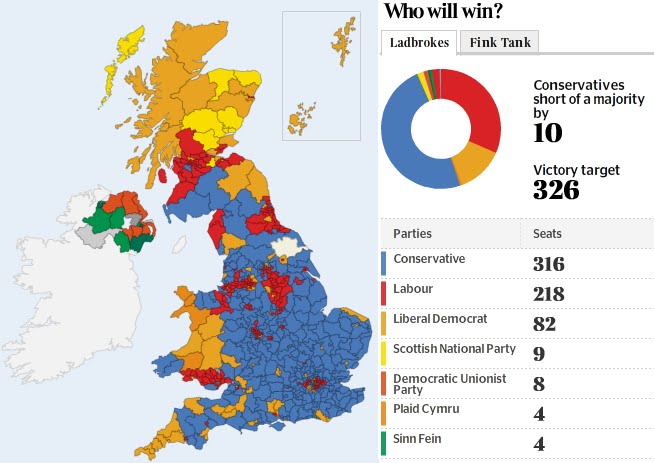
First, Ladbrokes has a very cool interactive map with rolling predictions. They’re currently predicting a hung Parliament, with the Tories short of a majority by 10 to 15 seats.
If I was a betting man, however, I’d rely more on the predictions made by FiveThirtyEight.com. They’ve been following the race more closely than I have (and probably closer than most Brits have) and they’ve developed a prediction model that finds the Tories could be short of a majority by more than 25 seats. They also find that Labour will be worse off than Ladbrokes does, and believe the Lib Dems will pick up 58 seats, rather than 20.
While these are by no means conservative estimates for the Conservatives (pun intended) FiveThirtyEight has an amazing track record when predicting election outcomes.
So what happens next?
I see two possible outcomes of this election. They both involve a hung Parliament.
1) The Conservative Party forms a minority Government. This is the view many in the UK are taking at the moment. If this happens, then Cameron will be on very shaky ground as Prime Minister. He will have a tougher time with Parliament, his own party, and the British people than President Obama is having with all the American equivalents.
2) The Labour Party forms a coalition government with the Liberal Democrats. Frankly, while these two parties don’t get along, they’re far more ideologically similar than either is with the Tories. Power sharing won’t be easy, but they may find it necessary. They may also want to court the Scottish Nationalist Party and Plaid Cymru (Welsh nationalists) for the coalition.
Either way, it’s been a fun and exciting election to observe, and I can’t wait for Thursday. Next week we’ll recap what happened and discuss what we’ll likely see in the coming weeks.
In the meantime, you might be wondering what party you’d support if you were British. The Daily Telegraph has a good online quiz to help you figure that out. Take a look!
Summary: A new poll predicts a slimmer swing to the Tories in Britain than previously expected.
I know we blogged about foreign elections yesterday, but the news from the United Kingdom this morning is worth mentioning. Back in January we noted how many in Britain had come to accept a Conservative Party victory in this year’s elections for Parliament. Now it’s more difficult to say what will happen.
It was recently revealed that a key Tory lord who will be bankrolling the party’s campaign operations has maintained a “non-dom” tax status (which allows him to forego taxes on international earnings) despite pledging to end it a decade ago. That’s creating problems for his party’s leader, David Cameron.
A new poll of the marginal constituencies (or “swing districts” as they would be called here) finds the Conservatives might be underperforming if they want to form the next government (or “majority” as we would say).
The poll shows that the switch of voters from Labour to the Tories is about 1.5 to 2 points higher in the battleground seats than nationally. That might be worth an extra 20 MPs to the Conservatives, smaller than many in the party would hope after the big spending on these targets. It might be enough only to take the Tories to the threshold of the 326 seats they need for a bare overall majority in the Commons.
Now, the poll excluded the Tories’ top 50 targeted seats - surveying the next 100 - as well as the seats they’re targeting that are currently held by Liberal Democrats. That might make a difference, but either way it’s all beginning to look a lot closer than expected.
If the swing implied by the poll occurred uniformly across the 100 seats, the Tories would gain 47, on the top of the first 50, to give them 97 Labour-held seats. Taking account of changed constituency boundaries, this would mean 307 Conservative MPs, up from a notional 210 at the last election (after adjusting for boundary changes). This would put them nearly 60 ahead of Labour.
While this poll is just in Tory/Labour marginals, the Tories would expect to gain a number of additional seats from the Lib Dems and other parties. They would need to gain at least an additional 15 to 20 seats for an overall majority of one in the new House of Commons.
In fact, an increasing number of Brits appear to be expecting a hung Parliament after the elections.
Basically, a hung Parliament is when no single party controls a majority of seats in the House of Commons. In these circumstances, two or more parties have to form a coalition government.
If the Conservatives fall short of a majority, they won’t necessarily be in too bad of shape. They’ll still be close to a majority, and could easily join with minor center-right parties such as the Democratic Unionists and Ulster Unionists from Northern Ireland. That would put them over the 326-seat threshold.
Labour, on the other hand, would be further behind. It would take more than the Scottish and Welsh national parties to help them form a coalition - they would need to consolidate with the Lib Dems in order to keep sitting on the government benches. Whether that would be possible or not is hard to say.
No matter what parties make up the government, it will be with a slim number of seats. It could certainly make for an interesting few years.
While the exact date of the elections is still unknown - the Labour government has still not called for them yet - they have to happen soon in order to stay within the constitutional rule of every-five-years. Most Brits are now guessing they will take place on May 6th.
Also, for a bit of fun, be sure to check out Sky News’s poll tracker. It can generate levels of support for each of the main three British parties as far back as 1983.
Summary: Conservatives expect to take down Labour in this year's UK elections - but can American poltiical consultants change the dynamic?
You can rest assured that we’ll be following this year’s midterm elections in the U.S. with a close eye. But we’ll also be following a very pivotal General Election in the United Kingdom, which could shift the balance of power in our close ally’s realm.
Lately, I noticed a strange increase in hits for this blog coming from London. I didn’t think much of it at first, until we received an email in press release form from a fellow campaign person.
Subject: The Independent (London) / Tory leader embraces "progressive" brand
David Cameron, the leader of the Conservative Party, is now leading [Prime Minister] Gordon Brown's Labour Party by 9% in the polls - in a nation with 3 major parties and some minor ones as well -- the current situation portends a disastrous predicament for Labour.
Cameron is a very articulate politician - so articulate that he has seized the 'progressive' brand and promised reforms that will include "incentives" -- ie. tax cuts or 'socialism' for the wealthy and the richest corporations.
In his 'progressive' statement, Cameron announces a law and order crackdown on drugs, alcohol and debtors along with the privatization of welfare and a massive expansion of the prison system as 'progressive' policies. Quite.
This very brief statement is a masterpiece of political rhetoric and propaganda.
He then added in Cameron’s statement to The Independent, a London newspaper.
David Cameron: Progressive Conservatism will mean a fairer, greener society
We will use the state to help remake society by encouraging people to take responsibility for themselves and for one another
Monday, January 4, 2010
If we win this year's election Britain will be under new economic management. We will send out the loudest signal that this country is back open for business and ready for investment. Decline is not inevitable. Confidence can return. If we take action now – to get a grip on the public finances and unleash enterprise – Britain can have a bright economic future. A strong economy gives us the foundation for a better life. But the mission that drives this party is building a stronger society.
We are progressive Conservatives. Our goal is a fairer, safer, greener country where opportunity is more equal. It's because we are progressives that we will protect the [National Health Service]. We recognise its special place in our society so we will improve it for everyone.
It's because we are progressives that we will support aspiration so that people from every background, not just the rich, have the chance to get on in life. A pupil premium that gives the poorest children the chance to go to the best state schools. Welfare reform that helps those in long-term poverty move into long-term employment. Strengthening families with practical and financial help to give parents time with their children and keep couples together. We will fight back against the root causes of deprivation – drug addiction, alcoholism, indebtedness, failing prisons.
It's because we are progressives that we will support responsibility and strong families so we help mend our broken society and tackle the crime and misery it brings. A decade of big government and blunt, bureaucratic control has undermined responsibility and made our social problems worse, not better.
We are determined to forge a new direction. We will use the state to help remake society by encouraging people to take responsibility for themselves and for one another. We will provide new opportunities for community groups, neighbourhood organisations, charities, social enterprises to help rebuild our civil society. We will create incentives and use the best technology to encourage and enable people to come together, solve their problems together, make this society stronger together.
As we do this we will redistribute power from the political elite to the man and woman in the street.
First let me address the rhetoric. It’s of no surprise to me that Cameron presents the Tories as “Progressive Conservatives” - progressive conservatism has been a sweeping force across Europe for a decade now. Leaders like French President Nicolas Sarkozy, German Chancellor Angela Merkel, and Italian Prime Minister Silvio Berlusconi all embody this sort of ideology.
And outside the individual countries, conservatives have been making electoral strides as well. The European Union Assembly is now dominated by a coalition of center-right parties. The UK’s Labour Party was especially upset following the EU election last June.
Conservatism itself doesn’t play well in Europe - few if any Europeans will tell you they respect the Republican Party of the U.S. But modern center-right parties like the Tories have done well to use the “progressive” brand. When I was in London a few years back, I remember non-affiliated young voters (the most progressive kind) telling me how David Cameron was a great man, and how he and his party were the best choice for Britain.
And the Conservative Party has gone beyond rhetoric and into image. British blogs frequently mention the way Cameron has tried to emulate President Obama (it’s somewhat easy, since they’re both young and articulate) and how the Tories’ website has been updated to look hip and optimistic, including the slogan “Year for Change”.
Of course, it’s all politics. Obama himself has reportedly called Cameron “a lightweight” and my guess is they’re not too interchangeable ideologically. But Obama has a strong resonance in Europe, and every politician wants to look like him.
And despite being a nearly all-white party, the Tories are doing it better than anyone.
Back to the London hits…
A quick query into why these Brits were reading our blog produced an interesting find: they were searching for American political consultants. We just happen to be American political consultants.
You see, the UK doesn’t have set elections. The government (i.e., the majority party) has to call for elections within 5 years of their last election. If they fail to do so, the Queen does it instead. The last election in the UK was in 2005, so everyone knows that there has to be one this year, although when it will be exactly no one's sure.
Keep in mind this is for all of Parliament (except for some of the Lords) - different from how Congress runs on just two-year cycles. Plus, local elections are often seen as meaningless and no one really works on them, except for some big Mayoral races. Almost all real policy work is done on the national level from Westminster.
From what I understand, because campaigning can only officially happen between the time the election is called and the date of the election they don't really have any professional campaigners - it's all organized by the parties.
Again, from what I’ve seen, party operatives place staffers from Parliament on the ground for those weeks to run campaigns. But because of the uncertainty in the system, there aren't many consultants because it's not as economically feasible to be one there.
As a result, American consultants are often brought in to work for the Tories, Labour, and other parties.
The reason 2010 will be a pivotal year for British politics is because few are actually expecting Labour to maintain control - most have resigned to accepting Cameron as the next Prime Minister. One only needs to see the downturn Labour has had on the electoral map to understand why.
Yet I believe a rush of American political consultants could help change the dynamic. Neither party in the UK has done an especially good job of expanding the electorate or appealing to new, young, and important untapped voters. Politics is rarely something to get excited about in Britain.
American politicos, however, have learned some important lessons on those fronts following the 2008 election of Barack Obama. The ongoing study of just how effectively that campaign built support, enthusiasm, and inevitably a movement demonstrates just how much campaigning matters.
And despite the glaring differences in electoral systems, British voters could be moved the same way Americans were with the proper input. We’re not saying Gordon Brown could easily present himself as the British Obama, but Labour will need to make a dramatic move towards an Obama-like campaign strategy if they really want to retain power.