
Today WAYLA reports on local politics from Wisconsin.
In 2008, Justice Louis Butler of the Wisconsin State Supreme Court was ousted because of an expensive campaign against him. One year earlier, the same happened to another candidate that was typically seen as liberal.
But the money and the controversial ads it produced was not coming from the campaign budgets of their conservative opponents, but rather from Wisconsin Manufacturers and Commerce (WMC), the premier business lobby in Wisconsin.
In 2009, Chief Justice Shirley Abrahamson - who has voted with Butler against WMC in the past - will be facing the conservative Jefferson County Judge Randy Koschnick. The only difference this year: WMC has promised to stay out of the race - as has the Club for Growth and the Coalition for American families.
Why is WMC shifting gears?
There are several reasons that might explain WMC's actions. First is the image they built with the ads they ran against Butler. The commercials which described the African-American Associate Justice as "Loophole Louie" used techniques that were seen as racist. FactCheck.org even compared it to the notorious Willy Horton ad. As a result, several businesses left WMC and others declared they would not do business with any of its members.
The second reason is the changing tides of campaign finance reform in Wisconsin. Many in the state now contend that judicial races ought to be publicly financed as to not let special interest groups buy court seats. Recent action taken on campaign finance reform - the new ban on contributions to state legislators during the budget proceedings - suggests that the winds are heading in that direction.
Others are suggesting pragmatic reasons - perhaps they felt Abrahamson was too strong or Koschnick was too weak for them to take a chance with their money.
Should we be skeptical of WMC?
The recent campaign finance reports filed for state races in Wisconsin shows Abrahamson ahead of Koschnick financially with a 56-to-1 advantage. Koschnick has raised less than $15,000 - well short of the nearly $4 million spent in favor of Judge Michael Gableman (Butler's opponent) last year.
It is unlikely that he would raise so little without expecting some outside support.
A few potential support sources would be All Children Matter (a conservative interest group from Michigan that spent $900,000 against Wisconsin Democrats last year) and the Wisconsin Institute for Leadership.
It is not inconceivable that WMC could spend money through these groups or others for the Supreme Court race.
Abrahamson will face Koschnick on April 7th.
Thursday, February 5, 2009


Wednesday, February 4, 2009
Going Solar with Un-Tied Shoelaces
Today WAYLA reports on local politics from Los Angeles.
On March 3rd residents of Los Angeles will use their Californian tradition of direct democracy to decide whether or not to boost solar energy for the city’s electricity consumption.

Measure B was originally proposed by the leadership of the International Brotherhood of Electrical Workers (IBEW) Local 13 due to fears that the city’s green energy plan was not moving along effectively. Under the measure, the solar panels would be owned by the union, installed for residents who wished to participate, and the city would provide initial financing as well as rebate programs to help residents afford the technology.
Yet the proposal has come under fire in recent days because David Nahai - head of the Department of Water and Power - was unable to provide the City Council with cost estimates. He will be delivering his report later this month - about four months after he urged the Council to place the measure on the ballot.
In addition to the IBEW, Measure B is supported by a large number of groups including the LA League of Conservation Voters as well as Mayor Antonio Villaraigosa.
Some on the Council are afraid they voted for it too quickly. "For some reason, they decided to wait until the last minute to take it to the council, probably because they thought they could slip it through without the facts, which they did," said Councilman Greig Smith, who now opposes the measure.
And the Los Angeles Times has turned critical to the way the issue was handled. This is what they said in a recent editorial:
In fact, it is not too uncommon that proposals are put to voters without a detailed analysis of the plan (especially in California - see Proposition 13) but it is especially detrimental when it becomes an issue that can derail a campaign. The nature of this new criticism makes Measure B seem unfit to support - not because it is a bad proposal, but because of procedure.
In this way, the Mayor and the City Council pursued a boost to solar energy like a child running through a hallway without his shoelaces tied. We’ll have to wait and see whether or not he trips.
On March 3rd residents of Los Angeles will use their Californian tradition of direct democracy to decide whether or not to boost solar energy for the city’s electricity consumption.

Measure B was originally proposed by the leadership of the International Brotherhood of Electrical Workers (IBEW) Local 13 due to fears that the city’s green energy plan was not moving along effectively. Under the measure, the solar panels would be owned by the union, installed for residents who wished to participate, and the city would provide initial financing as well as rebate programs to help residents afford the technology.
Yet the proposal has come under fire in recent days because David Nahai - head of the Department of Water and Power - was unable to provide the City Council with cost estimates. He will be delivering his report later this month - about four months after he urged the Council to place the measure on the ballot.
“Because the plan changed repeatedly until Nov. 7, the day the council put it on the ballot, there was no way to prepare an accurate analysis, Nahai said. ‘A fiscal analysis would have been meaningless had we done it before’ the final draft was adopted, he added. ‘What would we have analyzed?’
“Nahai has already had to contend with an unfavorable, if preliminary, analysis of the solar plan prepared by P.A. Consulting, a firm that expressed doubts about the DWP's ability to install so many new solar panels and obtain $1.5 billion in federal tax credits to pay for them.”
In addition to the IBEW, Measure B is supported by a large number of groups including the LA League of Conservation Voters as well as Mayor Antonio Villaraigosa.
Some on the Council are afraid they voted for it too quickly. "For some reason, they decided to wait until the last minute to take it to the council, probably because they thought they could slip it through without the facts, which they did," said Councilman Greig Smith, who now opposes the measure.
And the Los Angeles Times has turned critical to the way the issue was handled. This is what they said in a recent editorial:
"We remain open to the idea that this ballot measure may be the best way to get [smart solar power as an integral part of the city's green energy strategy]. But the process seems designed to get voters to sign off on a plan without sufficient knowledge of it, and it is undermining a broader discussion of solar power in Los Angeles. There is a point at which process gets so bad that it outweighs substance, no matter how good that substance may be. We're rapidly approaching that point."
In fact, it is not too uncommon that proposals are put to voters without a detailed analysis of the plan (especially in California - see Proposition 13) but it is especially detrimental when it becomes an issue that can derail a campaign. The nature of this new criticism makes Measure B seem unfit to support - not because it is a bad proposal, but because of procedure.
In this way, the Mayor and the City Council pursued a boost to solar energy like a child running through a hallway without his shoelaces tied. We’ll have to wait and see whether or not he trips.
Tuesday, February 3, 2009
Blagojevich Goes Out as Classy as Blagojevich Could
It's Tuesday, February 3, 2009. Here's what we're looking at:
Sen. Judd Gregg (R-NH) will be the next Secretary of Commerce after his Democratic governor, John Lynch, agreed to replace him with a Republican. The replacement will be the moderate Bonnie Newman. While Obama may have tried to squeeze out the filibuster, the Democrats have only two years before they can target the New Hampshire senate race.
The American Heart Association sounds pretty concerned about the stimulus bill, arguing that the language could dissuade schools from building athletic facilities. Thus, they say, the package might be encouraging childhood obesity.
Tom Daschle has withdrawn from his HHS nomination. Hours earlier, Obama's pick for Chief Performance Officer (a new position) withdrew because of her own tax problems.
The Department of Justice has rehired Leslie Hagen, an attorney removed during the Bush Administration due to rumors that she was a lesbian.
Finally, the New York Times gives a good account of Blagojevich spending his finals hours in office. He told employees "We should have been more selfish, not selfless" (yes you're reading that right), that his successor "has done a whole bunch as the lieutenant governor — taken all kinds of trips all over the world and trade missions — like he's got anything to do with anything as lieutenant governor" and that he always thinks "creatively", saying "I don't give up".
Monday, February 2, 2009
Short of Cash in South Carolina
Today WAYLA reports on local politics from South Carolina.
The hard economic times facing the nation are especially hard in South Carolina, where the recession has hit yet another industry - campaign politics.
According to an article in The State yesterday, campaigns and fundraising consultants throughout South Carolina are finding it especially difficult to raise money in the current economic environment. It may even make the campaign timelines there shorter.
Techniques such as small frequent donations and payment plans aren't working. Many frequent contributors are still tapped out from the last election cycle, and the recession is not helping them regenerate.
In part, the Palmetto State is getting hit by the recession harder than most places. South Carolina now has the third highest unemployment rate in the country at 9.5% - the national rate is 7.2%. State budget difficulties convinced the State Senate to work only once a week this week in order to "cut back" as they claim.
Yet this is particularly scary for those of us who work in campaign politics - for we have always felt this was a safe industry given that politics doesn't stop with a recession. Perhaps South Carolina is only the first to see such a trend. After all, President Obama has said it will get worse before it gets better.
In other unfortunate news (for those of us in the North) the Groundhog did see his shadow today - which means six more weeks of winter. Nonetheless, happy Groundhog Day.
The hard economic times facing the nation are especially hard in South Carolina, where the recession has hit yet another industry - campaign politics.
According to an article in The State yesterday, campaigns and fundraising consultants throughout South Carolina are finding it especially difficult to raise money in the current economic environment. It may even make the campaign timelines there shorter.
Techniques such as small frequent donations and payment plans aren't working. Many frequent contributors are still tapped out from the last election cycle, and the recession is not helping them regenerate.
In part, the Palmetto State is getting hit by the recession harder than most places. South Carolina now has the third highest unemployment rate in the country at 9.5% - the national rate is 7.2%. State budget difficulties convinced the State Senate to work only once a week this week in order to "cut back" as they claim.
Yet this is particularly scary for those of us who work in campaign politics - for we have always felt this was a safe industry given that politics doesn't stop with a recession. Perhaps South Carolina is only the first to see such a trend. After all, President Obama has said it will get worse before it gets better.
In other unfortunate news (for those of us in the North) the Groundhog did see his shadow today - which means six more weeks of winter. Nonetheless, happy Groundhog Day.
Friday, January 30, 2009
What’s the Story with Rush?
It’s Friday, January 30, 2008, and a very busy day. Here’s what we’re looking at:
Rush Limbaugh somehow convinced every House Republican to vote against Obama’s stimulus bill. One blogger writes “Is Rush Limbaugh the de facto leader of the GOP?” With the bill facing the Senate now, Americans United for Change are asking constituents of Republican Senators “Is (senator) with Obama or Rush?”
With a Special Election coming up fast, one candidate to replace Rahm gets a little...can we say fishy?
Senate Minority Leader Mitch McConnell lays down some ideas for a reemergence of the GOP. He is particularly concerned with the Republicans becoming a regional party based solely in the South.
Governor Rod Blagojevich has been removed from office with a unanimous vote by the Illinois State Senate. Lt. Gov. Patrick Quinn has already signed the oath of office.
SCHIP expansion has passed in the Senate. It wasn’t the first bill Obama signed but it could be in the first five.
Finally, President Obama tells reporters who he will be supporting in the Super Bowl on Sunday.
Need something to do this weekend before the Super Bowl? Why not play in the “Can You Find Your Congressperson?” Contest!
Rush Limbaugh somehow convinced every House Republican to vote against Obama’s stimulus bill. One blogger writes “Is Rush Limbaugh the de facto leader of the GOP?” With the bill facing the Senate now, Americans United for Change are asking constituents of Republican Senators “Is (senator) with Obama or Rush?”
With a Special Election coming up fast, one candidate to replace Rahm gets a little...can we say fishy?
Senate Minority Leader Mitch McConnell lays down some ideas for a reemergence of the GOP. He is particularly concerned with the Republicans becoming a regional party based solely in the South.
Governor Rod Blagojevich has been removed from office with a unanimous vote by the Illinois State Senate. Lt. Gov. Patrick Quinn has already signed the oath of office.
SCHIP expansion has passed in the Senate. It wasn’t the first bill Obama signed but it could be in the first five.
Finally, President Obama tells reporters who he will be supporting in the Super Bowl on Sunday.
Need something to do this weekend before the Super Bowl? Why not play in the “Can You Find Your Congressperson?” Contest!
Thursday, January 29, 2009
Introducing the "Can You Find Your Congressperson?" Contest!
For a little fun, we thought we would give you an opportunity to show off your political humor by introducing a contest to find your House Representative from the giant Inauguration photo and add an “insightful” (i.e. amusing) caption.
The winner - who we will choose at our discretion - will win a copy of Team of Rivals by Doris Kearns-Goodwin. The book has drawn a lot of attention because President Barack Obama (it is thought) has modeled his administration around similar principles of the Lincoln Administration.
The winner will be announced on the blog in a post on Monday, February 9th. We will also be sure to post as many entries as we can.
Here’s how to play:
First click on the “Terrific Inauguration Photo” link under the “This is what we’re looking at” column to your right.
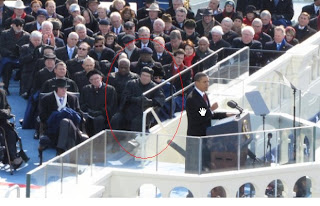
Scan through the Inauguration photo until you find your Representative. If your Congressperson wasn't present pick your favorite Representative instead. To give you an idea of what to do next, follow the example below (we will use Associate Justice Antonin Scalia as our model).
Step 1: Find your target.
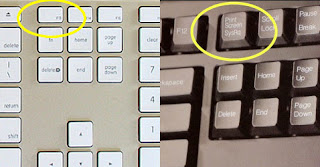
Step 2: Perform a “Print Screen” function by pressing the appropriate key on your keypad.
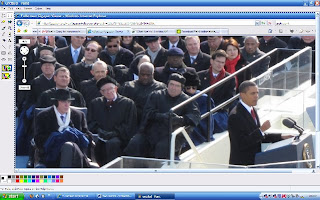
Step 3: Paste the image into Microsoft Paint, Apple Paint, or another appropriate program.
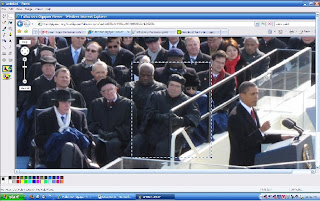
Step 4: Crop your zoomed-in image of your Congressperson and copy (ctrl C) and paste (ctrl V) the new image into a new file. After redrawing the boundaries, save the file and you have your picture!
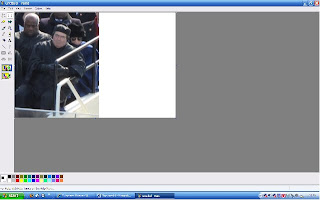
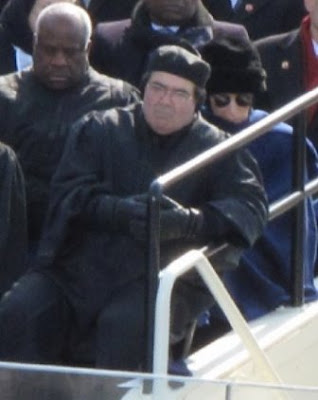
Step 5: Come up with a clever or otherwise humorous caption. (For this picture we would say something like: “Justice Antonin Scalia and his clothing from the late 1400s”)
Then email your picture and caption to Katy@HogensenStrategies.com. Don't forget to identify the Congressperson by name, district, and party!
Good Luck!
The winner - who we will choose at our discretion - will win a copy of Team of Rivals by Doris Kearns-Goodwin. The book has drawn a lot of attention because President Barack Obama (it is thought) has modeled his administration around similar principles of the Lincoln Administration.
The winner will be announced on the blog in a post on Monday, February 9th. We will also be sure to post as many entries as we can.
Here’s how to play:
First click on the “Terrific Inauguration Photo” link under the “This is what we’re looking at” column to your right.
Scan through the Inauguration photo until you find your Representative. If your Congressperson wasn't present pick your favorite Representative instead. To give you an idea of what to do next, follow the example below (we will use Associate Justice Antonin Scalia as our model).
Step 1: Find your target.

Step 2: Perform a “Print Screen” function by pressing the appropriate key on your keypad.

Step 3: Paste the image into Microsoft Paint, Apple Paint, or another appropriate program.

Step 4: Crop your zoomed-in image of your Congressperson and copy (ctrl C) and paste (ctrl V) the new image into a new file. After redrawing the boundaries, save the file and you have your picture!


Step 5: Come up with a clever or otherwise humorous caption. (For this picture we would say something like: “Justice Antonin Scalia and his clothing from the late 1400s”)
Then email your picture and caption to Katy@HogensenStrategies.com. Don't forget to identify the Congressperson by name, district, and party!
Good Luck!
Wednesday, January 28, 2009
How Does Bloomberg Plan to Win?
Today WAYLA reports on local politics from New York City.
The mayoral race in the Big Apple is heating up. Incumbent Michael Bloomberg has hired several Democratic consultants and strategists for his re-election bid this year.
Not only will this help his campaign terms of strategy and effectiveness, but it is also taking these consultants off the market for his two challengers - Rep. Anthony Weiner and City Comptroller Bill Thompson.
Political professionals he has hired so far include:
Bradley Tusk: Now installed as the mayor's campaign manager, he worked as a spokesman for Chuck Schumer and then became a top aide to the mayor during the first Bloomberg term.
Howard Wolfson: Another distinguished Schumer alumnus, his Democratic credentials are impeccable: Hillary Clinton, the Democratic Congressional Campaign Committee, New York's Democratic Party.
Josh Isay: He's yet another Schumer guy, and a founding partner of Knickerbocker SKD and partner at Squier Knapp Dunn Communications, which did print, radio and television ads for Bloomberg's 2005 mayoral campaign.
Basil Smikle: Just a few months ago, this former Hillary Clinton aide was working for Mr. Weiner. Now, the AP reports, he's signed on with the incumbent.
Hank Sheinkopf: The colorful and unflinching operative who was the general consultant on Bill Thompson's 2001 citywide campaign for comptroller is not signing on for Mr. Thompson's 2009 mayoral campaign. Now he's on the mayor's campaign payroll.
Doug Schoen: A founding partner in the firm that helped define its most famous client, Bill Clinton, Mr. Schoen has worked on both of Mr. Bloomberg's previous campaigns.
Ken Strasma: A number cruncher who worked on Barack Obama's presidential campaign, he will focus on analyzing poll numbers and targeting a message to a niche audience.
Maura Keaney: A top aide to City Council Speaker Christine Quinn, she did field operations for the mayor's reelection campaign in 2005 and is returning this year in a similar role. Ms. Keaney is married to Democratic consultant Mark Guma, who worked on the mayoral campaign of Alan Hevesi in 2001.
Patrick Brennan: He's a former staffer in the Community Assistance Unit who traveled to various states to lay the groundwork for Mr. Bloomberg's much-discussed hypothetical presidential race. He left City Hall to work at the Parkside Group.
Larry Scott Blackmon: He just left his job as chief of staff and deputy commissioner for intergovernmental affairs at the city's Small Business Services Department to lead the campaign's outreach to black voters.
Neil Giacobbi: A former chief of staff to Democratic City Councilman David Yassky of Brooklyn and aide to Deputy Mayor Kevin Sheekey, Mr. Giacobbi, 35, helped organize the Republican National Convention in 2004.
Micah Lasher: He's not yet 30, but Mr. Lasher is among the most capable political operators in the city. He worked for Mark Green's mayoral campaign in 2001 and worked until 2007 with Mr. Isay at Knickerbocker. He just left his most recent job, as an aide to Representative Jerry Nadler, to work for the city's Department of Education. Which would seem to rule out a role on any Democratic mayoral campaign against his new boss.
Mayor Bloomberg has one advantage over the other candidates in buying up consultants and operatives: a virtually unlimited amount of cash. The billionaire mayor spent tens of millions of dollars on his last campaign, and is expected to spend plenty again this time around.
"He could just about put every consultant in the country on retainer," said consultant Jerry Skurnik.
But there is more. Ever since Bloomberg pushed for abolishing term limits last year - and signing a City Council bill to do so in November - he has been allowed to enjoy the power of incumbency. A new Quinnipiac poll shows the mayor has a 15% advantage over both of his opponents.
"Term limits? We love them and we want them back - after we re-elect Bloomberg," is how Quinnipiac pollster Mickey Carroll interpreted the numbers.
In fact, challengers city-wide (especially in the Bronx and Brooklyn) have been trying to use the term-limit issue to attack their opponents who would otherwise be leaving office. Because they did not expect to be challengers, many of these candidates are having unforeseen difficulty with their campaigns due to the changed layout of the city elections scene. But so far this argument is not working.
Weiner and Thompson are no different.
So Bloomberg is planning to win on two fronts: riding on his popularity (which overcomes concerns about term-limits) and buying up as many political consultants and operatives as he can - not just to assemble a crack team for his re-election, but to keep them from working for the opposition.
Tuesday, January 27, 2009
The Rush to Replace Rahm
Today WAYLA reports on local politics from Chicago.
The first and foremost news of interest in the state of Illinois this week is the Senate impeachment trial of Gov. Rod Blagojevich. Despite his recent media blitz, it is unlikely he will fare well in the Illinois State Senate.
However, with spring elections coming up, many in the Chicago area are paying close attention to the race for White House Chief of Staff Rahm Emanuel's replacement in the U.S. House of Representatives.
A humorous story that has developed recently is about a forum for the several candidates vying to replace the hyper-political Chicago statesman. The Democratic Party for the 43rd Ward in Chicago set the forum date for February 1st in order to allow the candidates the time they need under such a short campaign timeline.
The only problem is that February 1st is Super Bowl Sunday.
Of course, the forum is scheduled to end by 3:00 PM, giving attendees plenty of time to get home before kickoff (5:20 PM CST). Yet the Super Bowl has become more than the game in recent years - it has become a holiday for many, and the forum date is unfortunate.
Smith acknowledges she is not a big sports fan. As quoted by the Chicago Reader, she said "I don't know who's in the Super Bowl this year - New England, are they in it?"
However, this demonstrates the difficulty of spring races. Candidates are expected to work under a much quicker timeline to secure the votes they need - and typically in an environment in which very few voters are as engaged in politics. Even for a federal seat.
That being said, the only thing that WE'LL be looking at on February 1st is the television screen…though perhaps we'll glance at the nachos we're simultaneously eating.
The first and foremost news of interest in the state of Illinois this week is the Senate impeachment trial of Gov. Rod Blagojevich. Despite his recent media blitz, it is unlikely he will fare well in the Illinois State Senate.
However, with spring elections coming up, many in the Chicago area are paying close attention to the race for White House Chief of Staff Rahm Emanuel's replacement in the U.S. House of Representatives.
A humorous story that has developed recently is about a forum for the several candidates vying to replace the hyper-political Chicago statesman. The Democratic Party for the 43rd Ward in Chicago set the forum date for February 1st in order to allow the candidates the time they need under such a short campaign timeline.
The only problem is that February 1st is Super Bowl Sunday.
"As 43rd Ward committeeman Michele Smith explains, they didn't really have much choice. The special election's been on an expedited schedule … [Emanuel] officially stepped down to become President Obama's chief of staff earlier this month. The deadline for filing nominating petitions was January 19. The election is March 3. From start to finish the whole thing's over in a blink.
"'I realize there are better days to have a forum,' says Smith. 'But there really weren't a lot of days to choose from.'"
Of course, the forum is scheduled to end by 3:00 PM, giving attendees plenty of time to get home before kickoff (5:20 PM CST). Yet the Super Bowl has become more than the game in recent years - it has become a holiday for many, and the forum date is unfortunate.
Smith acknowledges she is not a big sports fan. As quoted by the Chicago Reader, she said "I don't know who's in the Super Bowl this year - New England, are they in it?"
However, this demonstrates the difficulty of spring races. Candidates are expected to work under a much quicker timeline to secure the votes they need - and typically in an environment in which very few voters are as engaged in politics. Even for a federal seat.
That being said, the only thing that WE'LL be looking at on February 1st is the television screen…though perhaps we'll glance at the nachos we're simultaneously eating.
Monday, January 26, 2009
Tracking the Races this Spring
In the beginning of the year we promised we would bring you coverage of local issues and campaigns from across the country as the nation gears up for local elections.
Some places we will be following will be Milwaukee, Chicago, New York City, Los Angeles, Washington DC, Virginia, Louisiana, and South Carolina. We will dive into the campaigns for races pertaining to the courts, school boards, city councils, etc.
For those of you concerned about national coverage, we will continue to devote a day per week (usually Friday) to covering a topic of national concern - such as an important strategic move in Congress, by the new President, or the national parties.
As Tip O'Neill said, "All politics is local." It is with this important concept in mind that we bring you the true ground game of American politics.
Some places we will be following will be Milwaukee, Chicago, New York City, Los Angeles, Washington DC, Virginia, Louisiana, and South Carolina. We will dive into the campaigns for races pertaining to the courts, school boards, city councils, etc.
For those of you concerned about national coverage, we will continue to devote a day per week (usually Friday) to covering a topic of national concern - such as an important strategic move in Congress, by the new President, or the national parties.
As Tip O'Neill said, "All politics is local." It is with this important concept in mind that we bring you the true ground game of American politics.
Sunday, January 25, 2009
Plenty of Somber Sunday News
It’s Sunday, January 25 - Here is what we’re looking at:
After an executive order was signed this week to close the prisons at Guantanamo Bay, national security officials have discovered that the case files for detainees are in disarray -at least the ones that exist at all.
In what are perhaps futile attempts to save his image, Gov. Rod Blagojevich (D-IL) is appearing on several television morning talk shows. This morning on the Today Show, he compared himself to Nelson Mandela, Martin Luther King, Jr., and Mahatma Gandhi.
President Obama’s chief economic advisor Larry Summers and House Minority Leader John Boehner (R-OH) make their cases for and against the stimulus package (respectively) on Meet the Press.
After an executive order was signed this week to close the prisons at Guantanamo Bay, national security officials have discovered that the case files for detainees are in disarray -at least the ones that exist at all.
In what are perhaps futile attempts to save his image, Gov. Rod Blagojevich (D-IL) is appearing on several television morning talk shows. This morning on the Today Show, he compared himself to Nelson Mandela, Martin Luther King, Jr., and Mahatma Gandhi.
President Obama’s chief economic advisor Larry Summers and House Minority Leader John Boehner (R-OH) make their cases for and against the stimulus package (respectively) on Meet the Press.
Visit msnbc.com for Breaking News, World News, and News about the Economy
Friday, January 23, 2009
Race in the RNC Race
According to a recent article on Politico.com, the race for Republican National Committee Chair is heating up - and race has become the number one issue.
"[Race is] where we got killed in the presidential [campaign]," said Illinois RNC Committeeman Pat Brady. As a result, the GOP is moving strongly in a direction to court back some minority voters.
Racial symbolism is where Republicans believed they lost in 2008 - succeeding with a dismal 4% of the black vote against an African-American Democrat. A black Chairman of the RNC, they hope, will help correct this.
The two big African-American contenders are former Ohio Secretary of State Ken Blackwell and former Maryland Lt. Governor Michael Steele. The other four are trying hard to define themselves as minority-friendly leaders.
One strong RNC candidate - South Carolina GOP Chairman Katon Dawson - has even had to downplay his southern party-base credentials to appeal to RNC members concerned about racial symbolism.
So far he has come under some major fire.
"And more recently, his opponents have sought to damage his candidacy by circulating information about remarks he made at the University of South Carolina in 2003. In his comments at a seminar there, Dawson described his entry into politics as a reaction against 1960s-era school busing policies, telling students: 'Government reached into my life and grabbed me and shook me at the age of 15.'
"Dawson dismissed the latest wave of below-the-radar attacks as 'slash-and-burn politics.'"
Dawson supporters have tried to counter that with his actual African-American support. "There are three African-Americans on the national committee, and two of them are supporting Katon" according to one.
Will reshaping the Republican identity around racial symbolism reboost the GOP?
Doubtful.
Not only will President Barack Obama be a much more visible political figure than the Chairman of the RNC, but the GOP has a history of antagonism to minority progress. In years past it has been mounting an ideology of social conservativism in response to desegregation and (more recently) immigration. In recent years it has also been the GOP's neo-conservative ideology hindering the alleviation of urban poverty.
If this will indeed be the direction of the Republican Party, then two things will happen. One, the party will quickly learn that symbolism is not what minority Americans are looking for in politics - they are looking for real progress. Two, the GOP will significantly turn off its traditional white populist base and (like they did in 2008 with immigration-reform-supportive Sen. John McCain) fail to bring these individuals to the polls.
We have already said the GOP is in serious trouble on the national scene. This current path will only accelerate their current and future difficulties.
Thursday, January 22, 2009
Obama and the First 100 Days
Since the Presidency of Franklin D. Roosevelt, Americans have sought to judge their Commander-in-Chief by the number of important actions he takes within his first 100 days in office.
So what can we expect from President Barack Obama?
Actions Taken Already
Within hours of the new President taking the oath of office, the White House made their intentions to close the prisons at Guantanamo Bay clear. The military tribunals ceased yesterday and today President Obama has signed an executive order to close the prisons (within a year) and stop tribunals at "Gitmo", along with another executive order to ban the use of torture.
In addition, Obama signed a third executive order prohibiting lobbyists to work for the White House in a role which they once lobbied and denies his staff from lobbying the White House after they leave public office
Economic Stimulus
The most pressing issue President Obama will seek to act on is the weakening economy. After the confirmation of Treasury Secretary Tim Giethner, prospects for a stimulus package look brighter.
"We have to do everything in our power and Congress does too to get that package moving, to get that money into the economy ... to give the American people some confidence going forward," said White House Press Secretary Robert Gibbs at the first White House Press Conference of the Obama Administration.
Many expect an economic stimulus bill to be on the President's desk early next month.
Open Government Directive
The new President said today that he has asked his senior aides to draft an "Open Government Directive" with specific actions to be implemented in order to increase government transparency. He is giving them no more than 120 days.
Backburner Democratic Legislation
For years the Democrats in Congress have tried to pass several pieces of legislation, but have either been blocked by filibuster or denied by a Bush veto. Now with a nearly filibuster-proof Senate and more progressive President, they are ready to make these bills law.
SCHIP expansion passed the House yesterday with overwhelming approval. The Senate will now take it up within the next few days. As one of the principle pieces of legislation that Democrats have hoped to pass, this can be expected as among the first President Obama will sign.
The Lilly Ledbetter Bill to grant pay equity to women also passed the House yesterday and will also soon come before the Senate. Obama is expected to sign this into law as well.
The Employee Free Choice Act may not be signed within 100 days - but it will certainly be law soon. Obama has stood by the bill previously and the unions will be sure to pressure Congress to pass the card check legislation as soon as they can.
Other bills that Obama has vowed to support - particularly gay-rights legislation such as the Employee Non-Discrimination Act and expansion of what constitutes a hate crime - will probably stay on the backburner for a little while longer due to their controversial outlook in Congress. Nonetheless, we would expect them to be signed in this term.
In the end, the number of actions taken in the first 100 hours does not typically define a Presidency - and it would not be prudent to judge Obama by his first 100 days at this point in history.
But by the actions he has already taken and the decisions we expect to see him make soon, he is making it fairly obvious that the tides have changed.
So what can we expect from President Barack Obama?
Actions Taken Already
Within hours of the new President taking the oath of office, the White House made their intentions to close the prisons at Guantanamo Bay clear. The military tribunals ceased yesterday and today President Obama has signed an executive order to close the prisons (within a year) and stop tribunals at "Gitmo", along with another executive order to ban the use of torture.
In addition, Obama signed a third executive order prohibiting lobbyists to work for the White House in a role which they once lobbied and denies his staff from lobbying the White House after they leave public office
Economic Stimulus
The most pressing issue President Obama will seek to act on is the weakening economy. After the confirmation of Treasury Secretary Tim Giethner, prospects for a stimulus package look brighter.
"We have to do everything in our power and Congress does too to get that package moving, to get that money into the economy ... to give the American people some confidence going forward," said White House Press Secretary Robert Gibbs at the first White House Press Conference of the Obama Administration.
Many expect an economic stimulus bill to be on the President's desk early next month.
Open Government Directive
The new President said today that he has asked his senior aides to draft an "Open Government Directive" with specific actions to be implemented in order to increase government transparency. He is giving them no more than 120 days.
Backburner Democratic Legislation
For years the Democrats in Congress have tried to pass several pieces of legislation, but have either been blocked by filibuster or denied by a Bush veto. Now with a nearly filibuster-proof Senate and more progressive President, they are ready to make these bills law.
SCHIP expansion passed the House yesterday with overwhelming approval. The Senate will now take it up within the next few days. As one of the principle pieces of legislation that Democrats have hoped to pass, this can be expected as among the first President Obama will sign.
The Lilly Ledbetter Bill to grant pay equity to women also passed the House yesterday and will also soon come before the Senate. Obama is expected to sign this into law as well.
The Employee Free Choice Act may not be signed within 100 days - but it will certainly be law soon. Obama has stood by the bill previously and the unions will be sure to pressure Congress to pass the card check legislation as soon as they can.
Other bills that Obama has vowed to support - particularly gay-rights legislation such as the Employee Non-Discrimination Act and expansion of what constitutes a hate crime - will probably stay on the backburner for a little while longer due to their controversial outlook in Congress. Nonetheless, we would expect them to be signed in this term.
In the end, the number of actions taken in the first 100 hours does not typically define a Presidency - and it would not be prudent to judge Obama by his first 100 days at this point in history.
But by the actions he has already taken and the decisions we expect to see him make soon, he is making it fairly obvious that the tides have changed.
Tuesday, January 20, 2009
Happy Inauguration Day
Today we conclude our series on Why Obama Won. We have seen many good points made, and are grateful to our panelists.
Some thought the victory was due to the poor strategy of John McCain - others believed it was the good strategy put together by Plouffe and Axelrod. Some pointed out Obama’s strength with the youth vote - some said that Americans simply weren’t going to elect another Republican after Bush.
A few were right to point out the unique spirit of this particular campaign - built more on hope than any previous presidential campaign in memory.
Yet every panelist agreed that there were indeed a great many factors involved in this historic victory. Demographics shifting came just in time for an inspiring candidate with a team of genius campaign strategists, as well as the collapse of the financial market and a careless opposition - it all created the perfect storm for an Obama win.
There will be a lot to learn about this particular election cycle in the years to come - 2008 was an incredible year for the study of campaign politics.
Yet today we will honor the man rather than the accomplishment, and soak up the spirit of this Inauguration.
In the words of our friend, Sherwin Hughes, God bless our new President and God bless America.
Some thought the victory was due to the poor strategy of John McCain - others believed it was the good strategy put together by Plouffe and Axelrod. Some pointed out Obama’s strength with the youth vote - some said that Americans simply weren’t going to elect another Republican after Bush.
A few were right to point out the unique spirit of this particular campaign - built more on hope than any previous presidential campaign in memory.
Yet every panelist agreed that there were indeed a great many factors involved in this historic victory. Demographics shifting came just in time for an inspiring candidate with a team of genius campaign strategists, as well as the collapse of the financial market and a careless opposition - it all created the perfect storm for an Obama win.
There will be a lot to learn about this particular election cycle in the years to come - 2008 was an incredible year for the study of campaign politics.
Yet today we will honor the man rather than the accomplishment, and soak up the spirit of this Inauguration.
In the words of our friend, Sherwin Hughes, God bless our new President and God bless America.
Monday, January 19, 2009
Some Optimism on MLK Day
Dr. Martin Luther King, Jr. delivered his immortal “I Have a Dream” speech over 45 years ago. Since then he has come to represent the heart of the Civil Rights Movement, he has been properly lionized by blacks and whites alike, and is even remembered once a year with a celebration of his birthday.
And every year on this day the nation looks itself in the mirror as millions of citizens continue to ask “has his dream yet come true?”
Even after 45 years, after some time of thought on the subject, the answer usually comes out “No - it’s closer - but still unrealized.”
There are plenty of good reasons for such conclusions. For decades now, studies have shown that Americans are pessimistic about race relations. Even after President Clinton made the giant leap to direct Americans to talk about the state of race relations, these studies have demonstrated that most citizens are typically uncomfortable talking about what still needs to be done to achieve the Dream.
Until recently.
According to a recent article in the New York Times, President-Elect Barack Obama has been “an omnipresent icebreaker” in what psychologists call “interracial anxiety”.
"Cross-racial discussion about the topic of race seems to have become more common, and somewhat less fraught, with the rise of Mr. Obama, according to historians, psychologists, sociologists and other experts on race relations, as well as a number of blacks and whites interviewed around the country.
"‘All this exposure to this very counter-stereotypical African-American has actually changed — at least temporarily — what is on the tip of the tongue,’ said E. Ashby Plant, a psychologist at Florida State University and an author of a new study examining the impact of Mr. Obama on the attitudes of whites. ‘It may have very important implications.’
"…The unpublished study found that the answers revealed little evidence of anti-black bias, in sharp contrast to many earlier studies (including one by Dr. Plant) showing that roughly 80 percent of whites have some degree of bias."
According to one individual the Times interviewed “there’s a more readily accessible conduit into the conversation about race if it begins with Barack Obama.”
But Barack Obama alone is obviously not the cure-all to the poor state of race relations in the United States. Obama himself said in a speech last year that it was naïve to think “we can get beyond our racial divisions in a single election cycle, or with a single candidacy… [race relations are something in America] that we’ve never really worked through”.
And he’s right. A recent poll shows that while only 34% of whites believe that race relations in America are bad, over 60% of blacks agree.
Furthermore, psychologists are showing the new tensions among people of different skin colors. “Strategic colorblindness”, for example, is a way that whites try not to seem racist by going to great lengths to pretend they don’t even recognize race as a factor in their relationships (see Stephen Colbert). Furthermore, two studies showed that African-Americans often view this tactic as prejudice.
And of course, there is the socio-economics: roughly a quarter of minority individuals in the United States live below the poverty line - compared to less than 10% of whites.
Despite these shortcomings, however, optimism that King’s Dream will come true is at an all time high.
"Polls have captured increasing optimism among Americans about the future of race relations. The day after Mr. Obama was elected, a Gallup poll found that 67 percent of Americans believed a solution to black-white racial problems would eventually be worked out. Gallup said that it had been asking the same question for four decades, and that a poll last summer also reflected substantially more optimism than previously."
So while the Dream may not yet be a reality, these recent studies and polls do give us hope - as did the man who will take the oath of office as the first African-American President tomorrow, as well as the man whose birthday we celebrate today.
Happy Martin Luther King, Jr. Day.
Sunday, January 18, 2009
Why Obama Won - By Dan Weinberg
One answer is that Hillary Clinton dropped out and she gave all her voters over to Obama. People who thought in 2007 that Obama 'wasn't Black enough' changed their tune once Clinton dropped out.
Another reason Obama won was that in states like Indiana voters who hadn't voted in years or had voted Republican evolved into voters for Obama. The Democratic get-out-the-vote effort in Indiana was a huge factor.
Another reason that Obama won was that his rhetoric sped light years beyond what McCain could offer. Speeches and economic analysis that were intelligent, comfortable, and realistic gave Obama a push to the final prize.
The last reason that Barack Obama won is that he wanted it more. From his kindergarten essay to the November 2008 election he was like an eagle at the top of the food chain. Obama had his eyes on the White House for a long time.
Do you agree or disagree with Dan? Be sure to leave a comment!
Dan Weinberg is a librarian at Gary Public Libraries in Gary, IN. He lives in Chicago and is a staunch political observer.
Another reason Obama won was that in states like Indiana voters who hadn't voted in years or had voted Republican evolved into voters for Obama. The Democratic get-out-the-vote effort in Indiana was a huge factor.
Another reason that Obama won was that his rhetoric sped light years beyond what McCain could offer. Speeches and economic analysis that were intelligent, comfortable, and realistic gave Obama a push to the final prize.
The last reason that Barack Obama won is that he wanted it more. From his kindergarten essay to the November 2008 election he was like an eagle at the top of the food chain. Obama had his eyes on the White House for a long time.
Do you agree or disagree with Dan? Be sure to leave a comment!
Dan Weinberg is a librarian at Gary Public Libraries in Gary, IN. He lives in Chicago and is a staunch political observer.
Saturday, January 17, 2009
Why Obama Won - By Sherwin Hughes
I've been playing this game for a long time. I have never seen an offense like this one. The formations they used were simply unorthodox. As the plays began to unfold this team marched down the field and defeated each of their opponents one by one—including the previous national champion Clintons (John Edwards ultimately penalized himself out of contention). Election by election, they took state championships in places no one ever imagined. Iowa is one huge political football state—the string of victories started there. Those states, now marked by the hue of blue, were enough to crown a new champion in this game that can only be described as larger than the super bowl.
The Obama presidential campaign was nothing short of a phenomenon. This "Obamanon" will be the subject of study for political professionals for many years to come.
It is impossible to describe this campaign without the mention of the very basic intrinsic value of hope. It was the overarching theme throughout the campaign. When a charismatic figure is able to do more than talk, but inspire, you have the trappings of something incredible. Bill Clinton, also a charismatic figure, did little to kindle the American spirit in the same ways as Barack Obama. There are things that are simply intangible about Barack Obama as a man.
He is the combination of what divides America. He is as black and he is white. He stands a man in, and of, racial contrast. Ultimately, nothing can unite more than the very things that divide. He is, remarkably, every American. In his books he reveals his angst, his uncertain identity, and even his drug use. There is little about this man that people can't relate to. For those who tout "he's not black" or "he's not black enough" I offer you Michelle Obama and his beautiful daughters. These black women are the final and ultimate justification of this great man.
In the universe of campaigns, the candidate, sometimes, is of the least importance. For it is the organization and the message therein that will assume the momentum. Obama had the luxury of both.
The selection process to be a paid staffer in the campaign was unlike any I had ever before witnessed. In democratic presidential campaigns, we often start with the usual suspects. Individuals from organized labor, the slue of activists, (women's rights, environmentalists, GLBT, etc.) after that, campaigns are usually honored to take whoever else is willing—and sympathetic.
This campaign was exceptionally different. Not just seasoned political professions (only of a specific pedigree) but lawyers, PhD's of all sorts, master degreed professionals, and graduate students alike surrendered their lives of upward mobility and academia to join this movement.
This campaign was damn smart, Ivy League smart by design. I mean that literally.
Some of my most seasoned colleagues in campaign politics, people who do this to feed their families, people whom I worked and trained side by side were not paid staff of the Obama campaign. That was on purpose.
Some of us, like it or not, represented the old way—politics as usual. That Clinton way, that Kerry way was not how this thing was going to work.
I can recall the days when GOTV was a campaign bedding down in a minority community three weeks before an election with a big bag of money (clearly before the party-pooping McCain-Feingold Act). The "Obamanon" stood in antithesis of such antiquated ways. Instead of political professionals who expect payola, some of us were replaced with ordinary people. Ordinary people who were so inspired that they sought to volunteer. Imagine that. A campaign made overwhelmingly by people who were so inspired that they willingly walked their own communities, talking to their neighbors, friends, and family about the message of hope and change. The longer you think about it the more apparent the genius becomes.
Then of course, there's the money.
I liken right-wing conservative donors to gamblers. These poker players, drunk on their own hubris and wealth, are sitting down to a game of presidential stud, hold 'em or betting on horses at the track. The max buy-in is a cool $2,300. Their hands contain a peculiar set of face-cards—which include: Joe "The Plumber's", Sarah "The Palin's", and John "The McCain's". Those who previously held Rudy "The Giuliani's" and Mike "The Huckabee's" folded pretty early.
Those hands would ultimately be trumped. Millions of ordinary people sat down at that high stakes presidential poker game. The same people who haven't been invited to play for the last 8 years, and arguably the last 200, seated themselves with confidence at this exclusive backroom game. They pooled their $5 and $10 chips, raised, re-raised and splashed the pot. The cards were dealt face up and revealed a beautiful royal flush which consisted of the face cards of disenfranchised Americans, war veterans, and jobless individuals.
There were great complexities that existed within this campaign—the details of which we will be sorting for the next two decades. To the dismay of some, Obama was not farmed, and exclusively cultivated by the Black community. However, everything seemed to work. From NOT picking Senator Clinton as VP, to unleashing Biden only where his off the cuff style would be prudent, was the work of intellect and intention and not ignorance.
This was an airtight, largely gaffe-free campaign. So slick in its rhetoric, that the critics of Jeremiah Wright disappeared into obscurity.
The organization was foxy, cunning, and mostly free of missteps. The many financial contributions were obtained from a wide and exceptionally diverse constituency, making them seemingly unlimited. Most importantly, this campaign inspired us so much and kindled our spirits. In fact, the hope spilled out into the entire world. From goat herders in Africa to the cobblestone streets of Western Europe, we heard the world simultaneously shout "Yes We Can".
On a fateful day in November, America matured from her adolescence and blossomed into a woman. She now stands a beautiful woman who has begun overcoming her previously prejudicial ways.
There are some who are so obstinate to change that they only consult their grandmothers for advice.
They lost this time.
Then there are others whose sun was replaced by an "O" rising at dawn. They, this time, were the victors. God bless our new president and God bless America.

Do you agree or disagree with Sherwin? Be sure to leave a comment!
Sherwin Hughes is the Principal and Chief Strategist at STH & Associates, LLC - a political consulting firm in Milwaukee, WI. He is also a former Chair of the Wisconsin State Elections Board and has directed several community organizations.
The Obama presidential campaign was nothing short of a phenomenon. This "Obamanon" will be the subject of study for political professionals for many years to come.
It is impossible to describe this campaign without the mention of the very basic intrinsic value of hope. It was the overarching theme throughout the campaign. When a charismatic figure is able to do more than talk, but inspire, you have the trappings of something incredible. Bill Clinton, also a charismatic figure, did little to kindle the American spirit in the same ways as Barack Obama. There are things that are simply intangible about Barack Obama as a man.
He is the combination of what divides America. He is as black and he is white. He stands a man in, and of, racial contrast. Ultimately, nothing can unite more than the very things that divide. He is, remarkably, every American. In his books he reveals his angst, his uncertain identity, and even his drug use. There is little about this man that people can't relate to. For those who tout "he's not black" or "he's not black enough" I offer you Michelle Obama and his beautiful daughters. These black women are the final and ultimate justification of this great man.
In the universe of campaigns, the candidate, sometimes, is of the least importance. For it is the organization and the message therein that will assume the momentum. Obama had the luxury of both.
The selection process to be a paid staffer in the campaign was unlike any I had ever before witnessed. In democratic presidential campaigns, we often start with the usual suspects. Individuals from organized labor, the slue of activists, (women's rights, environmentalists, GLBT, etc.) after that, campaigns are usually honored to take whoever else is willing—and sympathetic.
This campaign was exceptionally different. Not just seasoned political professions (only of a specific pedigree) but lawyers, PhD's of all sorts, master degreed professionals, and graduate students alike surrendered their lives of upward mobility and academia to join this movement.
This campaign was damn smart, Ivy League smart by design. I mean that literally.
Some of my most seasoned colleagues in campaign politics, people who do this to feed their families, people whom I worked and trained side by side were not paid staff of the Obama campaign. That was on purpose.
Some of us, like it or not, represented the old way—politics as usual. That Clinton way, that Kerry way was not how this thing was going to work.
I can recall the days when GOTV was a campaign bedding down in a minority community three weeks before an election with a big bag of money (clearly before the party-pooping McCain-Feingold Act). The "Obamanon" stood in antithesis of such antiquated ways. Instead of political professionals who expect payola, some of us were replaced with ordinary people. Ordinary people who were so inspired that they sought to volunteer. Imagine that. A campaign made overwhelmingly by people who were so inspired that they willingly walked their own communities, talking to their neighbors, friends, and family about the message of hope and change. The longer you think about it the more apparent the genius becomes.
Then of course, there's the money.
I liken right-wing conservative donors to gamblers. These poker players, drunk on their own hubris and wealth, are sitting down to a game of presidential stud, hold 'em or betting on horses at the track. The max buy-in is a cool $2,300. Their hands contain a peculiar set of face-cards—which include: Joe "The Plumber's", Sarah "The Palin's", and John "The McCain's". Those who previously held Rudy "The Giuliani's" and Mike "The Huckabee's" folded pretty early.
Those hands would ultimately be trumped. Millions of ordinary people sat down at that high stakes presidential poker game. The same people who haven't been invited to play for the last 8 years, and arguably the last 200, seated themselves with confidence at this exclusive backroom game. They pooled their $5 and $10 chips, raised, re-raised and splashed the pot. The cards were dealt face up and revealed a beautiful royal flush which consisted of the face cards of disenfranchised Americans, war veterans, and jobless individuals.
There were great complexities that existed within this campaign—the details of which we will be sorting for the next two decades. To the dismay of some, Obama was not farmed, and exclusively cultivated by the Black community. However, everything seemed to work. From NOT picking Senator Clinton as VP, to unleashing Biden only where his off the cuff style would be prudent, was the work of intellect and intention and not ignorance.
This was an airtight, largely gaffe-free campaign. So slick in its rhetoric, that the critics of Jeremiah Wright disappeared into obscurity.
The organization was foxy, cunning, and mostly free of missteps. The many financial contributions were obtained from a wide and exceptionally diverse constituency, making them seemingly unlimited. Most importantly, this campaign inspired us so much and kindled our spirits. In fact, the hope spilled out into the entire world. From goat herders in Africa to the cobblestone streets of Western Europe, we heard the world simultaneously shout "Yes We Can".
On a fateful day in November, America matured from her adolescence and blossomed into a woman. She now stands a beautiful woman who has begun overcoming her previously prejudicial ways.
There are some who are so obstinate to change that they only consult their grandmothers for advice.
They lost this time.
Then there are others whose sun was replaced by an "O" rising at dawn. They, this time, were the victors. God bless our new president and God bless America.

Do you agree or disagree with Sherwin? Be sure to leave a comment!
Sherwin Hughes is the Principal and Chief Strategist at STH & Associates, LLC - a political consulting firm in Milwaukee, WI. He is also a former Chair of the Wisconsin State Elections Board and has directed several community organizations.
Friday, January 16, 2009
On His Way Out
With only four days left until President-Elect Barack Obama takes the oath of office, here is what we are looking at.
President George W. Bush gives his farewell address to the nation.
Visit msnbc.com for Breaking News, World News, and News about the Economy
Chris Matthews and Arianna Huffington give their analyses of the speech.
Visit msnbc.com for Breaking News, World News, and News about the Economy
FiveThirtyEight.com analyzes how Bush will go down in history.
Finally, Bush's White House staff makes their exit in preparation for a new President.
Thursday, January 15, 2009
Why Obama Won - By Derrick Shapley
The reason Obama won can be boiled down to four main reasons. The first reason is Howard Dean. When Howard Dean’s campaign ended its members did not leave the Democratic Party but became an integral part of it. Creating and maintaining blogs that challenged the right wing media of talk radio, Fox news, the Wall Street Journal and others.
No longer could the right wing go unchallenged in the media with its often-unfounded allegations of Democratic candidates being either elitist, who are out of touch with the American public or calling Democrats immoral and godless. Anytime there was an allegation by the right wing media the blogs and other form of Internet media was there to counter the allegation, which was then disseminated through traditional media outlets.
Another way Howard Dean helped Obama was when he became chairman of the Democratic Party he created the fifty state strategy. Democrats were no longer going to cede parts of the country to Republicans. This led to Obama challenging every state in both the primary and the general election.
In the primary fighting in caucus states that were small and that Hillary thought were not worth fighting in and in the general fighting in states such as Indiana, North Carolina, and Virginia, states that used to be hostile to Democratic presidential candidates and winning. If it wasn’t for the fact that both Howard Dean and Barack Obama saw that Democrats had to expand the electoral map Democrats may still be in the minority in congress.
The second reason Obama won is because the American public was tired of not only Republican Party ideology but also there campaign tactics. In this election the tired old traditions of the Republican Party in branding people Liberals and tax and spenders didn’t work.
With the problems of the economy, social issues within the campaign became almost irrelevant. We heard almost nothing on gay marriage, abortion rights, gun control, and other wedge issues this campaign cycle. Republicans and even Hillary tried to make wedge issues throughout the campaign with Bill Ayers and Jeremiah Wright but combined with McCain’s lack of enthusiasm about those issues and the American public’s distaste with this sort of politics of association these wedge issues did not succeed in the last election.
The third reason Obama won was because of the McCain campaign itself, like Dr. Shober said before me. McCain’s campaign made three crucial mistakes. First, it thought it could win on McCain’s record as a Prisoner of War, Senator, and as a reformer of campaign finance without offering much in the way of any ideas about what to do about the future. The McCain campaign set up a campaign theme that rarely acknowledged issues and, in which even their campaign manager Rick Davis declared, “This election is not about issues.” Unfortunately for the McCain campaign this election became about issues like fixing the economy, and restoring our standing around the world.
When the McCain campaign attacked Obama with almost trivial and sometimes disgusting advertising it went over like a lead balloon with the American public. Every reputable poll conducted during and after the election showed the American public viewed the campaign ran by McCain as negative.
The second mistake by McCain was to nominate Sarah Palin for Vice President. This took away McCain’s argument about experience. McCain was arguing that people should vote for him because of experience but then put somebody who was a heartbeat away from the presidency who had never been on a national stage before. The majority of America did not view Palin as experienced and after the pick Obama always could counter the experience angle with Palin. Palin herself did not do McCain many favors.
Yes, she did energize the conservative base, however this was at the expense of alienating moderates and even conservative democrats. Her lack of ability to address questions in interviews brought to the American public memories of a soon to be former president and her polarizing effect on voters was not the message McCain needed when people were wanting something to get done in Washington and to move away from this era of partisanship.
The third mistake McCain made was saying, “The fundamentals of our economy are strong.” After he said this and then a week or two later suspending his campaign and coming back to Washington the American public perceived him as not understanding what is going on in our economy. They viewed him as out of touch with economic issues and were really something McCain could never recover from.
The fourth reason Obama won was because of a certain person in the White House named George W. Bush. I could go over the list of failures of this administration but it would be too long to count. The bottom line is the American public lost confidence in the government’s ability to deal with major crises and the party in charge was the Republican Party so the people who get the blame are going to be Republicans. The almost abysmal favorability ratings of Bush was like a cloud that stood over the entire Republican party this election cycle and one from which they could not recover.
Do you agree or disagree with Derrick? Be sure to leave a comment!
Derrick Shapley is a graduate student in sociology at Mississippi State University. He has formerly worked for numerous campaigns across the country as a field operative.
Wednesday, January 14, 2009
GOP to Make Confirmations More Difficult
Several Senate confirmation hearings have gone smoothly for President-Elect Barack Obama's proposed cabinet. Former Senate Minority Leader - and incoming Secretary of Health and Human Services - Tom Daschle (D-SD) had no real troubles. Sen. Hilary Clinton (D-NY) seemingly breezed through her hearings for appointment as Secretary of State, and even got some good press. Even Rep. Hilda L. Solis (D-CA) made it through her hearings relatively easily, despite Republican reservations about the Employee Free Choice Act.
However, two confirmations are becoming more controversial by the day as GOP Senators look to derail bipartisan support of the incoming administration.

The first is for Obama's Attorney General pick, Eric Holder. Republicans on the Senate Judiciary Committee are preparing to question him about his 1999 support of clemency for Puerto Rican nationalists that bombed a New York City tavern in 1975. They will also hammer him for his positions on Second Amendment rights, and his support of President Clinton's 2001 pardon of Marc Rich - an issue they have pushed for over a month.
Ranking minority member Arlen Specter (R-PA) will bring Joseph Connor - whose father was killed in the 1975 bombing - to testify against Holder, along with Rick Hahn - who investigated the extremist organization responsible - and a pro-gun rights attorney, Stephen Halbrook of Virginia.

The GOP will also oppose hearings for Treasury Secretary nominee Tim Geithner due to revelations of previously unpaid back taxes and his housekeeper's work permit problems. Although the bulk of the controversy is fairly mute, the Republicans on the Senate Finance Committee want to see it get more air time.
In both cases, the GOP hopes to embarrass the President-Elect in the media - which will work especially well if they can use these controversies to derail the appointments.
As we have mentioned before, the Republican Party seems to be confused about whether or not to offer the President-Elect their support. Some have the philosophy that "when the President succeeds, America succeeds" and (more importantly) do not want to seem hyper-partisan. Others want to play to their base and stay critical of Obama at every possible corner. This confusion can be seen in the progress of the current confirmations.
Republicans certainly have the right to be critical of the Democratic administration - and they certainly have the right to offer Obama bipartisan support. But in order for their party to be effective in Congress they need to ask themselves "exactly what are our goals?" And they need to find an answer soon.
UPDATE:
In yet another sign of confussion, Republican Senators have now agreed to conduct hearings for Geithner on January 21st.
Tuesday, January 13, 2009
Why Obama Won – By Scott Simpson
Barack Obama will become President of the United States later this month having won the popular vote and Electoral College by significant margins. How did the same "center right" country that elected George W. Bush twice, and according to Karl Rove was on the cusp of a permanent Republican majority, vote so overwhelmingly for a black guy with a funny name who had been a measly state senator just 6 years prior? There were four factors that ultimately contributed to Obama's success:
Raw Talent: At his core, Barack Obama is a political savant with a unique perspective and understanding of American culture. While I believe that virtually any of the mainstream Democratic candidates probably could have won the general election in 2008, Obama's natural ability to comprehend the dynamics of both the primary and general electorate helped him beat both Hillary Clinton and John McCain. Whether it was speeches after primary victories in Iowa, South Carolina and North Carolina and during Reverend Wrightgate, or his performance during the economic collapse, Obama seemed to naturally adjust the tone and tenor of his message to communicate exactly the right thing at the right time. One can argue that eight years of George W. Bush may have created the perfect storm for Obama's particular set of political skills, but like my tenth grade basketball coach told me, "If the talent's not there, the talent's not there."
A Near Perfectly Executed Campaign: Simply placing a talented individual into a situation does not guarantee success (See: Michael Jordan pre-Phil Jackson) the other players still need to do their part. While Obama should get credit for bringing in the right people and using his political talent to generate enough money to pay for the whole thing, all members involved in the Obama campaign team deserve high praise for execution. Both the primary and the general election offer vivid examples of just a damn well run campaign. By focusing on caucuses instead of big state primaries Team Obama derailed what many considered an unstoppable Clinton Machine. In the general election consider the differences between Obama's well orchestrated process for selecting Joe Biden, compared to McCain's dysfunctional process for picking Sara Palin which was more akin to a reality television show, which admittedly had a fascinating first episode, but ended up giving voters the same disgusted/freaked out feeling they got from Trashelle in the Real World Las Vegas.
Mo Money, Less Problems: Beyond execution, Obama's massive financial advantage obviously gave him an overwhelming advantage down the stretch —no one has ever suffered from a 2 to 1 advantage in paid media. In the late summer many voters were still unfamiliar and somewhat skeptical of Obama, but by early-October he had sealed the deal. The increase in Obama's favorable ratings in polling was quite dramatic and could have only been achieved by using television advertising to reinforce his best attributes. Television advertising makes up the bulk of the modern campaign budget, but having ample resources means you also don't have to skimp in other places. Obama's ground game was indeed well funded and well executed. Multiple phone calls, along with canvassing and thousands of volunteers drove supporters to the polls and may have made the difference in some close states
Friendly Democratic Map: George W. Bush may have made it easier for a Democrat to win in 2008, but there is no way to deny that the modern electoral math favors Democrats, a pattern that should continue for some time. In both of George W. Bush's victories in 2000 and 2004, one change in the Electoral College would have given the race to Al Gore or John Kerry. There are simply too many solid blue Democratic electoral votes in the modern map for Republicans to easily overcome. Much of this "new math" is due to the country's changing demographics. Republicans are simply not winning in states populated with any significant minority populations, outside of the Deep South. Additionally their success in the South may actually be alienating the party from white voters in other parts of the country.
The combination of a once in lifetime political talent, backed by a well financed, well executed campaign helped put Barack Obama over the top, and helped America say "Thanks, but no thanks," to John McCain and Sarah Palin. What should be heartening for Democrats however is that even in the year where our self destructive nature seemed to temporarily dissipate, the changing makeup of America has made it very difficult for the party of Jefferson to lose. While I won't get all Rovian and say that this is the beginning of a permanent majority for Democrats, it's going to take some serious changes in order for Republicans to regain control of the White House in the near future.
Do you agree or disagree with Scott? Be sure to leave a comment!
Scott Simpson is a political consultant at Hamilton Campaigns in Washington DC. He has experience as an analyst conducting focus group research and developing political software. He also has a particular interest in helping minority candidates win tough seats and helping clients understand the cultural differences and dynamics of minority communities.
Subscribe to:
Posts (Atom)


