
Summary: Wrapping up our short series on America’s youngest generation.
We hope you’ve enjoyed - and learned from - our posts this week regarding the Millennial Generation.
To wrap up this mini-series, we thought you’d be interested in seeing this PBS report on the Pew study we looked at.
And you can find out just how Millennial you are by taking this short quiz!
Thursday, March 4, 2010


Wednesday, March 3, 2010
Who Are the Millennials? (Part 2)
Summary: The youngest generation of Americans is the most technologically savvy. Knowing how they communicate and obtain information is paramount to engaging them politically.
Yesterday we examined a new Pew Research Center study on the Millennial Generation to find out how they were different from older generation in terms of politics and values. While we found that there were some striking differences, they pale in comparison to the differences in terms of technology use.
From the study:
WAYLA often examines trends in New Media and their impact on the political scene. But what’s interesting is that the older generations - who are more likely to vote - are typically not the most likely to use these media.
Millennials dominate in terms New Media and cell phone technology. Three out of every four Millennials use online social networking, compared with just half of Gen Xers, and less than a third of Baby Boomers.

Almost nine out of ten Millennials use their phones to text, and do so about 20 times per day. 83% of them sleep next to their cell phones, compared to 68% of Gen Xers and 50% of Baby Boomers.
 They also appreciate technological advancements and innovation more than the average American. While almost a third of Baby Boomers believe these new technologies have made life more complicated, a staggering 74% of Millennials say they’ve made life easier.
One reason Millennials like these new technologies, no doubt, is because they’ve made it easier and more affordable to follow the news - especially the selective news they are interested in. They’re considerably less likely than their parents or grandparents to get news from television or newspapers, and more likely to find it on the internet.
In fact, “kids these days” are considerably less likely to watch television in general than any other age group.

None of these trends are necessarily surprising though, so why do we bring them up?
Knowing your audience is always important. Thus communicating via social networking services and texting will require different messages than traditional media.
Now, one of the most important rules in politics is maintaining a consistent message. But what areas of the message you focus on will differ depending on what media you use.
Understanding that Millennials - who have different perspectives and values than older generations - are more likely to use these new media sources means that tailoring your message over these media should reflect more on their concerns.
For example, Republicans should steer clear of stressing so-called “traditional family values” on Twitter and Facebook. Democrats should feel more free to promote issues in terms of equality and less compelled to defend the role of government in the economy. And while it would never hurt to do so, neither Republicans nor Democrats really need to hype veterans’ issues.
Tomorrow we’ll visit the topic of the Millennials one last time to wrap-up some key thoughts on the generational shift we’re seeing and its impact on politics.
Yesterday we examined a new Pew Research Center study on the Millennial Generation to find out how they were different from older generation in terms of politics and values. While we found that there were some striking differences, they pale in comparison to the differences in terms of technology use.
From the study:
Technological change and generational change often go hand in hand. That’s certainly the story of the Millennials and their embrace of all things digital. The internet and mobile phones have been broadly adopted in America in the past 15 years, and Millennials have been leading technology enthusiasts. For them, these innovations provide more than a bottomless source of information and entertainment, and more than a new ecosystem for their social lives. They also are a badge of generational identity. Many Millennials say their use of modern technology is what distinguishes them from other generations.
WAYLA often examines trends in New Media and their impact on the political scene. But what’s interesting is that the older generations - who are more likely to vote - are typically not the most likely to use these media.
Millennials dominate in terms New Media and cell phone technology. Three out of every four Millennials use online social networking, compared with just half of Gen Xers, and less than a third of Baby Boomers.

Almost nine out of ten Millennials use their phones to text, and do so about 20 times per day. 83% of them sleep next to their cell phones, compared to 68% of Gen Xers and 50% of Baby Boomers.
 They also appreciate technological advancements and innovation more than the average American. While almost a third of Baby Boomers believe these new technologies have made life more complicated, a staggering 74% of Millennials say they’ve made life easier.
One reason Millennials like these new technologies, no doubt, is because they’ve made it easier and more affordable to follow the news - especially the selective news they are interested in. They’re considerably less likely than their parents or grandparents to get news from television or newspapers, and more likely to find it on the internet.
In fact, “kids these days” are considerably less likely to watch television in general than any other age group.

None of these trends are necessarily surprising though, so why do we bring them up?
Knowing your audience is always important. Thus communicating via social networking services and texting will require different messages than traditional media.
Now, one of the most important rules in politics is maintaining a consistent message. But what areas of the message you focus on will differ depending on what media you use.
Understanding that Millennials - who have different perspectives and values than older generations - are more likely to use these new media sources means that tailoring your message over these media should reflect more on their concerns.
For example, Republicans should steer clear of stressing so-called “traditional family values” on Twitter and Facebook. Democrats should feel more free to promote issues in terms of equality and less compelled to defend the role of government in the economy. And while it would never hurt to do so, neither Republicans nor Democrats really need to hype veterans’ issues.
Tomorrow we’ll visit the topic of the Millennials one last time to wrap-up some key thoughts on the generational shift we’re seeing and its impact on politics.
Tuesday, March 2, 2010
Who Are The Millennials? (Part 1)
Summary: How to understand the youngest generation of Americans, and engage them politically.
 Last year we pointed out the magnitude Americans under 30 had on public opinion. Not only were they strikingly supportive of Barack Obama in the 2008 presidential election, but also of gay marriage, legalizing marijuana, curbing climate change, and amnesty for illegal immigrants.
A new Pew Report finds that the Millennials are still heavily Democratic, though their identification with the party has slipped about 8%.
Still, as any good political consultant understands, politics is about more than just “politics” - it is about the values that the voting public holds.
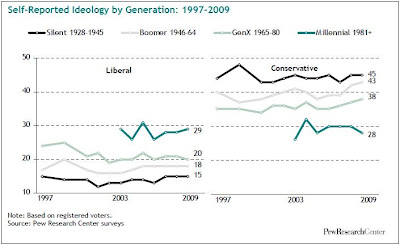
So what kind of values does this demographic hold?
First of all, their priorities compare with those of their parents, although not entirely. Whether the discrepancies are simply due to youth or if there's an actual shift is uncertain, but either way it’s something to take seriously when trying to communicate with them.
From the report summary:

But their shifting priorities and values aren’t meant to be part of a counter-culture. Unlike the Woodstock Generation of the Baby-Boomer years, they respect their parents - and their parents’ values - tremendously.
They also bring different perspectives to the arena than older generations did.
This is in part - no doubt - because of the intensity of their educational background. A record 39.6% of 18-22 year olds were enrolled in college in 2008. But just because they aren’t serving their country on the battlefield doesn’t mean they’re unwilling to serve in general. Quite the opposite, in fact.
Millennials also tend to be more ethnically diverse, less religious, and have higher confidence in the efficacy of government.
And then of course there are all the ways they are more technologically advanced, which is where we’ll pick up tomorrow.
 Last year we pointed out the magnitude Americans under 30 had on public opinion. Not only were they strikingly supportive of Barack Obama in the 2008 presidential election, but also of gay marriage, legalizing marijuana, curbing climate change, and amnesty for illegal immigrants.
A new Pew Report finds that the Millennials are still heavily Democratic, though their identification with the party has slipped about 8%.
Still, as any good political consultant understands, politics is about more than just “politics” - it is about the values that the voting public holds.

So what kind of values does this demographic hold?
First of all, their priorities compare with those of their parents, although not entirely. Whether the discrepancies are simply due to youth or if there's an actual shift is uncertain, but either way it’s something to take seriously when trying to communicate with them.
From the report summary:

In weighing their own life priorities, Millennials (like older adults) place parenthood and marriage far above career and financial success. But they aren't rushing to the altar. Just one-in-five Millennials (21%) are married now, half the share of their parents' generation at the same stage of life. About a third (34%) are parents, according to the Pew Research survey. We estimate that, in 2006, more than a third of 18 to 29 year old women who gave birth were unmarried. This is a far higher share than was the case in earlier generations.
But their shifting priorities and values aren’t meant to be part of a counter-culture. Unlike the Woodstock Generation of the Baby-Boomer years, they respect their parents - and their parents’ values - tremendously.
Looking back at their teenage years, Millennials report having had fewer spats with mom or dad than older adults say they had with their own parents when they were growing up. And now, hard times have kept a significant share of adult Millennials and their parents under the same roof. About one-in-eight older Millennials (ages 22 and older) say they've "boomeranged" back to a parent's home because of the recession.
They respect their elders. A majority say that the older generation is superior to the younger generation when it comes to moral values and work ethic. Also, more than six-in-ten say that families have a responsibility to have an elderly parent come live with them if that parent wants to. By contrast, fewer than four-in-ten adults ages 60 and older agree that this is a family responsibility.
They also bring different perspectives to the arena than older generations did.
Despite coming of age at a time when the United States has been waging two wars, relatively few Millennials -- just 2% of males -- are military veterans. At a comparable stage of their life cycle, 6% of Gen Xer men, 13% of Baby Boomer men and 24% of Silent men were veterans.
This is in part - no doubt - because of the intensity of their educational background. A record 39.6% of 18-22 year olds were enrolled in college in 2008. But just because they aren’t serving their country on the battlefield doesn’t mean they’re unwilling to serve in general. Quite the opposite, in fact.
Volunteering for an organization or helping others without being paid is one way many Americans are involved in their communities. Nearly six-in-ten (57%) Millennials say that they had volunteered in the past 12 months, which is no higher than the proportion of Gen Xers (54%) who said they had done this. About half of Baby Boomers (52%) and just 39% of those in the Silent generation say they volunteered in the past year.
Millennials also tend to be more ethnically diverse, less religious, and have higher confidence in the efficacy of government.
And then of course there are all the ways they are more technologically advanced, which is where we’ll pick up tomorrow.
Monday, March 1, 2010
Prediction Correct: Canada Got Home-Country Boost
Summary: Canada’s Olympic performance verifies that the host country does indeed win more medals than they would without home-field advantage.

Around the time the 2010 Winter Olympics began, we did an analysis which found that in eight of the past nine Olympics, the home-country did better than they do on average in terms of both overall medals and gold medals.
Now that the games are over, we decided to review our predictions.
We said that Canada - the host nation - would win 6 or 7 more medals than would otherwise be expected, including one or two additional gold medals.
This was based off the average medal increase that host countries saw over the past nine Olympics. Keep in mind there is a lot of variation on how much better the host country does. In theory, Canada should have brought in 2.57% additional available medals than they do on average during the Winter Games, including 2.1% additional golds.
We weren’t too far off.
With 26 medals overall - 14 of which were gold - Canada secured 1.68% more medals than they have on average. In a really surprising feat, they secured 9.91% more golds than on average.
In other words, Canada earned four or five more medals than they would have had the Olympics been outside their country, and a whopping eight or nine additional golds.
Meanwhile, the United States beat Canada (and the rest of the world) in the overall count (with 37 total medals), but lost in terms of gold medals (with only 9).
We really didn’t do too bad. We actually picked up about 4% more medals overall than on average for Winter games (though we did drop 0.14% in terms of golds). Perhaps our generally sound performance was due (at least in part) to Vancouver’s close proximity to the U.S. Our fans had a relatively short trip to make to support our athletes.
Either way, these findings further solidify our argument that Americans should always support their cities for hosting the games, regardless of politics.

Around the time the 2010 Winter Olympics began, we did an analysis which found that in eight of the past nine Olympics, the home-country did better than they do on average in terms of both overall medals and gold medals.
Now that the games are over, we decided to review our predictions.
We said that Canada - the host nation - would win 6 or 7 more medals than would otherwise be expected, including one or two additional gold medals.
This was based off the average medal increase that host countries saw over the past nine Olympics. Keep in mind there is a lot of variation on how much better the host country does. In theory, Canada should have brought in 2.57% additional available medals than they do on average during the Winter Games, including 2.1% additional golds.
We weren’t too far off.
With 26 medals overall - 14 of which were gold - Canada secured 1.68% more medals than they have on average. In a really surprising feat, they secured 9.91% more golds than on average.
In other words, Canada earned four or five more medals than they would have had the Olympics been outside their country, and a whopping eight or nine additional golds.
Meanwhile, the United States beat Canada (and the rest of the world) in the overall count (with 37 total medals), but lost in terms of gold medals (with only 9).
We really didn’t do too bad. We actually picked up about 4% more medals overall than on average for Winter games (though we did drop 0.14% in terms of golds). Perhaps our generally sound performance was due (at least in part) to Vancouver’s close proximity to the U.S. Our fans had a relatively short trip to make to support our athletes.
Either way, these findings further solidify our argument that Americans should always support their cities for hosting the games, regardless of politics.
Friday, February 26, 2010
The Aftermath of the Healthcare Summit
Summary: What the summit means for a healthcare reform bill and the 2010 midterm elections.
As promised yesterday, we need to give our wrap-up opinions on yesterday’s healthcare summit in Washington, DC.

First of all, the media have not been impressed by what was accomplished yesterday. I’m not quite sure what they were expecting, but evidently they seemed to assume that the bill would have been ready to go after the summit.
In fact, the new deadline for passing a bill is before Easter. That gives Congress over a month to continue hashing out the details - and even that’s under the unlikely scenario that they’ll meet the deadline - before there’s a final vote.
In part, it’s because the GOP still seems unwilling to cooperate.
From Politico:
Yet watching the summit, they seemed to be a lot more engaged in reaching a pragmatic compromise than usual. With the exception of John Boehner - who gave a speech loaded with conservative rhetoric about killing the bill - most Republicans (even the super-conservative Sen. Tom Coburn) appeared more focused on working with Democrats than we’ve seen so far.
This is in no small part thanks to President Obama, who took a very serious tone yesterday about bipartisan efforts, which I feel encouraged some Republicans to drop the talking points - especially because the one who did were called out on it.
So we come to two questions. 1) Will this lead to a bill being passed? 2) What implications will it have for the 2010 elections?
It seems to me like a bill was going to be passed regardless of the summit, but I feel that this helped the GOP get over their minority-complex. The attention President Obama showed them (and has been showing them) contrasts - in their minds - with the way the Democratic Congressional leadership has treated them.
And some bridges were built yesterday. Senators Kent Conrad (D-ND) and Tom Coburn (R-OK) made some progress together regarding prescription drug coordination, while Democrats and Republicans in general came to some broad agreements regarding the healthcare-deficit connection.
Of course, there will be plenty of time for Tea Party special interest groups to disrupt this progress, but I feel that the summit probably did help bringing Republicans to the table, making it a little less likely that the inevitable filibuster efforts will succeed.
But in order for a bill to pass by Easter, it is entirely clear that President Obama and the Democratic leadership will have to continue to engage Republicans.
In the 2010 midterms, Democrats will be between a rock and a hard place, but there is a growing agreement among pundits that passing a bill will be more beneficial to them than failing on a key issue they were elected to address. This is something we’ve been saying for months.
Yet if a bill doesn’t pass, pointing to the summit will be a good way for Democrats to defend themselves. “Hey, we had a summit,” they can say, “the Republicans still refused to work with us. They care more about these elections than about the American families who are struggling with healthcare costs.” It’s not a great defense, but it helps solidify the idea that the GOP is nothing more than a “Party of No” these days.
Anyone who watched the summit - there weren’t many who did, albeit, though web traffic for it tripled that of the State of the Union Address - could see how Democrats were more willing to work with Republicans on the bill than vice versa.
Yet even a lot of Republicans were less aggressive than normal yesterday.
Ultimately, a lot of people may be disappointed with the outcomes of the healthcare summit. I, for one, think it could prove to be rather successful.
As promised yesterday, we need to give our wrap-up opinions on yesterday’s healthcare summit in Washington, DC.

First of all, the media have not been impressed by what was accomplished yesterday. I’m not quite sure what they were expecting, but evidently they seemed to assume that the bill would have been ready to go after the summit.
In fact, the new deadline for passing a bill is before Easter. That gives Congress over a month to continue hashing out the details - and even that’s under the unlikely scenario that they’ll meet the deadline - before there’s a final vote.
In part, it’s because the GOP still seems unwilling to cooperate.
From Politico:
Heading into the summit, Democrats were preparing to start the steps to get the bill through the Senate with reconciliation — needing only 51 votes to pass a bill — as early as next week. They didn’t expect Republican cooperation Thursday and they didn’t get any. Republicans walked out of the session saying the same thing they said going in — unless you start over, we can’t get on board.
Yet watching the summit, they seemed to be a lot more engaged in reaching a pragmatic compromise than usual. With the exception of John Boehner - who gave a speech loaded with conservative rhetoric about killing the bill - most Republicans (even the super-conservative Sen. Tom Coburn) appeared more focused on working with Democrats than we’ve seen so far.
This is in no small part thanks to President Obama, who took a very serious tone yesterday about bipartisan efforts, which I feel encouraged some Republicans to drop the talking points - especially because the one who did were called out on it.
So we come to two questions. 1) Will this lead to a bill being passed? 2) What implications will it have for the 2010 elections?
It seems to me like a bill was going to be passed regardless of the summit, but I feel that this helped the GOP get over their minority-complex. The attention President Obama showed them (and has been showing them) contrasts - in their minds - with the way the Democratic Congressional leadership has treated them.
And some bridges were built yesterday. Senators Kent Conrad (D-ND) and Tom Coburn (R-OK) made some progress together regarding prescription drug coordination, while Democrats and Republicans in general came to some broad agreements regarding the healthcare-deficit connection.
Of course, there will be plenty of time for Tea Party special interest groups to disrupt this progress, but I feel that the summit probably did help bringing Republicans to the table, making it a little less likely that the inevitable filibuster efforts will succeed.
But in order for a bill to pass by Easter, it is entirely clear that President Obama and the Democratic leadership will have to continue to engage Republicans.
In the 2010 midterms, Democrats will be between a rock and a hard place, but there is a growing agreement among pundits that passing a bill will be more beneficial to them than failing on a key issue they were elected to address. This is something we’ve been saying for months.
Yet if a bill doesn’t pass, pointing to the summit will be a good way for Democrats to defend themselves. “Hey, we had a summit,” they can say, “the Republicans still refused to work with us. They care more about these elections than about the American families who are struggling with healthcare costs.” It’s not a great defense, but it helps solidify the idea that the GOP is nothing more than a “Party of No” these days.
Anyone who watched the summit - there weren’t many who did, albeit, though web traffic for it tripled that of the State of the Union Address - could see how Democrats were more willing to work with Republicans on the bill than vice versa.
Yet even a lot of Republicans were less aggressive than normal yesterday.
Ultimately, a lot of people may be disappointed with the outcomes of the healthcare summit. I, for one, think it could prove to be rather successful.
Thursday, February 25, 2010
Healthcare Summit and Getting the Job Done
Sorry this post is so late, as it’s been tough to avert my eyes from the healthcare summit going on today.
Watching it reminded me yet again why President Obama was such a wise choice in 2008. Throughout the day he’s been doing such a great job trying to put politics aside and hash out policy.
Perhaps nowhere was it more obvious then during an exchange that’s making headlines right now with his former rival, Sen. John McCain (R-AZ):
Watch CBS News Videos Online
Indeed, he seems to be taking this summit much more seriously than a lot of the attendees. This demeanor reminds me a lot about what Eric and I said yesterday about getting the job done.
Anyway, be sure to come back tomorrow as we give our wrap-up on the healthcare summit, and what it means for 2010.
In the meantime, you can watch the healthcare summit at www.WhiteHouse.gov.
We’ll also start live tweeting the summit at @HSGWAYLABlog.
Watching it reminded me yet again why President Obama was such a wise choice in 2008. Throughout the day he’s been doing such a great job trying to put politics aside and hash out policy.
Perhaps nowhere was it more obvious then during an exchange that’s making headlines right now with his former rival, Sen. John McCain (R-AZ):
Watch CBS News Videos Online
Indeed, he seems to be taking this summit much more seriously than a lot of the attendees. This demeanor reminds me a lot about what Eric and I said yesterday about getting the job done.
Anyway, be sure to come back tomorrow as we give our wrap-up on the healthcare summit, and what it means for 2010.
In the meantime, you can watch the healthcare summit at www.WhiteHouse.gov.
We’ll also start live tweeting the summit at @HSGWAYLABlog.
Wednesday, February 24, 2010
Editorial: Can’t We Just Get the Job Done?
Summary: Eric and Dave explain their frustrations with the politics of pessimism.
It’s not difficult to be pessimistic about the outlook of the world sometimes. In recent years, it hasn’t been difficult to be pessimistic about the future of the United States.
For liberals, many of us made the claim that we would move to Canada following the re-election of George W. Bush. In our knee-jerk reaction to the unconscionable decision of the American public, we were certain America was on its downfall. But when we had the chance to think clearly, we remembered it was our country, and we needed to fight for it.
Two years later, we started to win this fight by taking back both chambers of Congress for the Democrats.
Have we reached some sort of Utopia? Of course not. We never will.
Some liberals are now feeling that pessimism in the midst of the healthcare debate. We’re not getting the perfect bill we were hoping for. And some are afraid that if we pass an even mildly-controversial bill, seats will be lost in November.
But as Mark Sump from Activate reminded us on Monday, sometimes we just need to get the job done.
From his blog post:
This is how it seems to be with a lot of things these days - even when we put partisan politics aside. On TV, pundits and politicians are constantly telling us that we’ll be losing out to the Chinese because of our deficits, and that it’s placing an unfair burden on the next generation.
Guess what? We are that generation! We’re the next slot of Americans who will have to clean up this mess (Eric is 32, Dave is 22). So here’s our message: either grab a mop, or get out of the way.
In the end, it doesn’t matter if you’re old or young, conservative or liberal, Republican or Democrat. Times are tough, but complaining about it isn’t going to get us anywhere. We need to reform healthcare (everybody knows it), we need to curb climate-change, and - yes - we need to reach a balanced budget sooner rather than later.
So let’s do it. Let’s grab a mop and get the job done. And let’s make sure that we force out those who are standing in the way of this job - those practicing the politics of pessimism. Barack Obama (as he’s said himself) cannot the sole maker of change - we all have to be change makers.
What makes our country great is the resilience of the American people. We were resilient enough after the 2004 elections to re-group and get the job done for the Democrats.
Now we need to be resilient in the face of great challenges and get the job done for America.
It’s not difficult to be pessimistic about the outlook of the world sometimes. In recent years, it hasn’t been difficult to be pessimistic about the future of the United States.
For liberals, many of us made the claim that we would move to Canada following the re-election of George W. Bush. In our knee-jerk reaction to the unconscionable decision of the American public, we were certain America was on its downfall. But when we had the chance to think clearly, we remembered it was our country, and we needed to fight for it.
Two years later, we started to win this fight by taking back both chambers of Congress for the Democrats.
Have we reached some sort of Utopia? Of course not. We never will.
Some liberals are now feeling that pessimism in the midst of the healthcare debate. We’re not getting the perfect bill we were hoping for. And some are afraid that if we pass an even mildly-controversial bill, seats will be lost in November.
But as Mark Sump from Activate reminded us on Monday, sometimes we just need to get the job done.
From his blog post:
My son is 16, six foot four and plays varsity basketball at his high school. I attend all of his games. A couple weeks ago his team was playing one of the top teams in the conference. It was close. The other team stole the ball, drove the floor and went in for the lay up. There was one player between him and the basket. They both went up. Our player was trying not to foul, but there was no chance he wouldn’t. He tried to block the ball, but it was out of reach. The ball went in and the foul was called. I thought to myself, if you’re going to foul…foul. Don’t let the shot go in.
Sixteen years ago we tried to pass health care reform. We failed. That year the Republicans took the House. First time in decades. They patted themselves on the back and told the country it was because they succeeded in pushing back against change, against finally bringing true reform to our health care system.
In 1992, Bill Clinton won an electoral landslide. The campaign was built on hope and change. The cornerstone issue was health care reform. He had a mandate. He really did. Then he ran into a Democratic Congress who played not to lose. The more change that was proposed, the dimmer the outlook was for Democrats in Congress. They hesitated. They blinked. They were afraid to lose. Guess what? They lost anyway…
… So, here we are sixteen years later. We’re playing defense. The Republicans are going up for the dunk. Democrats have a decision to make. Do we stop them from scoring and take the penalty, or do we try not to foul.
We can learn from the past. We can know that sixteen years ago as many people were discouraged by our lack of ability to bring real change as were afraid of what that change might bring. Democrats can stand up today, knowing they will lose in November but knowing they did the right thing. Sixteen years ago we blinked and we know the results. History shows we’re going to lose seats in Congress if we do nothing.
So, do the right thing. Pass health care reform. Pass a public option. Pass a Medicare buy-in. Do it by any means possible. Pass a real reform by reconciliation.
If you’re going to foul…foul.
This is how it seems to be with a lot of things these days - even when we put partisan politics aside. On TV, pundits and politicians are constantly telling us that we’ll be losing out to the Chinese because of our deficits, and that it’s placing an unfair burden on the next generation.
Guess what? We are that generation! We’re the next slot of Americans who will have to clean up this mess (Eric is 32, Dave is 22). So here’s our message: either grab a mop, or get out of the way.
In the end, it doesn’t matter if you’re old or young, conservative or liberal, Republican or Democrat. Times are tough, but complaining about it isn’t going to get us anywhere. We need to reform healthcare (everybody knows it), we need to curb climate-change, and - yes - we need to reach a balanced budget sooner rather than later.
So let’s do it. Let’s grab a mop and get the job done. And let’s make sure that we force out those who are standing in the way of this job - those practicing the politics of pessimism. Barack Obama (as he’s said himself) cannot the sole maker of change - we all have to be change makers.
What makes our country great is the resilience of the American people. We were resilient enough after the 2004 elections to re-group and get the job done for the Democrats.
Now we need to be resilient in the face of great challenges and get the job done for America.
Tuesday, February 23, 2010
Troubling Indicators for Democrats in 2010
Gallup has started listing “Election 2010 Key Indicators” on their politics page. Two of these indicators might be troubling for Democrats.

First, they find a 12-point enthusiasm gap between Republicans and Democrats. We’ve mentioned this general trend before, but it is nice to have measured figures on it for once. I happen to think we can close that gap, but it won’t be easy.
Second, they find independents are supporting GOP candidates over Democrats 47%-31% for the generic congressional ballot. I usually don’t put much faith in the merits of the generic ballot, as people typically don’t vote for the party as much as they do for the individual candidate, but the size of the gap is something to watch.

First, they find a 12-point enthusiasm gap between Republicans and Democrats. We’ve mentioned this general trend before, but it is nice to have measured figures on it for once. I happen to think we can close that gap, but it won’t be easy.
Second, they find independents are supporting GOP candidates over Democrats 47%-31% for the generic congressional ballot. I usually don’t put much faith in the merits of the generic ballot, as people typically don’t vote for the party as much as they do for the individual candidate, but the size of the gap is something to watch.
Monday, February 22, 2010
The Healthcare-Deficit Connection
Summary: Explaining the real impact of healthcare reform on our deficits to the American voter.
Hale “Bonddad” Stewart had a good post at FiveThirtyEight.com over the weekend exploring the details of the federal budget. It clearly spelled out one factor of government spending that many of us have known about for a long time: the connection between our country’s rapidly inflating healthcare costs and the growing national debt.
As he maps out, mandatory spending (on programs like Social Security, Medicare, Medicaid, and Veterans Affairs services) has been steadily increasing over the past forty years while discretionary spending (for things such as national defense, agriculture subsidies, and a wide variety of other government programs) has been steadily decreasing in that time.
I should note that I would generally consider interest on the national debt as mandatory spending, but Stewart does not.

Now, among the mandatory spending programs - which are not covered by PAYGO rules in the House or Senate the same way that discretionary spending is - Social Security expenditures have actually gone down a bit since 1970, while Medicare and Medicaid expenditures are (for the most part) rising fast.

Now Republicans like to trash healthcare reform as something that will increase our debt. In fact, it is quite clear that without healthcare reform, our debt will continue to rise. In fact, it would not be wrong to assume that a balanced budget is impossible without controlling healthcare costs.
Democrats can do themselves a world of good by driving this point home. It needs to be a message that is consistent and constant in order for voters to believe it. If they do, we can kill two birds with one stone: justifying our support for healthcare reform, and letting voters know we are the party of fiscal responsibility.
That’s not to say it will be easy, especially in the age of sound-bite attention spans. The typical voter will struggle to understand the connection between these two issues - after all, there will be new government spending associated with healthcare reform, and the GOP has done a pretty good job characterizing government as incapable of saving money.
Perhaps we can start where Activate left us off last week with the Three Degrees of Separation.
Explaining the connection between healthcare reform and deficit reduction to volunteers shouldn’t be too difficult. Political activists are well engaged and equipped with the ability to see the relationship.
If they explain to fellow voters in their sphere of influence the benefits of healthcare reform on the federal budget, a basic level of understanding will trickle down. From there, they can talk to voters in their spheres of influence about this connection. This second degree of separation probably won’t understand the argument, but at least they’ll know of it.
Assuming your campaign has a volunteer base of at least 1,000 supporters (it will obviously depend on the size of your district) the message could theoretically reach as many as one million voters.
Tell me that wouldn’t help in 2010!
(By the way, the guys at Activate have a great new post up today about healthcare reform on their blog, The New Paradigm in Politics)
Hale “Bonddad” Stewart had a good post at FiveThirtyEight.com over the weekend exploring the details of the federal budget. It clearly spelled out one factor of government spending that many of us have known about for a long time: the connection between our country’s rapidly inflating healthcare costs and the growing national debt.
As he maps out, mandatory spending (on programs like Social Security, Medicare, Medicaid, and Veterans Affairs services) has been steadily increasing over the past forty years while discretionary spending (for things such as national defense, agriculture subsidies, and a wide variety of other government programs) has been steadily decreasing in that time.
I should note that I would generally consider interest on the national debt as mandatory spending, but Stewart does not.

Now, among the mandatory spending programs - which are not covered by PAYGO rules in the House or Senate the same way that discretionary spending is - Social Security expenditures have actually gone down a bit since 1970, while Medicare and Medicaid expenditures are (for the most part) rising fast.
Now Republicans like to trash healthcare reform as something that will increase our debt. In fact, it is quite clear that without healthcare reform, our debt will continue to rise. In fact, it would not be wrong to assume that a balanced budget is impossible without controlling healthcare costs.
Democrats can do themselves a world of good by driving this point home. It needs to be a message that is consistent and constant in order for voters to believe it. If they do, we can kill two birds with one stone: justifying our support for healthcare reform, and letting voters know we are the party of fiscal responsibility.
That’s not to say it will be easy, especially in the age of sound-bite attention spans. The typical voter will struggle to understand the connection between these two issues - after all, there will be new government spending associated with healthcare reform, and the GOP has done a pretty good job characterizing government as incapable of saving money.
Perhaps we can start where Activate left us off last week with the Three Degrees of Separation.
Explaining the connection between healthcare reform and deficit reduction to volunteers shouldn’t be too difficult. Political activists are well engaged and equipped with the ability to see the relationship.
If they explain to fellow voters in their sphere of influence the benefits of healthcare reform on the federal budget, a basic level of understanding will trickle down. From there, they can talk to voters in their spheres of influence about this connection. This second degree of separation probably won’t understand the argument, but at least they’ll know of it.
Assuming your campaign has a volunteer base of at least 1,000 supporters (it will obviously depend on the size of your district) the message could theoretically reach as many as one million voters.
Tell me that wouldn’t help in 2010!
(By the way, the guys at Activate have a great new post up today about healthcare reform on their blog, The New Paradigm in Politics)
Friday, February 19, 2010
CPAC All Over the Place
Summary: Just when it appeared conservatives were coming to a cohesive message, their annual conference produces a strange and wide array of views.
Following the political blogs today, one can’t help but see a lot of coverage of the Conservative Political Action Conference. One thing I couldn’t help but notice is the lack of collective discipline in message.
Politico reported today that “less than an hour before Tiger Woods was set to explain himself in a press conference, Minnesota Gov. Tim Pawlenty urged conservative activists to follow the golfer’s wife and ‘take a nine iron and smash the windows out of big government.’”
Then Rep. Mike Pence (R-IN) apparently embraced the “Party of No” image…
And Rep. Michele Bachmann accused President Obama of “choosing decline” for America.
Additionally, there was some infighting among the different factions of conservative activists. A Log Cabin Republicans type group, GOProud, got into something of a shouting match with the National Organization for Marriage - an anti-gay marriage group.
Then a lawyer from the Bush Administration who assisted lawmakers in drafting the USA PATRIOT Act made the interesting argument that Obama is killing too many terrorists. His speech received both applause and hissing.
Yet perhaps the strangest thing about the entire event was the warm embrace of the moderate Republican - at least in his history governing Massachusetts - Mitt Romney. Even his likely presidential primary rival, Sarah Palin, appeared to be backing him today.
There are a lot of rules about message in politics - one of them is clarity. For months the GOP had done a very good job explaining themselves with one clear idea: Obama equals massive deficits.
At CPAC, they’ve been all over the place. To the average onlooker, it would be difficult to say what exactly conservatives and Republicans stand for after today.
Obviously, this is meant to be more of a conservative pep rally than an appeal to the less-political voter, but I still was surprised to see such a lack of message discipline from prominent politicians and political groups.
Following the political blogs today, one can’t help but see a lot of coverage of the Conservative Political Action Conference. One thing I couldn’t help but notice is the lack of collective discipline in message.
Politico reported today that “less than an hour before Tiger Woods was set to explain himself in a press conference, Minnesota Gov. Tim Pawlenty urged conservative activists to follow the golfer’s wife and ‘take a nine iron and smash the windows out of big government.’”
Then Rep. Mike Pence (R-IN) apparently embraced the “Party of No” image…
“…after a year that saw every single House Republican vote against the stimulus bill ... Republicans in Congress are back in the fight, and they are back in the fight on the right…
When it comes to more borrowing, the answer is no. When it comes to more spending, the answer is no. When it comes to some health care summit that is nothing more than a photo-op to pave the way for Obamacare 2.0, the answer is no.”
And Rep. Michele Bachmann accused President Obama of “choosing decline” for America.
Additionally, there was some infighting among the different factions of conservative activists. A Log Cabin Republicans type group, GOProud, got into something of a shouting match with the National Organization for Marriage - an anti-gay marriage group.
Then a lawyer from the Bush Administration who assisted lawmakers in drafting the USA PATRIOT Act made the interesting argument that Obama is killing too many terrorists. His speech received both applause and hissing.
Yet perhaps the strangest thing about the entire event was the warm embrace of the moderate Republican - at least in his history governing Massachusetts - Mitt Romney. Even his likely presidential primary rival, Sarah Palin, appeared to be backing him today.
There are a lot of rules about message in politics - one of them is clarity. For months the GOP had done a very good job explaining themselves with one clear idea: Obama equals massive deficits.
At CPAC, they’ve been all over the place. To the average onlooker, it would be difficult to say what exactly conservatives and Republicans stand for after today.
Obviously, this is meant to be more of a conservative pep rally than an appeal to the less-political voter, but I still was surprised to see such a lack of message discipline from prominent politicians and political groups.
Thursday, February 18, 2010
Being the Home Country Increases Your Olympic Medals
Summary: A data analysis of the past nine Olympics finds one reason teams want the games in their home countries.
I know this isn’t strictly political, but hopefully it discourages the sort of partisanship over sports we saw when Republicans cheered Chicago’s bid-loss for the 2016 Summer Olympics.
While watching curling, I noticed that the vast majority of cheering from the crowd was for Canada. This really shouldn’t be a surprise, as the games are hosted there, but it got me thinking: “does being the hosting country give you a ‘home-field advantage?’”
So I spent some time overlooking and processing data on the past nine Olympics – five Summer Olympics, four Winter Olympics.
I decided not to go back before the 1992 games in Barcelona because of the disparities there would undoubtedly be between the Cold War era and post-Cold War Olympics, which would almost certainly throw-off the results.
Taking into account the fact that some countries do better in different Olympics (for example, Spain and Greece – while they have hosted Summer games recently – have not won Winter medals yet) and the fact that more events have been added over the years, we find the following results.

(Click Image to Expand)
With the exception of Italy during the 2006 Torino games, every year the home country takes a larger percentage of the medals than they would on average. Additionally, there is often an even sharper increase in the percentage of gold medals (indicated by the numbers in parentheses) taken by the country hosting the Olympics.
See the full data set here:

So one would expect Canada to win six or seven medals more than they would otherwise – including about one or two additional golds (assuming the 11.48% gold increase Japan had in 1998 was an outlier which can be ignored) – this year. We’ll have to wait until the games are over to be sure.
In the meantime, hopefully we Americans can cheer for our athletes – rather than against the politicians we oppose – when it comes to the Olympics.
I know this isn’t strictly political, but hopefully it discourages the sort of partisanship over sports we saw when Republicans cheered Chicago’s bid-loss for the 2016 Summer Olympics.
While watching curling, I noticed that the vast majority of cheering from the crowd was for Canada. This really shouldn’t be a surprise, as the games are hosted there, but it got me thinking: “does being the hosting country give you a ‘home-field advantage?’”
So I spent some time overlooking and processing data on the past nine Olympics – five Summer Olympics, four Winter Olympics.
I decided not to go back before the 1992 games in Barcelona because of the disparities there would undoubtedly be between the Cold War era and post-Cold War Olympics, which would almost certainly throw-off the results.
Taking into account the fact that some countries do better in different Olympics (for example, Spain and Greece – while they have hosted Summer games recently – have not won Winter medals yet) and the fact that more events have been added over the years, we find the following results.

(Click Image to Expand)
With the exception of Italy during the 2006 Torino games, every year the home country takes a larger percentage of the medals than they would on average. Additionally, there is often an even sharper increase in the percentage of gold medals (indicated by the numbers in parentheses) taken by the country hosting the Olympics.
See the full data set here:

So one would expect Canada to win six or seven medals more than they would otherwise – including about one or two additional golds (assuming the 11.48% gold increase Japan had in 1998 was an outlier which can be ignored) – this year. We’ll have to wait until the games are over to be sure.
In the meantime, hopefully we Americans can cheer for our athletes – rather than against the politicians we oppose – when it comes to the Olympics.
Wednesday, February 17, 2010
Could This Be the Worst Campaign Ad Ever?
Some of you have probably seen this by now, but if not, it’s time you did. Carly Fiorina’s senate campaign in California recently released this ad attacking her GOP primary opponent, Rep. Tom Campbell, via FCINO.com.
It’s hilariously bad. So bad that you may want to stop watching it half-way through. But I guarantee you’ll want to watch it through the end.
Now, in fairness, this was a web-ad rather than a television spot. But even so, if I was the consultant who produced it, I would be pretty embarrassed by my work.
You may be asking “why sheep?” “Why devil sheep?” “Why the pigs?” “Why so long?” I only wish I could answer these questions. Referring to the strange Reagan campaign commercial from 1984, our old friend Prof. Arnold Shober said today “this is the ‘There’s a Bear’ Ad gone wrong.”
And since it was released earlier this month, Fiorina has been getting a lot of (probably well-deserved) flack for the piece. I honestly cannot understand why they haven’t abandoned this strategy yet.
Plus (just in case this alone isn’t enough for you) there have been a lot of spoofs of it posted on YouTube.
It’s hilariously bad. So bad that you may want to stop watching it half-way through. But I guarantee you’ll want to watch it through the end.
Now, in fairness, this was a web-ad rather than a television spot. But even so, if I was the consultant who produced it, I would be pretty embarrassed by my work.
You may be asking “why sheep?” “Why devil sheep?” “Why the pigs?” “Why so long?” I only wish I could answer these questions. Referring to the strange Reagan campaign commercial from 1984, our old friend Prof. Arnold Shober said today “this is the ‘There’s a Bear’ Ad gone wrong.”
And since it was released earlier this month, Fiorina has been getting a lot of (probably well-deserved) flack for the piece. I honestly cannot understand why they haven’t abandoned this strategy yet.
Plus (just in case this alone isn’t enough for you) there have been a lot of spoofs of it posted on YouTube.
Tuesday, February 16, 2010
Why the Barrett Campaign Can Win in November
Summary: Tom Barrett’s gubernatorial campaign in Wisconsin applies new and traditional techniques alike to defy the odds in 2010.
I can’t really count how many times now I’ve said on this blog that Democrats will have a rough year in 2010. Across the country, the GOP looks poised to retake offices up and down the ticket.
In Wisconsin, two Republican candidates – Milwaukee County Executive Scott Walker and former U.S. Rep. Mark Neumann – have been campaigning for several months (years, arguably) in a gubernatorial race that should theoretically be a pretty easy GOP pick-up.
 Democrats, luckily, have managed to secure the bid of Milwaukee Mayor Tom Barrett who made national headlines last summer when he put himself in harm’s way to protect a grandmother outside the Wisconsin State Fair. The “Hero Mayor” status he received will go a long way towards securing the hearts of Wisconsin voters in a year that should bolster conservatives.
But the Mayor’s campaign has been doing more than relying on this status. They’ve been applying both new and traditional tactics that will go a long way come November.
For starters, they’ve been focusing hard on fundraising. Entering the race later than his Republican counterparts – in part because of Governor Jim Doyle’s late retirement announcement and in part because of the incident at the State Fair – he has had to do call-time and fundraisers at a much faster pace.
From Wispolitics.com:
Sure, the Walker campaign might have more cash-on-hand at this point, but when you break it down this is approximately what each campaign was raising per day by the end of the filing period:
Walker: $9,890/day
Neumann: $7,142/day
Barrett: $15,957/day
That’s pretty impressive.
Next, the Barrett campaign has been keeping the political community in Wisconsin confident in his chances. Just look at this email they sent regarding his fundraising numbers and a disappointing Rasmussen Poll:
Emails like this are exactly the kind of thing that kept Obama supporters confident during the 2008 presidential primaries, when people were convinced Hillary Clinton would be the inevitable Democratic nominee. Obama’s primary upset over Clinton would not have been possible otherwise. In 2010, it will be tactics like this that will send Barrett to Madison.
For those who have signed up for the Barrett email list, they’ve also been receiving important updates about the race that keep them engaged and give them a sense for who the man is. This is especially important when voters cannot see speeches day-in and day-out like they did in 2007 before the Iowa Caucuses.
Take this email for example:
Supporters love to see things like this because they are not fabricated. When Barrett sent the email, he clearly didn’t think it would be forwarded to supporters like it was. But by sending out an internal email like that, Walzak knew that he would make supporters feel like part of the team by giving them unmitigated access to the candidate’s informal update.
It also spoke to Barrett’s broader vision of what politics is about: not left v.s. right or Democrat v.s. Republican, but rather “let’s get the job done” – also, it's always a winning message.
And of course, the campaign was sure to let supporters know when they did well in a poll. Here is the breakdown of the latest poll taken regarding a Barrett-Walker match-up:

How will it all turn out in the end? It’s impossible to know who will win at this point, obviously. Despite Barrett’s many strengths, Walker is a formidable opponent and he is proven to be politically-savvy.
But in a year where Democrats are expected to do poorly, Barrett has been leading a remarkable campaign thus far. It really is the best chance Democrats could have of keeping the Governor’s Mansion in 2010.
I can’t really count how many times now I’ve said on this blog that Democrats will have a rough year in 2010. Across the country, the GOP looks poised to retake offices up and down the ticket.
In Wisconsin, two Republican candidates – Milwaukee County Executive Scott Walker and former U.S. Rep. Mark Neumann – have been campaigning for several months (years, arguably) in a gubernatorial race that should theoretically be a pretty easy GOP pick-up.
 Democrats, luckily, have managed to secure the bid of Milwaukee Mayor Tom Barrett who made national headlines last summer when he put himself in harm’s way to protect a grandmother outside the Wisconsin State Fair. The “Hero Mayor” status he received will go a long way towards securing the hearts of Wisconsin voters in a year that should bolster conservatives.
But the Mayor’s campaign has been doing more than relying on this status. They’ve been applying both new and traditional tactics that will go a long way come November.
For starters, they’ve been focusing hard on fundraising. Entering the race later than his Republican counterparts – in part because of Governor Jim Doyle’s late retirement announcement and in part because of the incident at the State Fair – he has had to do call-time and fundraisers at a much faster pace.
From Wispolitics.com:
Walker's campaign said the Republican county exec raised almost $1.8 million during the reporting period and ended the year with more than $2 million on hand.
GOP guv rival Mark Neumann filed his report earlier this year. It showed he raised just more than $1.3 million during the reporting period after putting almost $1.1 million of his own money into his campaign.
Dem frontrunner Tom Barrett raised more than $750,000 over 47 days after getting into the race in mid-November and had more than $1.5 million cash on hand. His war-chest got a boost from the more than $800,000 he already had in his mayoral account when he got into the race.
Sure, the Walker campaign might have more cash-on-hand at this point, but when you break it down this is approximately what each campaign was raising per day by the end of the filing period:
Walker: $9,890/day
Neumann: $7,142/day
Barrett: $15,957/day
That’s pretty impressive.
Next, the Barrett campaign has been keeping the political community in Wisconsin confident in his chances. Just look at this email they sent regarding his fundraising numbers and a disappointing Rasmussen Poll:
The impressive outpouring of support was raised in just 47 days, making it the best fundraising start to a gubernatorial campaign in Wisconsin history. The total brought Barrett’s cash-on-hand to more than $1.5 million…
…[Scott Walker] raised just $1.79M in 6 months. For the GOP frontrunner, for a guy who's been in race for 5 yrs, in the best GOP electoral climate in 15 yrs, this is a pretty weak showing.
He has to have spent $800K-$900K this period, a staggeringly high burn rate. His administrative incompetence has wreaked havoc with the County, now it’s hurting his campaign. Can Wisconsin afford this awful mismanagement in the governor’s office?...
…
Rasmussen Poll Numbers
- Their methodology is unreliable
"Other pollsters and political observers have long complained that Rasmussen polls are conducted through automated phone calls that reflect only the views of the most fervent likely voters because others are likely to hang up on a computerized caller."
--Milwaukee Journal Sentinel, 1/29/09
- Rasmussen oversamples conservative voters. In the recent Wisconsin gubernatorial poll, for example, nearly 60% of respondents oppose Obama, including most strongly, a high number given 2008 election results
Alan Abramowitz, an Emory University political scientist, said there was “huge concern right now” that Rasmussen was polling a universe of largely conservative-minded voters. “How is Rasmussen selecting likely voters almost a year before the election? And why would you even screen for likely voters in measuring presidential approval?” said Abramowitz. “My guess is that it's heavily skewed toward older, white, Republican voters.”
--Poltico.com 1/2/10
Emails like this are exactly the kind of thing that kept Obama supporters confident during the 2008 presidential primaries, when people were convinced Hillary Clinton would be the inevitable Democratic nominee. Obama’s primary upset over Clinton would not have been possible otherwise. In 2010, it will be tactics like this that will send Barrett to Madison.
For those who have signed up for the Barrett email list, they’ve also been receiving important updates about the race that keep them engaged and give them a sense for who the man is. This is especially important when voters cannot see speeches day-in and day-out like they did in 2007 before the Iowa Caucuses.
Take this email for example:
Dear Friend,
Tom visited a worker training facility in Kaukuana today and he sent me this note on how he thinks we can get Wisconsin's economy moving again…
Phil Walzak
Senior Advisor
Tom Barrett for Wisconsin
Begin forwarded message...
From: Tom Barrett
Sent: Thursday, February 4, 2010 1:37 p.m.
To: Phil Walzak
Subject: What I saw in Kaukuana today
Phil-
I had a great time today visiting the worker training facility in Kaukauna, WI. What I saw was incredible, and represents the kind of vision and commitment to partnership that I will bring to the governor's office to create jobs, expand opportunity, and get Wisconsin's economy working again.
The training center is a 41,000 sq. ft. facility that provides apprenticeship training programs to workers in a broad range of fields. It is operated by the Plumbers and Steamfitters Local 400, which is comprised of 2,000 people working in 18 counties throughout Northeast Wisconsin.
Local 400 works in partnership with 125 businesses across the region to train and supply the skilled workforce these companies need to get the job done. Basset Mechanical is one of these firms, and a representative of the company joined us for today's tour.
What I saw is a great example of the collaboration we need to get our economy working again -- organized labor and business management coming together to make sure people have jobs, and workers have the skills they need.
These are exactly the types of partnerships that I will fight to build and expand as governor, so let's be sure we are doing all we can to highlight them during this campaign.
See you back in the office,
Tom
Supporters love to see things like this because they are not fabricated. When Barrett sent the email, he clearly didn’t think it would be forwarded to supporters like it was. But by sending out an internal email like that, Walzak knew that he would make supporters feel like part of the team by giving them unmitigated access to the candidate’s informal update.
It also spoke to Barrett’s broader vision of what politics is about: not left v.s. right or Democrat v.s. Republican, but rather “let’s get the job done” – also, it's always a winning message.
And of course, the campaign was sure to let supporters know when they did well in a poll. Here is the breakdown of the latest poll taken regarding a Barrett-Walker match-up:
Milwaukee Mayor Tom Barrett and Milwaukee County Executive Scott Walker are locked in a dead heat in the race for Governor, with Barrett leading by a 1-point margin (40% Barrett, 39% Walker). This is virtually unchanged from a survey we conducted in September 2009, where Barrett led by a 2-point margin (39% Barrett, 37% Walker).
Both candidates show strength in their partisan bases, with Barrett leading among Democrats by a 79% to 4% margin, and Walker leading among Republicans by 82% to 5%. Barrett holds a slight 2-point lead among independents (32% Barrett, 30% Walker).
Barrett and Walker are each known to just over half of the Wisconsin electorate, though Barrett is slightly better liked among those who know each. As illustrated in the chart to the left, Barrett’s favorables are 1 point higher than Walker’s, while his unfavorables are 2 points lower. The same is true among independents, with Barrett (35% favorable, 15% unfavorable) garnering somewhat stronger favorability ratings than Walker (36% favorable, 21% unfavorable).

How will it all turn out in the end? It’s impossible to know who will win at this point, obviously. Despite Barrett’s many strengths, Walker is a formidable opponent and he is proven to be politically-savvy.
But in a year where Democrats are expected to do poorly, Barrett has been leading a remarkable campaign thus far. It really is the best chance Democrats could have of keeping the Governor’s Mansion in 2010.
Monday, February 15, 2010
How Do Volunteers Help a Campaign?
Summary: Exploring how, exactly, volunteers help win elections.
The answer to this question may seem all-too obvious for most readers, but according to a new post by our friends at Activate, it shouldn’t be.
The old-school way of viewing that question, according to them, is that “the volunteer influence merely displaces some of the phoning or canvassing that the campaign plans to outsource at the end of the campaign leading up to Election Day.”
But as many of us know, that impact is marginal. It is important in a close race, sure, but that doesn’t seem to be important enough to make it such an essential part of a campaign’s operations.
The real impact is via the “Three Degrees of Seperation.”
From the post:
Could it be so easy?
It’s certainly an interesting concept, and it certainly falls in line with our understanding of how volunteers go about their daily lives, and how people make voting decisions.
Unfortunately, like most things in campaign politics, it is difficult to accurately measure votes based on volunteer numbers. In other words, confirming this hypothesis is a challenge.
One concern is the size of the district and location. If a volunteer lives across the street from a different district, then a good number of the people he or she talks to on a daily basis is unable to vote in that election in the first place. Relying on them for these purposes is not as beneficial as it would be in a state-wide race.
The other worry is about overlap. What if Voter A is influenced by a volunteer, he goes and influences Voter B in the Second Degree of Separation, and she then influences Voter C, who happens to have also talked to the original volunteer like Voter A did? Certainly Volunteer C would be all the more likely to support the candidate, but a potential Voter D is left out of the picture.
All-in-all, this is just some food for thought. Activate is certainly doing the world of campaigners a service by re-emphasizing the importance of volunteers. As we’ve seen time and time again, of all the aspects of a campaign that can be controlled for, volunteers are really the most critical.
The answer to this question may seem all-too obvious for most readers, but according to a new post by our friends at Activate, it shouldn’t be.
The old-school way of viewing that question, according to them, is that “the volunteer influence merely displaces some of the phoning or canvassing that the campaign plans to outsource at the end of the campaign leading up to Election Day.”
But as many of us know, that impact is marginal. It is important in a close race, sure, but that doesn’t seem to be important enough to make it such an essential part of a campaign’s operations.
The real impact is via the “Three Degrees of Seperation.”
From the post:
“I recall my first presidential campaign in 1988 and my boss explaining to me the first tenet of my three degrees of separation theory: Every volunteer on a campaign will influence the vote of 50 voters by virtue of who they talk to in their own lives…friends, neighbors, family, co-workers. It isn’t about how many people they reached on the phone bank or at the doors. It’s all about who they come into contact with in their daily lives.
Remember, the new paradigm: Voters are primarily influenced by people around them, people they trust.
Okay, so let’s do the math. If a campaign has 1000 active volunteers and they each influence 50 voters, the first degree of separation is 50,000 votes.
So let’s say that the second degree of separation is calculated at 20% of that, so those 50,000 voters each influence 10 voters. The second degree of separation adds 500,000 voters. So now we’re at 551,000 voters.
Okay, now we’re cooking. The third degree of separation is calculated again at 20%, so those 500,000 voters will each influence 2 voters. The third degree of separation adds 1,000,000 voters.
Now we’re at 1,551,000 votes! Think about it. How many campaigns are won with 1.55 million votes?
Figuring out how many volunteers you need is rather simple. Take the expected vote and divide it by 1,551 and that will give you the number of volunteers a campaign needs to win.”
Could it be so easy?
It’s certainly an interesting concept, and it certainly falls in line with our understanding of how volunteers go about their daily lives, and how people make voting decisions.
Unfortunately, like most things in campaign politics, it is difficult to accurately measure votes based on volunteer numbers. In other words, confirming this hypothesis is a challenge.
One concern is the size of the district and location. If a volunteer lives across the street from a different district, then a good number of the people he or she talks to on a daily basis is unable to vote in that election in the first place. Relying on them for these purposes is not as beneficial as it would be in a state-wide race.
The other worry is about overlap. What if Voter A is influenced by a volunteer, he goes and influences Voter B in the Second Degree of Separation, and she then influences Voter C, who happens to have also talked to the original volunteer like Voter A did? Certainly Volunteer C would be all the more likely to support the candidate, but a potential Voter D is left out of the picture.
All-in-all, this is just some food for thought. Activate is certainly doing the world of campaigners a service by re-emphasizing the importance of volunteers. As we’ve seen time and time again, of all the aspects of a campaign that can be controlled for, volunteers are really the most critical.
Thursday, February 11, 2010
A Look at Silver’s Analysis of Palin-2012
Summary: FiveThirtyEight.com’s Nate Silver explores Sarah Palin’s 2012 presidential primary chances, but leaves out an important variable.
For those who haven’t seen it yet, Nate Silver’s analysis of Palin’s 2012 chances is quite interesting. While long and in-depth, he makes some good points.
From the post:
He then runs the data and comes up with chart showing how well Palin should theoretically do on a state-by-state basis. In the map below, the most red states is where she is strongest and the most blue is where she is weakest.

Next - taking other candidates’ strenghts and weaknesses into account - he gives his outlook for how Palin could secure the nomination. (For clarification on the colors he mentions, see the map at the bottom of this post).*
Among the other possible candidates he mentions:
- Former Governor Mitt Romney (R-MA)
- Former Governor Mike Huckabee (R-AR)
- Former House Speaker Newt Gingrich (R-GA)
- Senator Scott Brown (R-MA)
- Governor Haley Barbour (R-MS)
- Senator John Thune (R-SD)
- Congressman Mike Pence (R-IN)
- Governor Rick Perry (R-TX)
This set off a huge red-flag for me. Last year, I wrote about Governor Tim Pawlenty (R-MN) being a particularly strong candidate to win the GOP nomination in 2012.
Looking at the map, who is better positioned to win both Iowa and New Hampshire than Pawlenty? Nobody. Romney can win New Hampshire, but probably not Iowa. Palin and Huckabee could both win Iowa but probably not New Hampshire. (This is still according to Silver’s analysis).
Pawlenty, on the other hand, has contacts within the Iowa GOP and is better positioned to use the party infrastructure early on. Because of his work in Minnesota, he is a very strong candidate in the agricultural Midwest. In fact, I know the Wisconsin GOP already gave his Freedom First PAC access to their donor list.
Additionally, Pawlenty doesn’t have the same “uneducated” style of politics about him (for lack of a better term, I swear) that candidates like Palin or Huckabee do. This will give him strength in a state like New Hampshire, which otherwise seems to be a given for Romney.
Sure, he probably can’t win Nevada or South Carolina as easily, but he’d be in great position for the next few states (a few of which boarder his own) and the momentum he builds could easily deliver him a victory.
Obviously, we’ll have to wait and see, but I think it was a mistake on Silver’s part to ignore Pawlenty’s presence come 2012.

*Silver:
For those who haven’t seen it yet, Nate Silver’s analysis of Palin’s 2012 chances is quite interesting. While long and in-depth, he makes some good points.
From the post:
So where is Palin likely to run strongest? Obviously, it would depend on the candidates she's up against and the type of campaign she might want to run, but I think we can make some basic inferences. What I've done is to create an index of how favorable each state is to Palin based on six variables: fundraising totals to date for SarahPAC and five demographic and attitudinal variables taken from 2008 exit polls.
Fundraising: What I looked at is the ratio of contributions that Palin has received in each state so far through SarahPAC to the amount of contributions received by all Republican candidates in the 2008 cycle. The idea is to see how Palin compares vis-a-vis a typical Republican candidate -- indeed, I've found fundraising data to have quite a bit of predictive power in the past, even if the data is a little rough at this stage. Relative to other Republicans, Palin's best fundraising state is, of course, Alaska. Her fundraising has also been quite strong in the Pacific Northwest, and many of the prairie/frontier states. It has been weakest on the East Coast, as well as several other urban and industrial states located throughout the country. The fundraising data receives double weight in our index.
Variables from 2008 Exit Polls: What I looked at is not what a state's electorate looked like overall, but rather, the characteristics of the McCain (i.e. Republican) voters in each state. This is an important distinction -- for instance, although Oregon is a fairly progressive state overall, the conservatives there are quite conservative and rural, and this is what matters in the context of a Republican primary. Note that, although it would probably have been better to look at exit polling data from the 2008 Republican primaries, a lot of states either didn't have a competitive primary in 2008 or didn't have exit polling data available; thus, we look at McCain general election voters as our best proxy.
Specifically, the exit polling variables that I evaluated were as follows:
Rural and small town voters. That is, the percentage of McCain voters in each state that come from communities of less than 50,000 people. Palin spent a great deal of time campaigning in exurban and fairly rural areas in 2008, and I suspect that it's here -- not necessarily among soccer moms in the collar suburbs -- where her most enthusiastic voters lie. And Palin herself, of course, comes from a very rural area and is appealingly outdoorsy and self-reliant. This variable receives a double weight.
No college voters. Early polls of the 2012 Republican field, such as from Marist and Rasmussen, show Palin overperforming among this group (or, if you prefer, underperforming among college graduates), which certainly squares with my intuition about where her appeal lies. This variable also receives a double weight.
Conservatives. We also look at the number of McCain general election voters who described themselves as conservative in each state, although it receives only a single weight. Although clearly Palin wears the conservative label very comfortably and is liable to be harmed in states where there are a relatively large number of moderates and independents in the primary electorate, there are likely to be at least a couple other capital-C conservatives in the Republican primary field, which means we need to temper this somewhat.
White Evangelicals. Although Palin also polls well among this group, a lot of this may be because a lot of white evangelicals are also rural and lack a college degree. That is, although Palin runs well among the sorts of voters who happen to be evangelicals, it may not be because they're evangelicals. Nor, although Palin has increasingly invoked religious rhetoric in her speeches, does she have the scholarly religious credibility of someone like a Mike Huckabee or a Pat Robertson. It's conceivable that Palin could get outflanked by a Huckabee or lose votes to a Santorum among voters who are evangelicals first and working-class whites second. Thus, although we include this variable, we only give it a single weight.
Energy and Terrorism voters. Lastly, although this is a bit speculative, we look at the percentage of McCain voters in each state who said their votes were determined because of energy or terrorism policy, which appear as though they'll be Palin's core issues. These issues -- particularly terrorism -- lend themselves relatively well to the meta-narratives that Palin prefers and require less policy nuance than something like the economy or health care. This variable receives a single weight.
He then runs the data and comes up with chart showing how well Palin should theoretically do on a state-by-state basis. In the map below, the most red states is where she is strongest and the most blue is where she is weakest.

Next - taking other candidates’ strenghts and weaknesses into account - he gives his outlook for how Palin could secure the nomination. (For clarification on the colors he mentions, see the map at the bottom of this post).*
Palin's path to victory, then, would seem to consist of one of the following scenarios:
Palin Plan A. Win Iowa. Win South Carolina. Clean up in orange states. You probably have enough momentum to survive the consolidation of the GOP field which is liable to occur at this point.
Palin Plan B. Lose Iowa narrowly, especially to a Midwestern candidate. Hope that a Southerner isn't running strongly and win South Carolina. Clean up in orange states. Then you anchor in the South, winning Texas (green group), Florida/Georgia (gold group) or Indiana/North Carolina (purple group). At some point, you need to break through and win a big Midwestern battleground like Ohio or Wisconsin.
Palin Plan C. Win Iowa. Lose South Carolina narrowly to a Southern candidate. Regain momentum in orange states. Hope that green states vote next and aim in particular for a big win in Texas. If it's the gold states instead, go all-in in Ohio and Pennsylvania. If it's the purple states, you'll need some help.
Among the other possible candidates he mentions:
- Former Governor Mitt Romney (R-MA)
- Former Governor Mike Huckabee (R-AR)
- Former House Speaker Newt Gingrich (R-GA)
- Senator Scott Brown (R-MA)
- Governor Haley Barbour (R-MS)
- Senator John Thune (R-SD)
- Congressman Mike Pence (R-IN)
- Governor Rick Perry (R-TX)
This set off a huge red-flag for me. Last year, I wrote about Governor Tim Pawlenty (R-MN) being a particularly strong candidate to win the GOP nomination in 2012.
Looking at the map, who is better positioned to win both Iowa and New Hampshire than Pawlenty? Nobody. Romney can win New Hampshire, but probably not Iowa. Palin and Huckabee could both win Iowa but probably not New Hampshire. (This is still according to Silver’s analysis).
Pawlenty, on the other hand, has contacts within the Iowa GOP and is better positioned to use the party infrastructure early on. Because of his work in Minnesota, he is a very strong candidate in the agricultural Midwest. In fact, I know the Wisconsin GOP already gave his Freedom First PAC access to their donor list.
Additionally, Pawlenty doesn’t have the same “uneducated” style of politics about him (for lack of a better term, I swear) that candidates like Palin or Huckabee do. This will give him strength in a state like New Hampshire, which otherwise seems to be a given for Romney.
Sure, he probably can’t win Nevada or South Carolina as easily, but he’d be in great position for the next few states (a few of which boarder his own) and the momentum he builds could easily deliver him a victory.
Obviously, we’ll have to wait and see, but I think it was a mistake on Silver’s part to ignore Pawlenty’s presence come 2012.

*Silver:
The first states to vote are the traditional early states of Iowa, New Hampshire, Nevada and South Carolina. These states are shown in light blue. Note that this list does not include Florida and Michigan, which jumped in the queue to try to vote early in 2008 -- although who knows whether they'll be in a more cooperative mood this time around when push comes to shove.
Next to vote are the orange states, which are grouped together by virtue of their small populations. This includes 14 states and several territories, the largest grouping of which is on the prairies and the Western frontier, although there are also several New England states. Notably, no Southern states vote in this group -- the Republican calender definitely de-emphasizes the South.
Finally, there are gold, purple and green groupings of some of the larger states. These groups have some geographical integrity -- for instance, most of the traditional Midwestern Rust Belt states are in the gold group, whereas the purple states tend to be more coastal and the green more in flyover country -- although there are some exceptions. The order in which the gold, purple and green states vote will rotate every cycle and, to my knowledge, has not yet been determined for 2012.
Wednesday, February 10, 2010
How Democrats Can Claim Fiscal Responsibility for Themselves
Summary: Democrats have an opportunity to turn a core Republican message back on them.
Over the past year or so, Republicans in Washington have been quick to criticize the spending coming out of Congress with the blessing of the Obama Administration.
Knowing full well that most Americans are adverse to deficits (which are now higher than ever before) the GOP is calling Democrats “out of touch” with the average American.
It’s had an impact – Republican Scott Brown won his Senate race in the liberal Mecca of Massachusetts in part by criticizing Washington’s spending habits. Defeats like this, in turn, have made Democrats dispirited.
In many places, it’s already primary season for 2010. So if you’re a Democratic candidate, and you need to motivate the base, what do you say?
For starters, the Republican National Committee has demonstrated itself to be anything but fiscally responsible lately.
Last year, the RNC managed to burn through a whopping $95 million despite the fact that they were only supporting about four competitive races. They ended 2009 with just under $9 million cash-on-hand. These spending habits have caused their donors some concern – especially because of how much better the DNC has been doing – and RNC operatives have been frantically trying to reassure their contributers.
Knowing that they were having money troubles, where did the RNC decide to have its Winter strategy meeting? A beachside resort in Hawaii, with the best food, entertainment, and recreation that money can buy. Literally.
From a segment on last night’s episode of the Daily Show:
With weeks – and in most cases months – before the primaries, it’s not really worth anyone’s time to make this point a panicle one for your campaign message.
But as Democratic candidates are locating activists and donors, this message is a great way to engage them. An email blast to supporters criticizing the Republicans for trying to make fiscal responsibility their issue – when they’ve proven to be so fiscally irresponsible – is a great way to bring in some small contributions right now.
This is a good message for this part of the campaign because it gives the base a reason to fight.
Over the past year or so, Republicans in Washington have been quick to criticize the spending coming out of Congress with the blessing of the Obama Administration.
Knowing full well that most Americans are adverse to deficits (which are now higher than ever before) the GOP is calling Democrats “out of touch” with the average American.
It’s had an impact – Republican Scott Brown won his Senate race in the liberal Mecca of Massachusetts in part by criticizing Washington’s spending habits. Defeats like this, in turn, have made Democrats dispirited.
In many places, it’s already primary season for 2010. So if you’re a Democratic candidate, and you need to motivate the base, what do you say?
For starters, the Republican National Committee has demonstrated itself to be anything but fiscally responsible lately.
Last year, the RNC managed to burn through a whopping $95 million despite the fact that they were only supporting about four competitive races. They ended 2009 with just under $9 million cash-on-hand. These spending habits have caused their donors some concern – especially because of how much better the DNC has been doing – and RNC operatives have been frantically trying to reassure their contributers.
Knowing that they were having money troubles, where did the RNC decide to have its Winter strategy meeting? A beachside resort in Hawaii, with the best food, entertainment, and recreation that money can buy. Literally.
From a segment on last night’s episode of the Daily Show:
| The Daily Show With Jon Stewart | Mon - Thurs 11p / 10c | |||
| RNC Meeting in Hawaii | ||||
| ||||
With weeks – and in most cases months – before the primaries, it’s not really worth anyone’s time to make this point a panicle one for your campaign message.
But as Democratic candidates are locating activists and donors, this message is a great way to engage them. An email blast to supporters criticizing the Republicans for trying to make fiscal responsibility their issue – when they’ve proven to be so fiscally irresponsible – is a great way to bring in some small contributions right now.
This is a good message for this part of the campaign because it gives the base a reason to fight.
Tuesday, February 9, 2010
Who Will Replace John Murtha?
Summary: Following the death of Congressman Murtha (D-PA), candidates prepare for a competitive special election.
 Last night, the powerful Democratic Congressman from Pennsylvania’s 12th district – John Murtha – died of complications during gallbladder surgery. He was 77.
Murtha was first elected in 1974 during a special election in the midst of the Watergate scandal. One of the first Vietnam War veterans elected to Congress, he would see his own share of scandal over the years, but ultimately survive them. A confidant of Tip O’Neil and Nancy Pelosi, he directed virtually all defense spending as Chair of the Appropriations Defense Subcommittee.
Using the power of incumbency, he always managed to bring in more than 55% of the vote for him during his re-elections.
But now his seat is vacant, and it’s likely to be an especially competitive special election this Spring.
From Politico:
In 2008, while Murtha won over 57% in PA-12, John McCain was able to edge out Barack Obama in the presidential contest there by less than 1%.

Murtha’s former challenger – William Russell – was already set to run again and has raised almost $3 million. Unfortunately for him, his direct mail consultants are particularly expensive and he spends almost everything he brings in as soon as it’s deposited. As of the end of 2009, he had about $211,000 cash-on-hand. His primary opponent, however, has raised even less than what Russell currently has.
These are certainly things that local party leaders are going to take into account when choosing a candidate for the May election.
On the Democratic side, Murtha had an unusual primary challenge from ex-Naval officer Ryan Bucchianeri. While his background seems good – in terms of electability in this district – I can definitely see him being passed over by the 12CD Democratic Party because he had the gall to challenge Murtha. This is especially so in the short aftermath of the Congressman’s passing.
If things go the way they have been going for Democrats in moderate areas over the past few months, this is bad news for them. Recent elections in Virginia, New Jersey, and Massachusetts are giving Republicans a feeling of momentum, and they’re as fired-up as ever.
That’s not to say it’s impossible for the Democratic nominee, but it won’t be easy.
 Last night, the powerful Democratic Congressman from Pennsylvania’s 12th district – John Murtha – died of complications during gallbladder surgery. He was 77.
Murtha was first elected in 1974 during a special election in the midst of the Watergate scandal. One of the first Vietnam War veterans elected to Congress, he would see his own share of scandal over the years, but ultimately survive them. A confidant of Tip O’Neil and Nancy Pelosi, he directed virtually all defense spending as Chair of the Appropriations Defense Subcommittee.
Using the power of incumbency, he always managed to bring in more than 55% of the vote for him during his re-elections.
But now his seat is vacant, and it’s likely to be an especially competitive special election this Spring.
From Politico:
His passing means there will be a special election held during the spring to fill the remainder of his term. Once the congressman’s vacancy is declared, Gov. Ed Rendell (D-Pa.) has 10 days to call the special election date, which can be held 60 days or less from his declaration.
The most likely special election date, according to Democratic sources, is May 18, the same date as the regularly-scheduled Pennsylvania primary election. Holding the special election along with the primaries would save Pennsylvania, already struggling to balance its budget, a significant amount of money.
There will be no special primary to nominate candidates. Instead, county party leaders from Murtha’s western Pennsylvania-based 12th District will each select the nominees at a convention, and the winners will then square off in the special election.
The Cook Political Report changed its rating of the now-vacant seat to “toss-up” status Monday evening, making it the 50th Democratic-held House seat rated in its most competitive groupings.
In 2008, while Murtha won over 57% in PA-12, John McCain was able to edge out Barack Obama in the presidential contest there by less than 1%.

Murtha’s former challenger – William Russell – was already set to run again and has raised almost $3 million. Unfortunately for him, his direct mail consultants are particularly expensive and he spends almost everything he brings in as soon as it’s deposited. As of the end of 2009, he had about $211,000 cash-on-hand. His primary opponent, however, has raised even less than what Russell currently has.
These are certainly things that local party leaders are going to take into account when choosing a candidate for the May election.
On the Democratic side, Murtha had an unusual primary challenge from ex-Naval officer Ryan Bucchianeri. While his background seems good – in terms of electability in this district – I can definitely see him being passed over by the 12CD Democratic Party because he had the gall to challenge Murtha. This is especially so in the short aftermath of the Congressman’s passing.
If things go the way they have been going for Democrats in moderate areas over the past few months, this is bad news for them. Recent elections in Virginia, New Jersey, and Massachusetts are giving Republicans a feeling of momentum, and they’re as fired-up as ever.
That’s not to say it’s impossible for the Democratic nominee, but it won’t be easy.
Monday, February 8, 2010
What Was the Point of the Tim Tebow Superbowl Ad?
Summary: Dave analyzes the effectiveness of what was supposed to be a controversial ad-buy.
For weeks the news and sports media in the U.S. hyped up the Superbowl ad featuring Tim Tebow and sponsored by Focus on the Family – a conservative pro-life organization.
It shocked a lot of people to think that CBS would allow a politically and religiously-charged issue like abortion to interfere with the American love of sports. Laura Craft Hogensen explained her discomfort with the ad last week on WAYLA.
But when the ad played during the first quarter of the game, what really shocked everyone was that it was relatively noncontroversial. The word abortion was never used, there was no persuasion made regarding anything really – it only asked that people visit the Focus on the Family website.
Watch the ad here:
So with such little information about anything, one has to ask “what was the point of this ad?” The answers only lead to more questions.
First, let’s make an easy assumption and say Focus on the Family assumed that people would see this ad, be curious, and visit the website and watch the extended video.
So visiting the Focus on the Family website, and clicking on the appropriate link we find a fairly long interview with Tebow’s parents. (Sorry, there’s no way to embed it here).
As you can see by watching the interview, that’s where all the controversy will begin. It plays heavily on religion (so much so that you really need to be an Evangelical in order for it to be effective) and suggests that doctors who recommend abortion as an option are untrustworthy.
Here are the immediate flaws with this way of advancing a pro-life position:
1) You can’t assume that people are going to be interested in watching this video. There will likely be two sorts of people watching the online video: strong supporters of the pro-life position and strong opponents of it. The few undecideds out there are probably not too interested in visiting the website because they are more likely to be apathetic about the issue.
2) Even if they were trying to convert strong opponents of their position (which is a waste of time and resources by itself) I can guarantee they didn’t succeed. It played so much towards religion and family that it simply could not have resonated with many (if any) liberals.
So again we’re left asking “what was the point of the ad?” Why on Earth would Focus on the Family pay $2.5 million for winning no converts?
There are three ways we might try to answer this…
1) The decision to run this ad was not a rational one. I suppose it’s very possible that someone at Focus on the Family decided that – since the Tebows were supporters – they should run a Superbowl commercial. After all, a lot of companies do it, so why shouldn’t they? Then their media consultants – knowing they’d get a huge commission on the ad – shied away from explaining to them that it wouldn’t actually do anything.
But at over $2.5 million, it’s hard to believe that.
2) The ad was meant to inspire the pro-life base. If the ad, and subsequent interview, was good for anything it was inspiring the Evangelical supporters Focus on the Family already has. In fact, many companies that advertise during the Superbowl are doing it for brand-loyalty purposes. The average consumer who sees a funny ad with Brett Favre mocking himself isn’t going to immediately go out and buy a Hyundai.
But there are Hyundai owners who – after seeing that ad – probably subconsciously say to themselves “that’s funny, I’m glad I bought my car from that company.” Next time that consumer needs a car, guess which company has the advantage of a sale?
But politics doesn’t really work that way. On an issue like abortion, you don’t get more or less support – even from your base – by trying to instill that sort of loyalty. You either have it or you don’t. Perhaps Focus on the Family was trying to convince moderate pro-lifers (such as those who believe in exceptions if it affects the mother’s health) to be more conservative in their position. Considering moderation is typically a means to a sweeping policy change like they hope for with abortion – however – I don’t know if that was really the reason.
3) This wasn’t an issue-advocacy commercial. There are those out there who will tell you they personally would never get an abortion, but they don’t feel comfortable taking that choice away from someone else. There is a possibility that the goal of this ad was to encourage women to not seek abortion for themselves, regardless about how they view current abortion policy.
Obviously this does not make sense to a lot of people – I did just say (after all) that the only people who would follow up with the ad are hardcore pro-lifers and pro-choicers, and that only the pro-lifers would agree with the message anyway.
The thing is, Evangelicals are actually the most likely single-women to have abortions. They do not believe in using contraception because it may increase their likeliness to have pre-marital sex. When they do have pre-marital sex – resulting in an unexpected pregnancy – they have two options: 1) be seen in church pregnant out-of-wedlock, or 2) have an abortion. Fearing they’ll be judged, they often choose the latter.
Is it possible that it was this sort of person the ad was targeting? Well, that’s my best guess up to this point. Do I think it will actually work? Maybe a little. Do I think it was a cost-effective way of doing it? No idea.
My best guess is Focus on the Family probably took a lot of these ideas into account, but probably not the ineffectiveness of the strategy.
For their purposes, however, there was something they could have – and should have – done in conjunction with this ad: a fundraising program. They should have had a “contribute” button somewhere near the online video of his parents for those pro-lifers who went to see it on the Focus on the Family website.
In the end, though, I have to say this was probably a waste of their money.
For weeks the news and sports media in the U.S. hyped up the Superbowl ad featuring Tim Tebow and sponsored by Focus on the Family – a conservative pro-life organization.
It shocked a lot of people to think that CBS would allow a politically and religiously-charged issue like abortion to interfere with the American love of sports. Laura Craft Hogensen explained her discomfort with the ad last week on WAYLA.
But when the ad played during the first quarter of the game, what really shocked everyone was that it was relatively noncontroversial. The word abortion was never used, there was no persuasion made regarding anything really – it only asked that people visit the Focus on the Family website.
Watch the ad here:
So with such little information about anything, one has to ask “what was the point of this ad?” The answers only lead to more questions.
First, let’s make an easy assumption and say Focus on the Family assumed that people would see this ad, be curious, and visit the website and watch the extended video.
So visiting the Focus on the Family website, and clicking on the appropriate link we find a fairly long interview with Tebow’s parents. (Sorry, there’s no way to embed it here).
As you can see by watching the interview, that’s where all the controversy will begin. It plays heavily on religion (so much so that you really need to be an Evangelical in order for it to be effective) and suggests that doctors who recommend abortion as an option are untrustworthy.
Here are the immediate flaws with this way of advancing a pro-life position:
1) You can’t assume that people are going to be interested in watching this video. There will likely be two sorts of people watching the online video: strong supporters of the pro-life position and strong opponents of it. The few undecideds out there are probably not too interested in visiting the website because they are more likely to be apathetic about the issue.
2) Even if they were trying to convert strong opponents of their position (which is a waste of time and resources by itself) I can guarantee they didn’t succeed. It played so much towards religion and family that it simply could not have resonated with many (if any) liberals.
So again we’re left asking “what was the point of the ad?” Why on Earth would Focus on the Family pay $2.5 million for winning no converts?
There are three ways we might try to answer this…
1) The decision to run this ad was not a rational one. I suppose it’s very possible that someone at Focus on the Family decided that – since the Tebows were supporters – they should run a Superbowl commercial. After all, a lot of companies do it, so why shouldn’t they? Then their media consultants – knowing they’d get a huge commission on the ad – shied away from explaining to them that it wouldn’t actually do anything.
But at over $2.5 million, it’s hard to believe that.
2) The ad was meant to inspire the pro-life base. If the ad, and subsequent interview, was good for anything it was inspiring the Evangelical supporters Focus on the Family already has. In fact, many companies that advertise during the Superbowl are doing it for brand-loyalty purposes. The average consumer who sees a funny ad with Brett Favre mocking himself isn’t going to immediately go out and buy a Hyundai.
But there are Hyundai owners who – after seeing that ad – probably subconsciously say to themselves “that’s funny, I’m glad I bought my car from that company.” Next time that consumer needs a car, guess which company has the advantage of a sale?
But politics doesn’t really work that way. On an issue like abortion, you don’t get more or less support – even from your base – by trying to instill that sort of loyalty. You either have it or you don’t. Perhaps Focus on the Family was trying to convince moderate pro-lifers (such as those who believe in exceptions if it affects the mother’s health) to be more conservative in their position. Considering moderation is typically a means to a sweeping policy change like they hope for with abortion – however – I don’t know if that was really the reason.
3) This wasn’t an issue-advocacy commercial. There are those out there who will tell you they personally would never get an abortion, but they don’t feel comfortable taking that choice away from someone else. There is a possibility that the goal of this ad was to encourage women to not seek abortion for themselves, regardless about how they view current abortion policy.
Obviously this does not make sense to a lot of people – I did just say (after all) that the only people who would follow up with the ad are hardcore pro-lifers and pro-choicers, and that only the pro-lifers would agree with the message anyway.
The thing is, Evangelicals are actually the most likely single-women to have abortions. They do not believe in using contraception because it may increase their likeliness to have pre-marital sex. When they do have pre-marital sex – resulting in an unexpected pregnancy – they have two options: 1) be seen in church pregnant out-of-wedlock, or 2) have an abortion. Fearing they’ll be judged, they often choose the latter.
Is it possible that it was this sort of person the ad was targeting? Well, that’s my best guess up to this point. Do I think it will actually work? Maybe a little. Do I think it was a cost-effective way of doing it? No idea.
My best guess is Focus on the Family probably took a lot of these ideas into account, but probably not the ineffectiveness of the strategy.
For their purposes, however, there was something they could have – and should have – done in conjunction with this ad: a fundraising program. They should have had a “contribute” button somewhere near the online video of his parents for those pro-lifers who went to see it on the Focus on the Family website.
In the end, though, I have to say this was probably a waste of their money.
Thursday, February 4, 2010
Which States Are Most Blue? Which States Are Most Red?
Gallup and Politico have some cool new maps to browse over for those of us watching the political landscape this year.
First, Gallup has a new “State of the States” page in which you can see what states most identify as Republican, Democratic, conservative, moderate, and liberal.

Overall, the Democrats are still more popular in the minds of the voters than Republicans. 49% of those polled identify with the party of Jefferson, while less than 41% identify with the GOP. Conservative is still the most popular ideology at 40%, followed by moderate at about 36%, with liberals in last place with under 21%.
There were only 8 states that identified more with Republicans than Democrats.
Politico also has an interesting page worth checking out in their new 2010 section. In it you can find a map with election results for gubernatorial, senatorial, and House races going back ten years. Additionally, they provide dates for primaries across the country.
First, Gallup has a new “State of the States” page in which you can see what states most identify as Republican, Democratic, conservative, moderate, and liberal.

Overall, the Democrats are still more popular in the minds of the voters than Republicans. 49% of those polled identify with the party of Jefferson, while less than 41% identify with the GOP. Conservative is still the most popular ideology at 40%, followed by moderate at about 36%, with liberals in last place with under 21%.
The Top 5 GOP States:
1) Wyoming
2) Utah
3) Idaho
4) Alaska
5) Alabama
The Top 5 Democratic States:
1) Maryland
2) Massachusetts
3) Rhode Island
4) Vermont
5) Illinois
There were only 8 states that identified more with Republicans than Democrats.
Politico also has an interesting page worth checking out in their new 2010 section. In it you can find a map with election results for gubernatorial, senatorial, and House races going back ten years. Additionally, they provide dates for primaries across the country.
Wednesday, February 3, 2010
Did the SOTU Address Bump Obama’s Approval Rating?
Summary: The State of the Union Address did help President Obama - but by how much, and will it last?
A week ago today President Obama delivered his first State of the Union Address. Earlier that day we asked “could it bump his approval rating?”
We looked at Gallup data from previous SOTU speeches and determined it was unlikely. Presidents rarely get a significant bump following their annual address. But after seeing the speech, we determined that if any address could help his approval rating, it was that one.
Well, the new Gallup data is in, and - though it was small - there was a notable increase.

In just a day or two, the gap between his approval and disapproval ratings increased from 2% to 6%. As of this morning it is currently at 9% (note: the approval rating data will be updated later today).
As Gallup notes though, most of that increase came because Obama was able to re-inspire confidence in the Democratic base - not among Independents and Republicans.
Of course, the impact of single political events - even as high-profile as a State of the Union Address - fade quickly. A small bump in his approval rating this week means virtually nothing when looking forward to the 2010 elections. President Obama needs to continue what he started during that speech.
And he appears to be doing so. His tone has become more populist, more inspiring, and more reasonable. His recent address and Q&A with House Republicans was a very good event for him. If he manages to keep this up he could easily recapture a lot of the ground he lost over 2009 in terms of popularity.
Obviously he is not up for election this year - members of Congress are. But as a Democratic president during a year Democrats are expected to see big losses, he certainly has his role to play. And for now, he appears to be playing it well.
A week ago today President Obama delivered his first State of the Union Address. Earlier that day we asked “could it bump his approval rating?”
We looked at Gallup data from previous SOTU speeches and determined it was unlikely. Presidents rarely get a significant bump following their annual address. But after seeing the speech, we determined that if any address could help his approval rating, it was that one.
Well, the new Gallup data is in, and - though it was small - there was a notable increase.

In just a day or two, the gap between his approval and disapproval ratings increased from 2% to 6%. As of this morning it is currently at 9% (note: the approval rating data will be updated later today).
As Gallup notes though, most of that increase came because Obama was able to re-inspire confidence in the Democratic base - not among Independents and Republicans.
Support for Obama among Democrats on a week-by-week basis has held steady in the mid-80s during January, although with some minor shifts among segments of the Democratic Party. His approval rating dipped mid-month among liberal Democrats before rebounding a bit last week. His support increased slightly in mid-January among conservative Democrats and has held at the higher level.
Support for Obama is now a bit lower among moderate/liberal Republicans than it was at the start of the month (27% vs. 33%). It is also slightly lower among conservative Republicans and pure independents (those who don't lean to either party), but neither of those changes is statistically significant.
Of course, the impact of single political events - even as high-profile as a State of the Union Address - fade quickly. A small bump in his approval rating this week means virtually nothing when looking forward to the 2010 elections. President Obama needs to continue what he started during that speech.
And he appears to be doing so. His tone has become more populist, more inspiring, and more reasonable. His recent address and Q&A with House Republicans was a very good event for him. If he manages to keep this up he could easily recapture a lot of the ground he lost over 2009 in terms of popularity.
Obviously he is not up for election this year - members of Congress are. But as a Democratic president during a year Democrats are expected to see big losses, he certainly has his role to play. And for now, he appears to be playing it well.
Subscribe to:
Posts (Atom)


